
Audit Your Pharmaceutical Stainless Steel Supplier Before Quality Takes a Hit
Oct 29, 2026
Why Are Alloys So Valuable in Industry?
To audit a pharmaceutical stainless steel supplier, verify ASME BPE and cGMP compliance, request EN 10204 Type 3.1 material traceability, inspect orbital weld quality and surface finish certifications, and confirm passivation per ASTM A967. These checks ensure the supplier can deliver contamination-free, sterile processing equipment. In their elemental states, pure metals like iron are often too soft for structural containment and are notoriously vulnerable to oxidation and rapid rust. When exposed to oxygen and moisture, raw iron converts directly into unstable iron oxides that flake away, destroying the component’s integrity. To overcome these fundamental limitations, metallurgical engineering combines base metals with specific elements to create advanced alloys that offer superior mechanical strength, corrosion resistance, and high-temperature stability.
Adding carbon introduces hardness and structural load capacity, while alloying with at least 10.5% chromium transforms iron into stainless steel. This chromium content reacts with atmospheric oxygen to create an ultra-thin, continuous, self-healing chromium oxide passive layer. This micro-barrier shields the underlying metal from corrosive media, chemical degradation, and bacterial colonization. Selecting the right stainless steel grade enables engineers to tailor materials precisely across modern sectors:
- Construction: Heavy structural beams, architectural cladding, and industrial piping rely on high-yield steel alloys for seismic resilience and load-bearing performance.
- Oil & Gas: High-pressure subsea lines, severe-service fittings, and robust flanges withstand hydrogen sulfide, high chlorides, and abrasive hydrocarbons.
- Automotive & Aerospace: High-strength chassis frames, turbine components, and high-temperature engine systems require optimal strength-to-weight ratios.
- Medical & Consumer Goods: Biocompatible surgical implants, hospital devices, and sanitary kitchenware depend on non-reactive, sterile metallurgical surfaces. The FDA’s current good manufacturing practice regulations for finished pharmaceuticals, available through the U.S. Food and Drug Administration, reinforce the same contamination-control principles that guide sanitary alloy selection.
Core Standards Every Pharmaceutical Stainless Steel Supplier Must Meet
Operating within pharmaceutical and bioprocessing manufacturing leaves zero margin for material contamination. Processing vessels, bioreactors, and distribution lines handle high-value active pharmaceutical ingredients (APIs), sterile injectable solutions, and harsh clean-in-place (CIP) chemicals. Consequently, every reputable pharmaceutical stainless steel supplier must engineer products that comply with strict regulatory and international technical benchmarks.
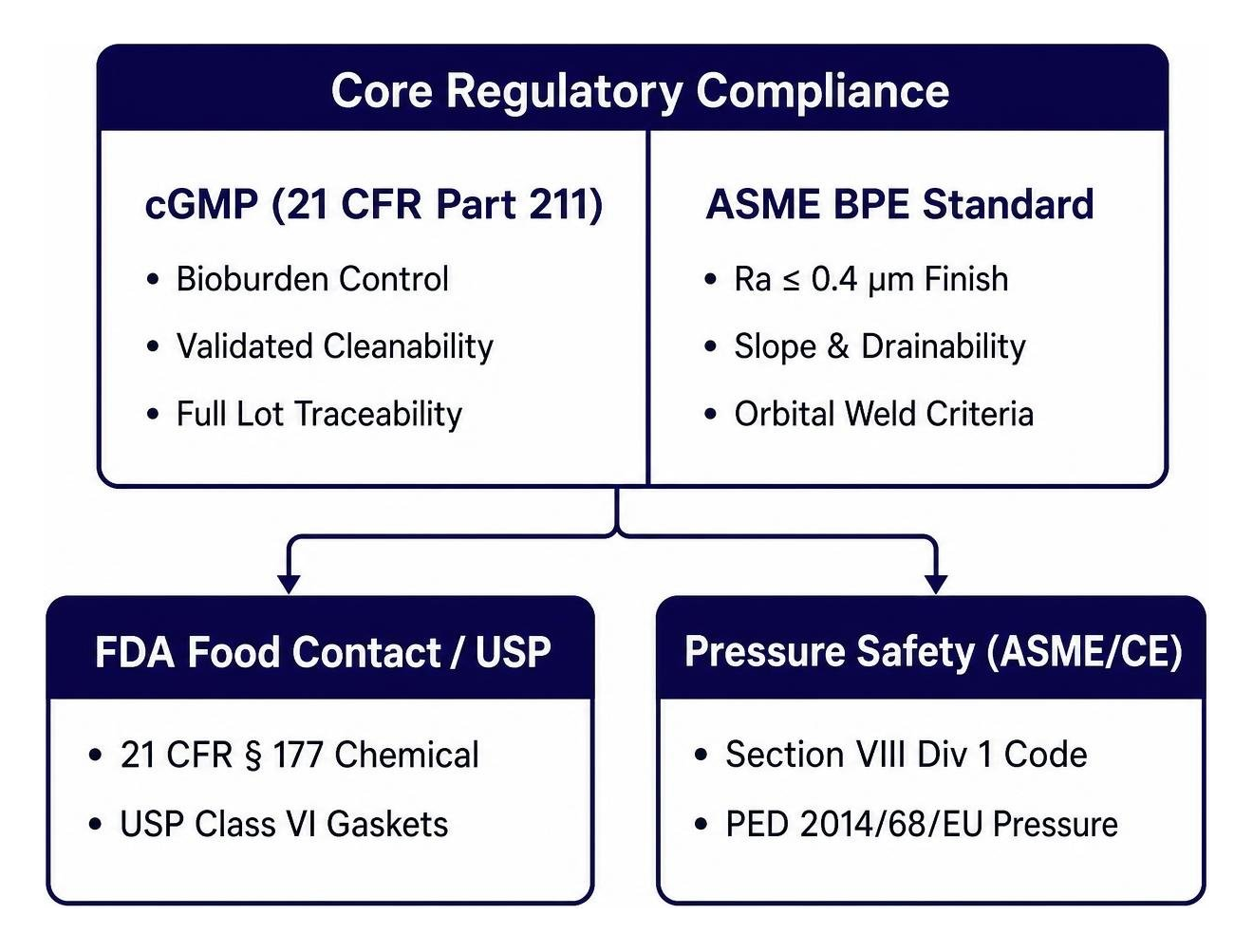
- Current Good Manufacturing Practice (cGMP): Enforced by the FDA (under 21 CFR Part 211), cGMP requires that contact surfaces do not react with, add to, or absorb drug formulations. Equipment must support repeatable sterilization without degrading over time.
- ASME Bioprocessing Equipment (ASME BPE): The global standard governing vessel design, piping geometry, dimensional tolerances, material composition, surface finishes, and weld acceptance criteria for hygienic and biopharmaceutical processes. Understanding food-grade fitting standards helps clarify how ASME BPE builds upon basic food-grade guidelines with tighter tolerances and strict sterile boundary controls.
- FDA Food Contact & USP Standards: Materials, seals, and process-wetted components must satisfy FDA 21 CFR § 177 requirements and USP Class VI biocompatibility tests to prevent chemical leaching into the process stream.
- ASME Boiler and Pressure Vessel Code (BPVC) & CE/PED: Vessels subjected to pressurized thermal cycles or steam sterilization must satisfy ASME Section VIII Division 1 or the European Pressure Equipment Directive (PED 2014/68/EU) to guarantee structural safety under pressure.
How to Audit a Pharmaceutical Stainless Steel Supplier for Traceability and Quality Control
Stainless steel accounts for over 85% of materials used in pharmaceutical processing vessels due to its corrosion resistance and cleanability. However, industry data shows that over 70% of pharmaceutical tank failures stem from improper surface finishes or weld defects. When auditing a supplier, your engineering and quality assurance teams should evaluate these core fabrication capabilities:
- Welding Methodologies: Look for automated orbital Tungsten Inert Gas (TIG) welding alongside closed-chamber robotic tools. Manual welds must be executed by certified welders working under inert gas purging (such as high-purity argon) to prevent heat tint and internal oxidation (“sugaring”).
- Inspection Protocol: Inspect their use of digital borescopes for internal visual weld examination. Ensure non-destructive testing includes liquid penetrant testing, ultrasonic wall thickness verification, and hydrostatic pressure testing.
- Positive Material Identification (PMI): Confirm that incoming raw materials and completed components undergo X-ray Fluorescence (XRF) or Optical Emission Spectrometry (OES) to verify that carbon, chromium, nickel, and molybdenum levels match certified limits.
- Chemical Passivation and Pickling: Fabricators must demonstrate compliance with ASTM A967 or ASTM A380 standards. Acid pickling removes free-iron contamination and heat scale, followed by citric or nitric acid passivation to establish a robust chromium-to-iron oxide ratio (>1.5).
Rigorous quality control verifies that sanitary tubing for hygienic fluid transfer maintains its passive layer without pinholes or cracks that could harbor microbial biofilms.
Validation Packages Provided by a Pharmaceutical Stainless Steel Supplier
A physical vessel is only as good as the paperwork accompanying it. In pharmaceutical validation, if a parameter is not documented, it does not exist. A dependable supplier will provide a comprehensive Turnover Package (TOP) containing:
| Documentation Component | Regulatory Reference | Purpose & Scope |
|---|---|---|
| Mill Test Reports (MTRs) | EN 10204 Type 3.1 | Verifies heat numbers, chemical composition, tensile strength, and raw melt origin. |
| Weld Logs & Purge Maps | ASME BPE Part MJ | Maps every weld seam to its specific operator, machine setting, weld date, and borescope video record. |
| Surface Finish Profilometry | ASME BPE Part SF | Certified surface profilometer logs verifying internal Ra values at multiple tank locations. |
| Passivation Certification | ASTM A967 / ASTM A380 | Certifies chemical immersion baths, exposure durations, and ferroxyl or water-immersion test results. |
| IQ/OQ Support Protocols | cGMP / GAMP 5 | Provides documentation to streamline Installation Qualification and Operational Qualification. |
| Hydrostatic Test Reports | ASME BPVC Section VIII | Verifies pressure test parameters at 1.3 to 1.5 times the maximum allowable working pressure (MAWP). |
Sanitary Material Selection: 316L vs. 304 and High-Performance Alloys
Selecting the appropriate stainless steel grade balance capital expenditure, operating longevity, and corrosion resistance. In sanitary and bioprocessing environments, austenitic alloys form the foundation of processing systems.
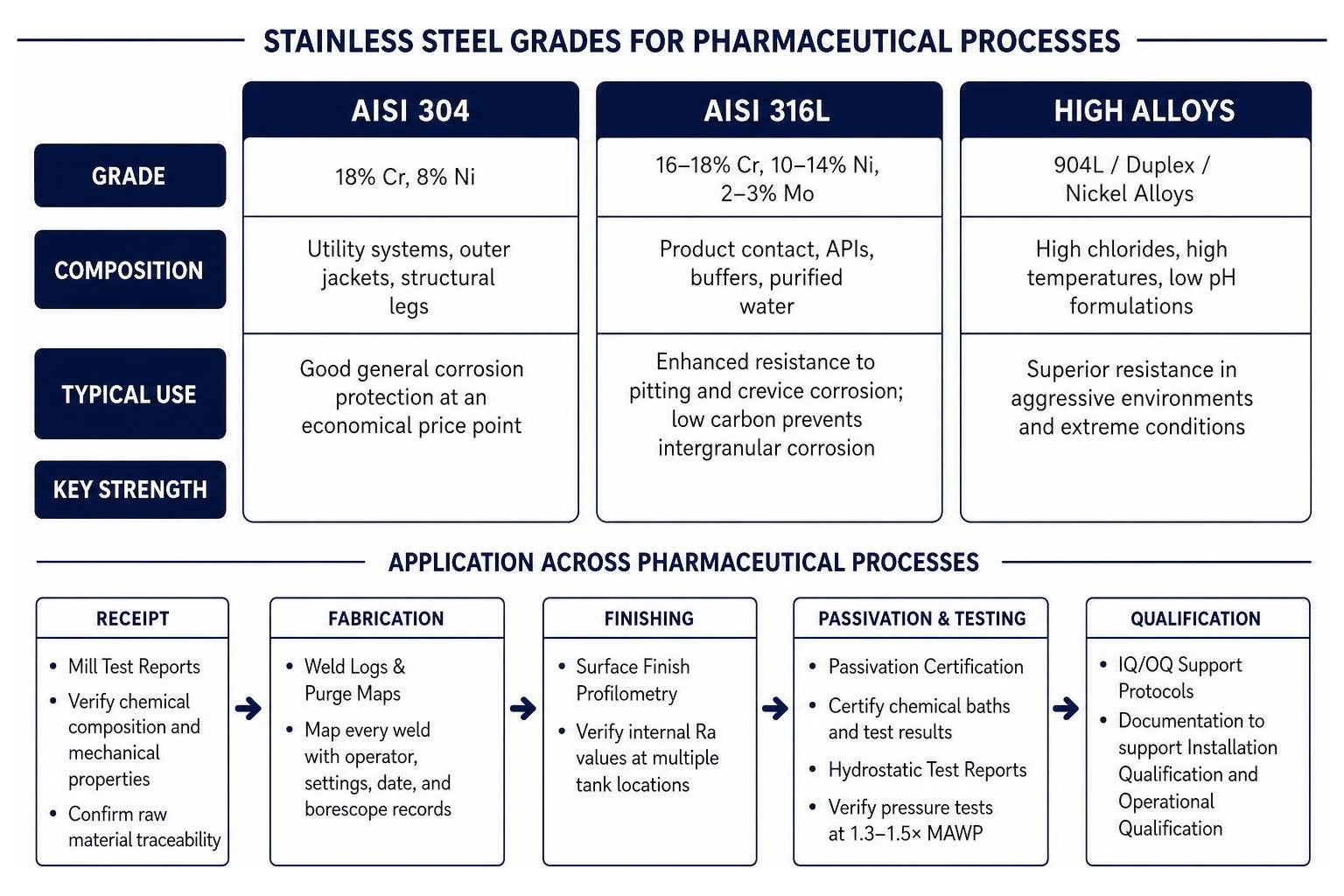
- Type 304 Stainless Steel: Composed of roughly 18% chromium and 8% nickel, SS304 provides good general corrosion protection at an economical price point. In pharmaceutical facilities, it is primarily used for non-wetted applications, including outer vessel jackets, support structures, access ladders, and cleanroom utility lines.
- Type 316L Stainless Steel: The standard workhorse for wetted pharmaceutical applications. Adding 2.0% to 3.0% molybdenum increases resistance against pitting and crevice corrosion caused by chlorides and sanitizing chemicals. The “L” indicates low carbon content (max 0.03%), which prevents chromium carbide precipitation along grain boundaries during welding. Reviewing a guide to 316L vs 316 stainless steel shows how controlling carbon levels prevents intergranular corrosion during orbital welding. The underlying reasons why chemical processing relies on 316 stainless steel apply directly to the aggressive chemical environments found in pharmaceutical CIP cycles.
High-Purity Applications and Specialized Alloy Upgrades
While 316L stainless steel handles most sanitary operations, certain aggressive pharmaceutical formulations demand higher-alloy upgrades:
- Water for Injection (WFI) & Pure Steam Loops: Continuous exposure to high-temperature (80°C+) deionized water and clean steam can deplete standard passive films, leading to rouge (iron oxide particulate accumulation). Upgrading critical loop sections to high-molybdenum or electropolished 316L prevents rouging.
- Chloride-Rich API Synthesis & Low-pH Buffers: Formulations containing high salt concentrations, hydrochloric acid adjustments, or low-pH buffers can cause pitting corrosion in standard austenitic steels. In these scenarios, using a reliable 904L pipe supplier allows engineers to integrate 4.5% molybdenum alloys that prevent pitting and stress-corrosion cracking.
- High-Pressure Fermentation & Bioreactor Systems: Large-scale fermentation can subject vessel walls to cyclic pressure loads and high shear stresses. Evaluating duplex stainless steel material properties provides engineers with twice the mechanical yield strength of standard austenitic alloys alongside enhanced chloride stress-corrosion resistance.
Critical Vessel Engineering, Surface Finishes, and Customizations
A pharmaceutical vessel’s cleanability depends heavily on its internal micro-finish. Surface roughness is quantified as Ra (Roughness Average), measuring the microscopic peaks and valleys on the metal surface in micrometers.
- Mechanical Polishing (Mirror Finish): Progressive grit abrasion followed by polishing wheels creates a bright, reflective interior with an Ra of 0.4 micrometers or less (16 micro-inches), removing surface fissures where microbes could hide.
- Electropolishing (EP): An electrochemical process that selectively dissolves microscopic peaks, leaving a smooth, rounded surface profile with an Ra of 0.25 to 0.38 micrometers. Electropolishing enriches the surface with chromium, improving corrosion resistance and reducing biofilm adhesion.
- Seals and Gaskets: Cleanability also depends on fitting connections. Understanding gasket surface finish requirements helps prevent elastomeric extrusion, cold flow, and joint fluid retention.
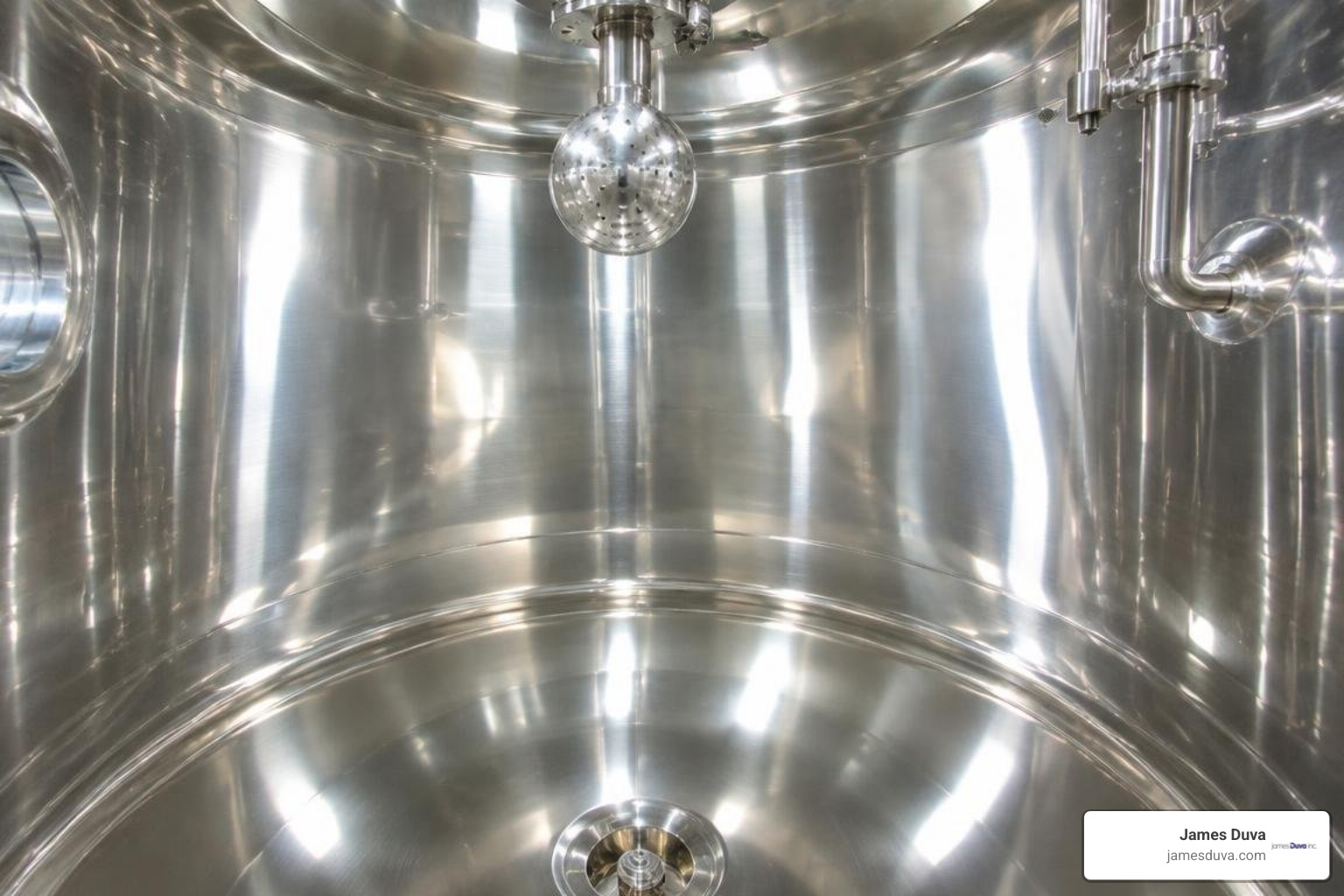
Complete drainability is essential for Clean-In-Place (CIP) and Steam-In-Place (SIP) systems. Tanks must feature steeply sloped conical or dished bottoms (such as ASME flanged and dished or true ellipsoidal heads) that direct fluids toward zero-dead-leg diaphragm bottom outlet valves. Standard piping designs must also follow ASME BPE L/D ratio limits (where the branch length L does not exceed its internal diameter D) to eliminate stagnant flow zones.
Vessel Geometry, Capacity Scaling, and Process Customizations
Suppliers engineer pharmaceutical vessels to handle diverse process requirements across laboratory, pilot, and full commercial scales:
- Geometry Selection: Vertical cylindrical tanks are standard across cleanrooms because they offer a small footprint, efficient mixing patterns, and good gravity drainage. Horizontal vessels are typically reserved for large-volume bulk storage where ceiling heights are limited.
- Capacity Scaling: Pilot-scale bioreactors often range from 10 to 500 liters, while industrial bulk storage tanks can reach 300,000 liters. High-quality stainless steel pharmaceutical tanks regularly deliver over 20 years of service life under standard operating and maintenance conditions, compared to 5 to 10 years for non-metallic alternatives.
- Thermal Regulation Jackets: Dimple jackets handle high steam pressures economically, whereas half-pipe coil jackets provide directed, high-velocity heating or cooling fluid flow. These systems are wrapped in chloride-free mineral wool or polyurethane insulation and sealed under an external 304 stainless steel skin.
- Sanitary Mixing & Process Control: Agitator options include top-entering mechanical seal shafts for high-viscosity media and bottom-mounted magnetic mixers that eliminate dynamic shaft penetrations. Fluid control relies on sterile diaphragm valves and clean-bore Ball Valves designed to maintain sterile flow paths. For broader fluid management, reviewing different valve types across industrial systems helps match process conditions with suitable component designs.
Frequently Asked Questions about Sourcing Pharmaceutical Stainless Steel
Why is an Ra value of 0.4 micrometers or lower required for pharmaceutical vessels?
An Ra finish of 0.4 micrometers or lower removes microscopic crevices that could otherwise trap microbial cells, cellular debris, or active drug residues. Smoothing these surface peaks reduces bacteria’s physical adherence, allowing CIP spray solutions and SIP clean steam to wet the surface and sanitize the system reliably.
What is the difference between SS304 and SS316L in pharmaceutical environments?
SS316L contains 2% to 3% molybdenum and maintains a strict maximum carbon limit of 0.03%, whereas SS304 contains no molybdenum and allows up to 0.08% carbon. Molybdenum protects 316L against pitting corrosion from chlorides and CIP chemicals, while the low carbon content prevents intergranular carbide precipitation during welding. As a result, 316L is used for product-contact surfaces, while 304 is typically used for non-wetted external jackets, structural supports, and utility lines.
What validation documentation is mandatory before commissioning stainless steel equipment?
Commissioning requires an EN 10204 Type 3.1 Mill Test Report for chemical and mechanical traceability, orbital weld inspection and borescope logs, surface profilometer roughness reports, passivation certificates (per ASTM A967), hydrostatic pressure test records, and comprehensive Installation Qualification/Operational Qualification (IQ/OQ) support documentation.
Conclusion
Auditing your stainless steel supply chain protects your processing systems against batch contamination, unexpected downtime, and regulatory non-compliance. Thoroughly reviewing raw material test reports, automated welding methods, surface finishing data, and sanitary vessel geometry ensures your fluid transfer lines and storage tanks meet strict cGMP and ASME BPE standards.
James Duva Inc. supplies high-grade stainless steel and nickel alloy industrial products from our facility in Branchburg, NJ. With industry expertise dating back to 1978, we provide the traceable materials, documented testing, and technical support required for demanding high-purity fluid processing. Contact our engineering team today to explore certified pharmaceutical stainless steel solutions that protect your process integrity.
About James Duva Inc.
Since 1978, James Duva Inc. has been your trusted source for stainless steel and high-nickel alloy industrial products. Whether you’re in the water treatment, process or power industry, we pride ourselves on always having what you need. Say goodbye to your sourcing problems with just one call to James Duva.