
How to Choose the Right Precision Stainless Tubing for Your Project

Aug 10, 2026
Why Precision Stainless Tubing Is the Backbone of High-Performance Industrial Systems
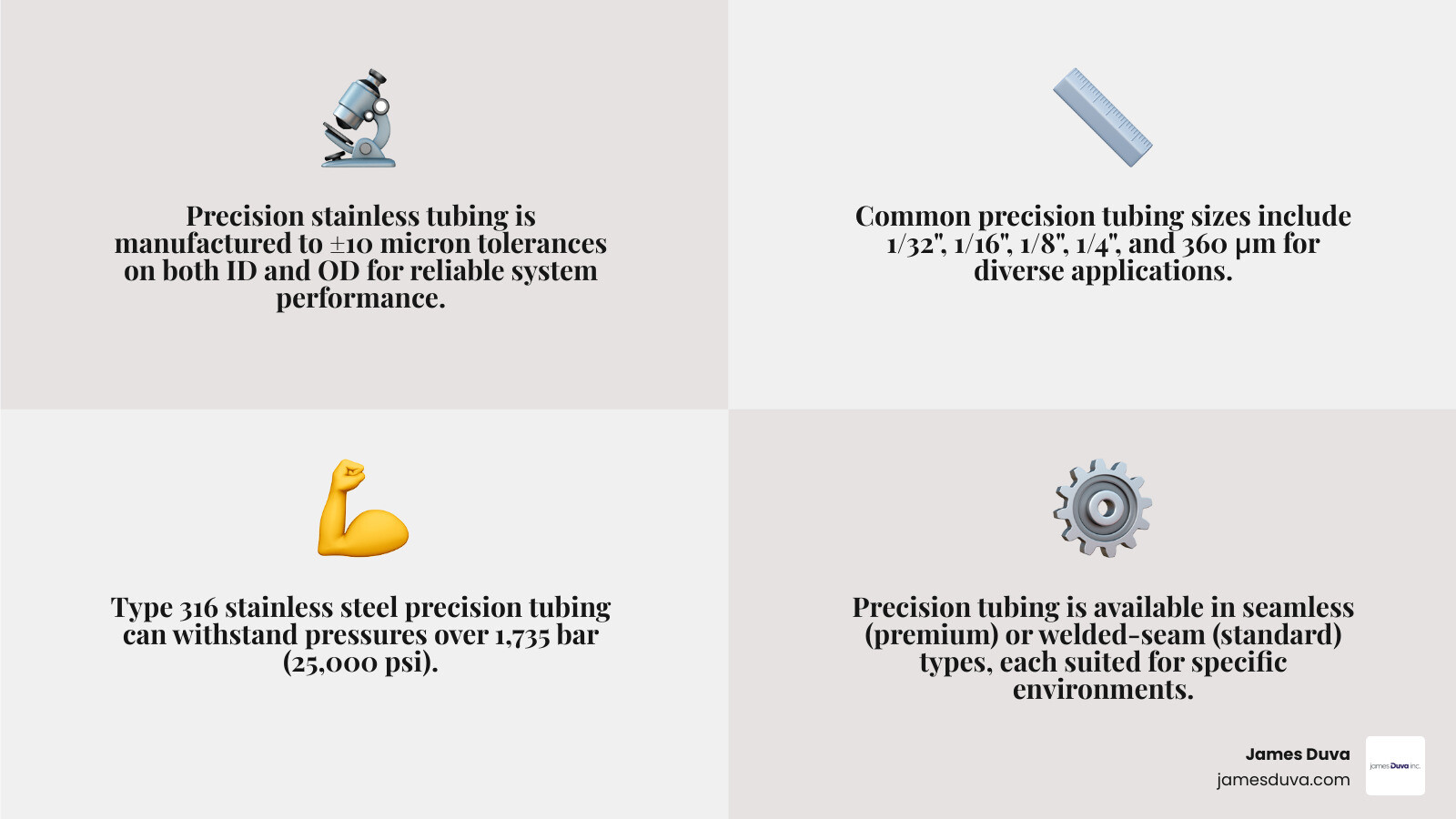
Precision stainless tubing is manufactured to extremely tight dimensional tolerances — typically within ±10 microns on both the inner and outer diameter — making it the go-to choice for demanding applications like HPLC, Ultra-HPLC, gas chromatography, and high-pressure industrial fluid systems.
Here’s a quick summary of what makes it different from standard tubing:
| Feature | Precision Stainless Tubing |
|---|---|
| Material | Type 316 stainless steel (most common) |
| ID/OD Tolerance | ±10 microns (±0.025mm / .001″) |
| Max Pressure Rating | >1,735 bar (25,000 psi) |
| Surface Finish | Smooth internal bore; soft annealed OD |
| Common Sizes | 1/32″, 1/16″, 1/8″, 1/4″, 360 µm |
| Key Applications | HPLC, GC, chemical processing, instrumentation |
| Tubing Types | Seamless (premium) or welded-seam (standard) |
Whether you are connecting analytical columns in a lab or routing high-pressure fluid lines in a chemical plant, the dimensional accuracy and material quality of your tubing directly affect system reliability, flow consistency, and safety.
Getting the wrong tubing — even tubing that looks similar — can mean leaks, peak distortion in chromatography, or catastrophic pressure failures in industrial systems.
I’m Billy Walker, Vice President of James Duva Inc., where I’ve spent years helping engineers and procurement professionals source specialty stainless steel and high-nickel alloy products — including precision stainless tubing — from leading domestic manufacturers. In the sections below, I’ll walk you through everything you need to know to choose the right tubing for your specific application.
Precision stainless tubing further reading:
Why Are Alloys So Valuable in Industry?
To understand why precision tubing relies so heavily on stainless steel and other advanced alloys, we first have to look at the fundamental chemistry of industrial metals. Pure metals, such as pure iron, are rarely suitable for demanding structural or fluid-handling applications. In their elemental state, pure metals are often too soft, highly malleable, and extremely prone to rust and chemical oxidation when exposed to moisture and air.
By combining pure metals with other elements, we create alloys that dramatically improve upon the base material’s physical properties. Alloys like steel incorporate carbon, chromium, nickel, and molybdenum to deliver superior mechanical strength, hardness, and corrosion resistance.
These properties make alloys indispensable across nearly every major sector:
- Construction: Heavy-duty structural beams, high-strength concrete reinforcement, and architectural piping rely on steel alloys to support immense weight and resist environmental weathering.
- Oil & Gas: High-pressure environments require robust alloy fittings, flanges, and piping systems that can withstand sour gas, corrosive chemicals, and extreme temperatures without degrading.
- Automotive & Aerospace: Engine components, structural frames, and exhaust systems use specialized alloys to reduce weight while maintaining high-temperature strength and fatigue resistance.
- Medical & Consumer Goods: Surgical implants require biocompatible alloys that will not corrode inside the human body, while consumer kitchenware utilizes food-grade stainless alloys for hygiene and dent resistance.
In fluid dynamics and analytical chemistry, utilizing the correct alloy is the difference between a high-performing, leak-free system and a costly failure. For a deeper dive into the metallurgy behind these materials, you can read A Practical Guide to Stainless Steel Tubing.
Understanding Precision Stainless Tubing Grades and Manufacturing
When selecting precision stainless tubing, the manufacturing process and material grade establish the baseline for how the tubing will perform under mechanical and chemical stress. The industry standard for high-performance fluid systems is Type 316 stainless steel.
Type 316 contains molybdenum, which significantly enhances its resistance to pitting and crevice corrosion in chloride-rich environments compared to standard Type 304. To achieve the extreme dimensional accuracy required for precision applications, the tubing undergoes a cold-drawn manufacturing process. Cold drawing pulls the metal through a series of dies at room temperature, which refines the grain structure, increases tensile strength, and achieves incredibly smooth surface finishes.
Understanding the physical differences between seamless and welded options is key to choosing the right product. You can learn more about these differences in our article Seamless Pipe and Welded Pipe: What’s the Difference?.
Seamless vs. Welded-Seam Precision Stainless Tubing
Choosing between premium-grade seamless tubing and standard-grade welded-seam tubing is one of the most critical decisions in system design.
- Premium-Grade Seamless Tubing: Produced from a solid billet of steel that is pierced and drawn, seamless tubing has no weld seam. This eliminates any risk of structural inconsistencies along the length of the tube, providing maximum pressure integrity and uniform corrosion resistance. It is highly recommended for harsh environments, ultra-high-pressure applications, and critical analytical setups where even microscopic weld defects could cause fluid disruption or premature failure.
- Standard-Grade Welded-Seam Tubing: Formed by rolling a flat strip of stainless steel into a tube and welding the seam, this option is generally more cost-effective. However, the welding process can alter the local grain structure of the metal, making the seam slightly more susceptible to chemical attack and mechanical stress.
For high-pressure analytical systems, seamless tubing is almost always preferred. You can explore this topic further by reading Smooth Operator: Why Seamless Stainless Tubing Rules Harsh Environments and Industrial Tubing: A Down-to-Earth Guide to Seamless and Welded Tubing Solutions.
Key Specifications of Precision Stainless Tubing
When specifying precision stainless tubing, three key dimensions dictate its physical performance: the Outer Diameter (OD), the Inner Diameter (ID), and the wall thickness.
In precision fluidics, the relationship between these dimensions is tightly controlled. While standard industrial tubing focuses primarily on OD and nominal wall thickness, precision tubing requires exact tolerances on both the OD (to ensure a perfect, leak-free fit with compression fittings) and the ID (to maintain precise flow rates and minimize dead volume). For a comprehensive look at how these specifications are measured and standardized, refer to The Definitive Guide to 304 Stainless Tubing.
Key Advantages of Stainless Steel Tubing in Chromatography and HPLC
In analytical chemistry, particularly in High-Performance Liquid Chromatography (HPLC) and Ultra-High-Performance Liquid Chromatography (UHPLC), the choice of tubing material is paramount. Stainless steel is the gold standard for these applications because it offers an exceptional combination of high mechanical strength, chemical inertness, and physical stability.
Unlike polymer-based alternatives, which can swell, degrade, or leach organic compounds when exposed to aggressive organic solvents, stainless steel remains completely stable. Its incredibly smooth internal surface prevents sample carryover and minimizes turbulent flow, ensuring highly reproducible analytical results. For technical insights into how tubing surfaces affect analytical separation, you can review the Scientific research on chromatography tubing performance.
Pressure Ratings and High-Pressure Performance
Modern HPLC and UHPLC systems operate under extreme pressures to force mobile phases through tightly packed stationary-phase columns. Precision stainless steel tubing is engineered to comfortably handle these demands, with a pressure rating exceeding 1,735 bar (25,000 psi).
This high pressure rating ensures the safety and long-term reliability of the system, preventing blowout failures and maintaining consistent flow dynamics even during rapid gradient changes. To learn more about how pressure ratings are calculated and maintained in industrial systems, check out Industrial Tubing Core Principles.
The Importance of Close Tolerances
In chromatography, minimizing “dead volume” (uncontrolled pockets of fluid within the flow path) is critical to preventing peak broadening and sample distortion. This is why close dimensional tolerances are so important.
Premium-grade precision tubing holds incredibly tight tolerances of ±10 microns (±0.025mm or .001″) on both the ID and the OD.
- OD Tolerance: Ensures that compression fittings and ferrules seat perfectly, preventing high-pressure leaks.
- ID Tolerance: Ensures consistent capillary flow and predictable pressure drops across the system, allowing analytical chemists to trust their chromatographic data.
Pre-Cut vs. Bulk Tubing: Making the Right Choice
When sourcing precision stainless tubing for your laboratory or facility, you must decide between pre-cut, finished tubing and bulk tubing. This choice impacts material cost, preparation time, and the potential risk of system contamination.
| Comparison Factor | Pre-Cut Tubing | Bulk Tubing |
|---|---|---|
| Cost Efficiency | Higher initial cost per piece | Lower cost per foot; cost-effective for large layouts |
| Preparation Time | Zero; ready for immediate installation | Requires cutting, deburring, and cleaning |
| Contamination Risk | Extremely low (steam-cleaned and capped) | High if not properly cleaned after cutting |
| End Finish | Electrolytically cut (perfectly flat and burr-free) | Rough-cut (often deformed by cutting tools) |
| Best Used For | Critical HPLC/UHPLC column connections | General utility lines, gas routing, long runs |
The Critical Role of Proper End-Cutting
One of the most common causes of chromatographic system failure is poorly cut tubing. Bulk tubing is typically shipped in long coils or straight lengths and is often cut to length using standard hand tools or pliers. This mechanical cutting deforms the tube end, leaving behind sharp metal burrs, a restricted inner diameter, and a non-perpendicular face.
If a deformed tube end is inserted into an analytical port, it creates a small void or cavity. This dead volume acts as a mixing chamber where sample bands can spread out, leading to severe peak distortion and tailing. Furthermore, loose metal burrs can break free and travel downstream, clogging sensitive column frits or damaging injector valves.
Pre-cut tubing addresses this issue entirely. It is electrolytically cut to ensure a perfectly square, flat face, and is then steam-cleaned and dried to eliminate any trace of oil, metal shavings, or atmospheric dust.
Soft Annealed OD and Ferrule Connections
To achieve a reliable, leak-free seal in high-pressure systems, the tubing outer diameter must interact seamlessly with the system’s compression fittings. Precision stainless tubing is manufactured with a soft annealed outer diameter.
Annealing is a heat-treatment process that softens the outer layer of the metal. When a compression nut is tightened, the hard metal ferrule can easily “bite” into the soft annealed OD of the tubing, creating a permanent, gas-tight mechanical seal without slipping or requiring excessive torque.
Understanding how these components interface is crucial for system assembly. You can find detailed guidance on fitting selection in Understanding Tube Fittings: Types, Applications, and Benefits for Industrial Systems.
Sizing and Applications in GC and HPLC Systems
Integrating the correct size of precision stainless tubing is essential for balancing system pressure, volume, and flow rate. Different diameters serve specific functions within gas chromatography (GC) and high-performance liquid chromatography (HPLC) systems. To learn more about selecting the right physical dimensions for instrumentation, read A Deep Dive into Welded and Seamless Instrumentation Tubing.
Standard Tubing Sizes and Their Uses
- 1/32″ OD: Often used in micro-bore liquid chromatography (Micro-LC) and capillary systems where minimizing system volume is the primary goal.
- 1/16″ OD: The universal standard for analytical HPLC and UHPLC systems. It connects the injector, column, and detector, offering a perfect balance of mechanical strength and low internal volume.
- 1/8″ OD: Commonly used for gas supply lines in gas chromatography (GC) systems, mobile phase inlet lines, or low-pressure purge lines.
- 1/4″ OD: Typically reserved for high-flow preparative chromatography systems or industrial fluid distribution lines where high volume is required.
- 360 µm OD: Used in specialized nano-LC applications, requiring extremely delicate handling and specialized microscopic fittings.
Flexible Stainless Steel Tubing
For applications that require routing through tight spaces or connecting modular components that undergo frequent adjustment, standard rigid stainless steel is often too stiff to use.
Flexible stainless steel tubing solves this problem. It features a unique design—such as a 1/32″ OD flexible center body with robust 1/16″ OD welded ends—allowing for easy bending without kinking or restricting the internal flow path. This specialized tubing is available with micro-bore inner diameters of 50 and 75 microns, providing the flexibility needed for tight layouts while maintaining the extreme pressure resistance and low dead volume of rigid steel.
Frequently Asked Questions about Precision Stainless Tubing
What are the tolerances and pressure ratings for precision stainless steel tubing?
Precision stainless steel tubing holds extremely tight dimensional tolerances of ±10 microns (±0.025mm / 0.001″) on both the inner and outer diameters. This extreme accuracy allows the tubing to withstand working pressures exceeding 1,735 bar (25,000 psi), making it fully compatible with modern UHPLC applications.
Why is a soft annealed OD important for tubing connections?
A soft annealed outer diameter allows the metal compression ferrule to easily bite into the surface of the tubing when the fitting is tightened. This plastic deformation creates a highly reliable, leak-free, high-pressure seal that prevents the tubing from slipping out under pressure. For more information on selecting and installing fittings, refer to A Comprehensive Guide to Choosing Tube Fittings.
What is the difference between bulk and pre-cut stainless steel tubing?
Bulk tubing is sold in continuous lengths and is roughly cut by the user, which requires mechanical deburring and thorough cleaning before installation. Pre-cut tubing is professionally cut using advanced electrolytic processes, leaving a perfectly flat, burr-free face. It is then steam-cleaned, dried, and capped, making it ready for immediate use in high-end analytical applications.
Conclusion
Choosing the right precision stainless tubing requires balancing material grades, manufacturing methods, dimensional tolerances, and preparation techniques. Whether your system demands the flawless interior of premium seamless tubing or the convenience of pre-cut, steam-cleaned capillary lines, selecting the correct specifications ensures optimal performance, safety, and reliability.
At James Duva Inc., we have been serving diverse industries—including chemical processing, analytical laboratories, and oil & gas—from our facility in Branchburg, New Jersey, since 1978. We are a trusted partner with decades of industrial expertise, offering a comprehensive selection of high-grade stainless steel and nickel alloy products.
Let us help you source the perfect components for your next project:
- Explore our high-performance Ball Valves for reliable fluid control.
- Browse our complete inventory under Product Categories: Tubing to find the exact sizes and grades you need.
About James Duva Inc.
Since 1978, James Duva Inc. has been your trusted source for stainless steel and high-nickel alloy industrial products. Whether you’re in the water treatment, process or power industry, we pride ourselves on always having what you need. Say goodbye to your sourcing problems with just one call to James Duva.