
No More Heavy Metal Drama Sourcing Your Nickel 200 Safely

Aug 7, 2026
Why Finding the Right Nickel 200 Supplier Matters for Your Project
Finding a reliable Nickel 200 supplier is one of the most important decisions you’ll make when sourcing materials for chemical processing, oil and gas, or other demanding industrial applications. The wrong supplier means delayed projects, rejected materials, and costly downtime.
Quick Answer: What to Look for in a Nickel 200 Supplier
| Criteria | What to Check |
|---|---|
| Material purity | Minimum 99.6% nickel (UNS N02200) |
| Certifications | ASTM B160 (bar), ASTM B162 (plate/sheet) |
| Available forms | Sheet, plate, bar, pipe, fittings |
| Lead time | Typically 4 to 8 weeks for sheet and plate |
| Quality documentation | Mill test reports (MTRs) included |
| Industry experience | Proven track record in chemical, energy, or aerospace sectors |
Nickel 200 is not a commodity material. It is a high-purity nickel alloy with very specific performance characteristics — and sourcing it from the wrong distributor can put your entire operation at risk. The global nickel market is growing fast, projected to climb from $33.5 billion in 2022 to nearly $49.6 billion by 2032. That growth brings more suppliers into the market, but not all of them deliver consistent quality.
This guide cuts through the noise. It explains what Nickel 200 is, where it’s used, and exactly how to evaluate distributors so you can source with confidence.
I’m Billy Walker, Vice President of James Duva Inc., where I’ve spent years helping engineers and procurement professionals source specialty nickel alloys and stainless steel piping components for the power, process, and water treatment industries — making me well-positioned to guide you through every step of selecting a trusted Nickel 200 supplier. Whether you’re comparing material grades or vetting distributor credentials, the sections ahead will give you a clear, practical framework.
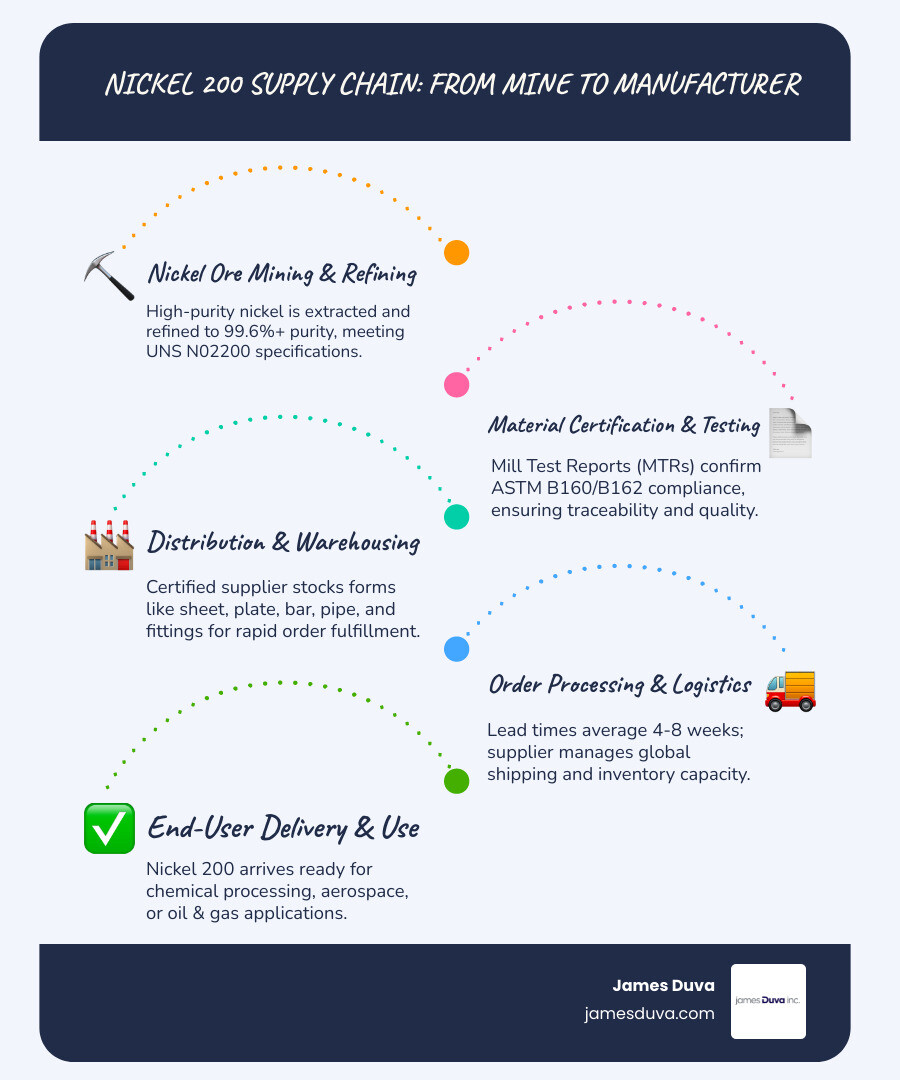
Nickel 200 supplier terms made easy:
Why Are Alloys So Valuable in Industry?
To understand why a specialized material like Nickel 200 is so highly sought after, we first need to look at the broader picture of metallurgy. Why do we use alloys in the first place?
Pure metals, while chemically simple, often fall short when subjected to real-world industrial stresses. For instance, pure iron is relatively soft and highly vulnerable to rust and corrosion when exposed to oxygen and moisture. To solve this, metallurgists combine iron with carbon and other elements to create steel. This alloying process dramatically improves the metal’s strength, durability, and resistance to environmental degradation.
By strategically mixing different elements, we can engineer alloys designed to withstand extreme temperatures, highly corrosive chemicals, and immense physical pressure. When standard metals fail, specialty alloys step in to keep operations running safely and efficiently. You can read more about these decisions in our guide on When to Choose Nickel Alloys Over Stainless Steel in Industrial Applications.
Alloys are the backbone of modern industrial infrastructure, providing essential performance characteristics across several key sectors:
- Construction: Structural steel beams, high-strength reinforcing bars, and durable piping systems rely on alloys to support massive physical loads and resist weathering over decades of service.
- Oil & Gas: High-performance alloy fittings, flanges, and valves must withstand sour gas, high pressures, and corrosive offshore environments where failure is not an option.
- Automotive & Aerospace: High-strength engine frames, turbine blades, and exhaust systems use specialized nickel and titanium alloys to handle extreme thermal stress and mechanical fatigue.
- Medical & Consumer Goods: Biocompatible implants, joint replacements, and surgical tools utilize advanced alloys, while everyday consumer items like kitchenware and appliances benefit from the rust resistance of stainless steel.
Understanding Nickel 200: Properties and Key Applications
When it comes to pure elemental performance, Nickel 200 (UNS N02200) stands out as a commercial powerhouse. It boasts a minimum purity of 99.6% nickel, making it one of the most pure commercial alloys available today.
This high level of purity grants Nickel 200 a unique set of physical and chemical properties:
- Incredible Corrosion Resistance: It is highly resistant to many reducing chemicals and is particularly famous for its outstanding resistance to caustic alkalis, such as sodium hydroxide (caustic soda).
- Excellent Thermal and Electrical Conductivity: Compared to heavily alloyed stainless steels, Nickel 200 conducts heat and electricity much more efficiently.
- High Ductility and Formability: It can be easily hot- and cold-worked, machined, and welded using standard fabrication methods.
- Magnetic and Magnetostrictive Properties: It exhibits magnetic properties at room temperature, which is useful in specialized electronic applications.
Because of these properties, Nickel 200 is a staple in the chemical processing industry, which accounts for over 20% of its global applications. It is frequently used to manufacture reactors, vessels, piping, and heat exchangers that handle highly corrosive alkaline solutions.
Additionally, because Nickel 200 maintains its mechanical properties from cryogenic temperatures all the way up to 600°F (315°C), it is a reliable choice for aerospace, defense, and energy applications where structural integrity at low temperatures is critical. You can explore its full metallurgical profile in our Nickel 200 Properties Step-by-Step Guide to Terms Demystified or learn about its role in flight systems in our article on Nickel Based Alloys in the Aerospace Industry.
Choosing Between Nickel 200, Nickel 201, and Inconel
While Nickel 200 is highly versatile, it is not the universal solution for every high-nickel application. Choosing the wrong grade can lead to premature material failure. The most common comparison buyers make is between Nickel 200, its low-carbon sibling Nickel 201, and chromium-heavy Inconel alloys.
The primary difference lies in carbon content and temperature limits. Nickel 200 has a maximum carbon content of 0.15%. At temperatures above 600°F (315°C), the carbon in Nickel 200 can precipitate as graphite at the grain boundaries, a process known as graphitization. This severely embrittles the metal and leads to structural failure.
To prevent this, Nickel 201 (UNS N02201) was developed with a restricted carbon content of 0.02% maximum. This slight chemical adjustment allows Nickel 201 to be safely used in high-temperature environments up to 1250°F (677°C) without the risk of embrittlement.
If your application demands extreme strength and oxidation resistance at even higher temperatures, you will likely need to step up to an Inconel alloy (such as Inconel 600, 625, or Alloy 800H). These alloys incorporate chromium and iron, creating a protective oxide layer that thrives in extreme heat. For more details on high-temperature options, check out our guide on Nickel Alloy 800H Properties Applications and Benefits in High Temperature Environments.
| Material | Key Composition | Max Temperature Limit | Primary Use Case |
|---|---|---|---|
| Nickel 200 | 99.6% Ni, Max 0.15% C | 600°F (315°C) | Chemical processing of caustic soda, synthetic fibers, food processing. |
| Nickel 201 | 99.6% Ni, Max 0.02% C | 1250°F (677°C) | High-temperature caustic evaporators, combustion vessels, reactors. |
| Inconel (e.g., 600/625) | Ni-Cr-Fe base | Up to 2000°F (1093°C) | Aerospace engine components, chemical furnace muffles, nuclear engineering. |
Sourcing Specifications and Forms from a Nickel 200 Supplier
When you partner with a Nickel 200 supplier, you need to ensure they can provide the exact material forms required for your fabrication. Because industrial systems are complex, a project rarely requires just one shape.
A comprehensive supplier should stock a wide variety of raw and semi-finished forms:
- Sheets and Plates: Essential for fabricating large storage vessels, heat exchanger shells, and chemical tanks.
- Bars and Rods: Used for machining fasteners, shafts, valves, and internal pump components. You can learn more about these in our article on Nickel Alloy Round Rod and Bar Inconel Hastelloy and Beyond.
- Pipes and Tubes: Critical for fluid transport in highly corrosive chemical lines. Discover the advantages of these configurations in Nickel 200 Pipe Purity Performance and Piping Hot Benefits.
- Fittings and Flanges: Elbows, tees, reducers, and flanges are vital for connecting piping systems securely. Read about why these components are so critical in Why Nickel Alloy Fittings Are Essential for Demanding Environments.
How to Evaluate a Nickel 200 Supplier for Quality and Certifications
You cannot take a supplier’s word on material purity. In high-stakes industries, you must verify the paperwork. A reliable Nickel 200 supplier must provide complete traceability and certified quality control documentation for every shipment.
When reviewing a supplier, ensure their inventory complies with major international standards:
- ASTM International B160: Standard specification for nickel alloy rod and bar.
- ASTM B162: Standard specification for nickel alloy plate, sheet, and strip.
- ASTM B161 / B163: Specifications for nickel seamless pipe and tube.
Every delivery should be accompanied by a Mill Test Report (MTR). This document details the exact chemical composition (verifying the 99.6% nickel content) and the mechanical properties (tensile strength, yield strength, and elongation) of the specific heat of metal you purchased. If a distributor hesitates to provide MTRs, walk away. For more sourcing tips, read our article on 5 Ways to Find Nickel Alloy Suppliers Like a Pro.
Logistics, Lead Times, and Inventory Capacity of a Reliable Nickel 200 Supplier
Project timelines live and die by supply chain logistics. When sourcing Nickel 200, you need to understand the distributor’s inventory depth and geographic reach.
The average lead time for Nickel 200 sheet and plate from major mills and large distributors typically ranges from 4 to 8 weeks, depending on the thickness, processing requirements, and overall order volume. If your project is on a tight schedule, you cannot afford to wait for a supplier to broker the material from a third party.
A distributor with a deep, in-stock inventory and established logistics capabilities can bypass these long lead times by shipping directly from their warehouse. When vetting a partner, ask about their Minimum Order Quantities (MOQs). Some suppliers only cater to massive mill-run orders, while others offer flexible sourcing for both small-scale repairs and large capital projects. You can read more about evaluating these logistics capabilities in our A-Z Guide to Nickel Alloy Suppliers.
Mitigating Risks and Challenges in Nickel Alloy Procurement
Procuring specialty alloys comes with inherent risks. Because nickel is a highly traded global commodity, the market is subject to price volatility and supply chain disruptions. As demand increases—with the global market projected to reach $49.6 billion by 2032—procurement teams must be vigilant.
One of the biggest risks in the market is material substitution or the accidental mixing of grades. For example, installing Nickel 200 in an application that reaches 800°F instead of Nickel 201 can result in catastrophic structural failure due to graphitization.
A reputable supplier mitigates these risks through rigorous quality assurance processes:
By partnering with a distributor that performs Positive Material Identification (PMI) testing, you ensure that the physical metal matches the paperwork before it ever arrives at your job site. Having a single, reliable partner simplifies this entire process, as explained in One-Stop Solution Sourcing Stainless Steel and Nickel Alloy Products Made Easy.
Frequently Asked Questions about Sourcing Nickel 200
What is the difference between Nickel 200 and Nickel 201?
The primary difference is carbon content. Nickel 200 contains a maximum of 0.15% carbon, while Nickel 201 is limited to a maximum of 0.02% carbon. Because of this, Nickel 200 is susceptible to embrittlement (graphitization) at temperatures above 600°F (315°C). Nickel 201 is the preferred choice for service temperatures exceeding 600°F up to 1250°F.
What are the standard lead times for Nickel 200 sheets and plates?
For standard, in-stock sizes, reputable distributors can often ship materials within a few days. However, for custom processing, non-standard thicknesses, or large mill-direct orders, typical lead times range from 4 to 8 weeks.
How do I verify the authenticity of Nickel 200 materials?
Always request Mill Test Reports (MTRs) that show compliance with ASTM specifications (such as ASTM B162 for plate/sheet or ASTM B160 for bar). Additionally, you can request Positive Material Identification (PMI) testing, which uses X-ray fluorescence to verify the chemical makeup of the alloy without damaging the material.
Conclusion
Sourcing specialty metals shouldn’t feel like a high-stakes gamble. By understanding the unique properties of Nickel 200, verifying ASTM certifications, and partnering with an experienced distributor, you can eliminate procurement drama and keep your projects running smoothly.
At James Duva Inc., based in Branchburg, NJ, we have been helping companies navigate complex material sourcing since 1978. As a trusted one-stop shop, we maintain a deep inventory of high-grade stainless steel and nickel alloy products, including Ball Valves and specialty piping components, to serve the chemical processing, power, and water treatment industries.
When you need reliable materials backed by decades of technical expertise, we are here to help. Explore our full range of high-performance materials in our Nickel Alloys Category or contact our team in New Jersey today to secure the precise components your next project demands.
About James Duva Inc.
Since 1978, James Duva Inc. has been your trusted source for stainless steel and high-nickel alloy industrial products. Whether you’re in the water treatment, process or power industry, we pride ourselves on always having what you need. Say goodbye to your sourcing problems with just one call to James Duva.