
The Complete Guide to Grade 410 Martensitic Stainless Steel

Aug 12, 2026
Why Are Alloys So Valuable in Industry?
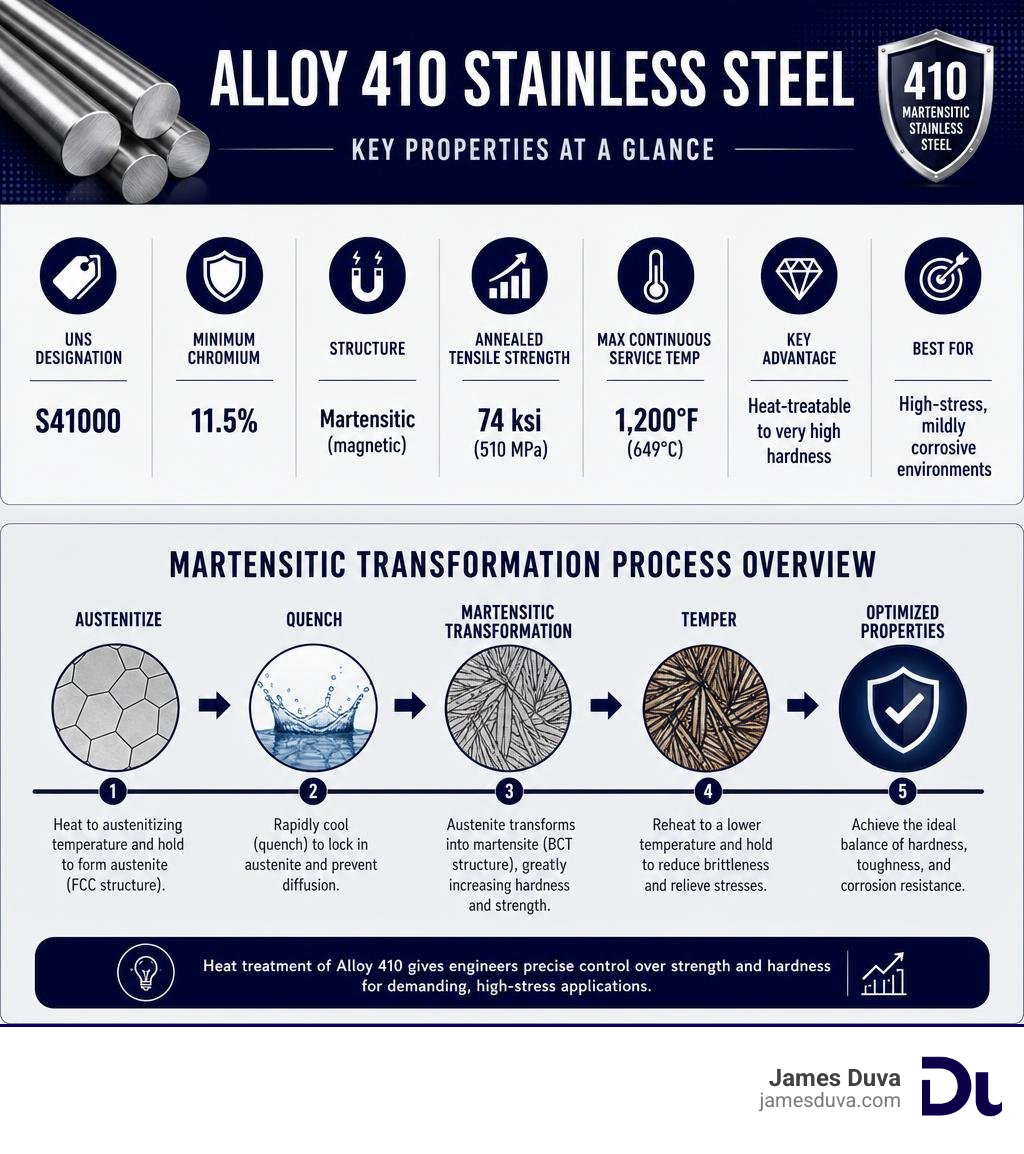
Alloy 410 stainless steel is the most widely used general-purpose martensitic stainless steel, designed for highly stressed parts that need a reliable balance of high strength, hardness, and moderate corrosion resistance.
Here is a quick snapshot of what makes Grade 410 stand out:
| Property | Value |
|---|---|
| UNS Designation | S41000 |
| Minimum Chromium | 11.5% |
| Structure | Martensitic (magnetic) |
| Annealed Tensile Strength | 74 ksi (510 MPa) |
| Max Continuous Service Temp | 1,200°F (649°C) |
| Key Advantage | Heat-treatable to very high hardness |
| Best For | High-stress, mildly corrosive environments |
Unlike austenitic grades such as 304 or 316, Grade 410 can be hardened through heat treatment — giving engineers precise control over strength and hardness levels. That makes it a go-to choice across industries like oil and gas, petrochemical processing, power generation, and medical instrument manufacturing.
But to get the best out of this alloy, you need to understand its composition, heat treatment requirements, and fabrication limits. Get any of those wrong — especially during welding or tempering — and you risk cracking, embrittlement, or reduced corrosion resistance.
This guide covers everything: chemical composition, mechanical properties, heat treatment protocols, welding best practices, and how Grade 410 stacks up against other common stainless steel grades.
I’m Billy Walker, Vice President of James Duva Inc., where we have been supplying specialty stainless steel and high-nickel alloy products — including alloy 410 stainless steel — to the power, process, and water treatment industries since 1978. With decades of hands-on sourcing experience, I’ll walk you through everything you need to know to select, specify, and work with this versatile martensitic grade.
Key alloy 410 stainless steel vocabulary:
To appreciate why alloy 410 stainless steel is so widely specified, it helps to look at the broader picture of metallurgy. Pure metals, such as pure iron, are rarely suitable for demanding industrial applications. In their unalloyed states, pure metals are often too soft, structurally weak, and highly susceptible to rust and environmental degradation.
By strategically introducing other elements, metallurgists create alloys that offer vastly superior strength, durability, and corrosion resistance. For example, adding carbon to iron creates steel, while introducing chromium and other elements transforms it into stainless steel. These modifications allow materials to withstand extreme pressures, corrosive chemicals, and high temperatures.
In modern engineering, specialized alloys are the backbone of critical infrastructure and high-performance products:
- Construction: Heavy-duty structural beams and industrial piping systems rely on high-strength alloys to support massive loads and resist environmental wear. For more insights on how these metals are utilized, read our guide on Stainless Steel Applications for Every Industry.
- Oil & Gas: Severe environments require robust fittings, flanges, and high-performance Ball Valves that can manage high-pressure corrosive fluids without leaking or failing.
- Automotive & Aerospace: High-strength, lightweight alloy frames and heat-resistant engine components are essential to withstand severe thermal and mechanical stresses.
- Medical & Consumer Goods: Biocompatible alloys are used for surgical implants and dental tools, while durable, easy-to-clean alloys are standard in commercial kitchenware and cutlery.
In the sections below, we will explore how the specific alloy formulation of Grade 410 makes it uniquely suited for these demanding roles.
Chemical Composition and Properties of Alloy 410 Stainless Steel
At its core, alloy 410 stainless steel is a 12% chromium martensitic stainless steel. The term “martensitic” refers to its crystal structure, which allows the metal to be hardened through heating and quenching. This structure also ensures that the material remains strongly magnetic in both the annealed and heat-treated conditions.
Understanding the specific microstructure of this alloy is key to predicting its behavior under stress. For a broader look at how this fits into the wider family of metals, check out our Detailed Guide to Stainless Steel Types.
Elemental Breakdown of Alloy 410 Stainless Steel
The chemical composition of UNS S41000 is carefully balanced to ensure it can achieve high hardness while maintaining baseline stainless properties. The chromium content is kept near the minimum threshold required for stainless steel, which allows the carbon content to actively drive the hardening reaction during thermal processing.
The standard chemical composition limits for alloy 410 stainless steel include:
- Chromium (Cr): 11.5% to 13.5%. This provides the protective chromium oxide film that prevents rusting in mild environments.
- Carbon (C): 0.08% to 0.15%. Carbon is the primary hardening agent; this range allows for significant strength increases during heat treatment.
- Manganese (Mn): 1.00% maximum. Added to improve hot workability and increase hardenability.
- Silicon (Si): 1.00% maximum. Acts as a deoxidizer during the melting process.
- Nickel (Ni): 0.75% maximum. Kept low to maintain the martensitic structure and keep the material cost-effective.
- Phosphorus (P): 0.040% maximum. Residual element kept low to prevent brittleness.
- Sulfur (S): 0.030% maximum. Kept low to avoid hot-shortness and maintain structural integrity.
- Iron (Fe): Balance.
For detailed raw chemical limits and engineering data, you can refer to the technical specifications compiled in eFunda: Properties of Stainless Steel AISI Type 410.
Physical and Thermal Characteristics
The physical properties of Grade 410 are highly comparable to those of carbon and low-alloy engineering steels, making it an easy substitute when extra corrosion resistance is needed. We have detailed these relationships in our In-Depth Guide to Stainless Steel Alloy Properties.
Key physical parameters of Grade 410 include:
- Density: 0.276 lb/in³ (7.64 g/cm³) at 68°F (20°C).
- Melting Range: 2700°F to 2790°F (1482°C to 1532°C).
- Modulus of Elasticity: 29 x 10⁶ psi (200 GPa).
- Thermal Conductivity: 14.4 BTU/(hr·ft·°F) (24.9 W/m·K) at 212°F (100°C).
- Electrical Resistivity: 56 microhm-cm (5.7 x 10⁻⁷ Ω·m) at 68°F (20°C).
- Coefficient of Thermal Expansion: 5.90 x 10⁻⁶ in/in/°F from 68°F to 392°F, rising to 6.5 x 10⁻⁶ in/in/°F up to 1112°F.
Heat Treatment, Fabrication, and Welding Guidelines
Working with alloy 410 stainless steel requires careful thermal management. Because it is an air-hardening steel, it will naturally harden when cooled rapidly from high temperatures. This characteristic makes it highly versatile, but it also means that fabrication steps like welding, hot working, and machining must be planned with precision. For a deeper look at how thermal processing alters metals, read How Different Alloys Change Steel’s Properties.
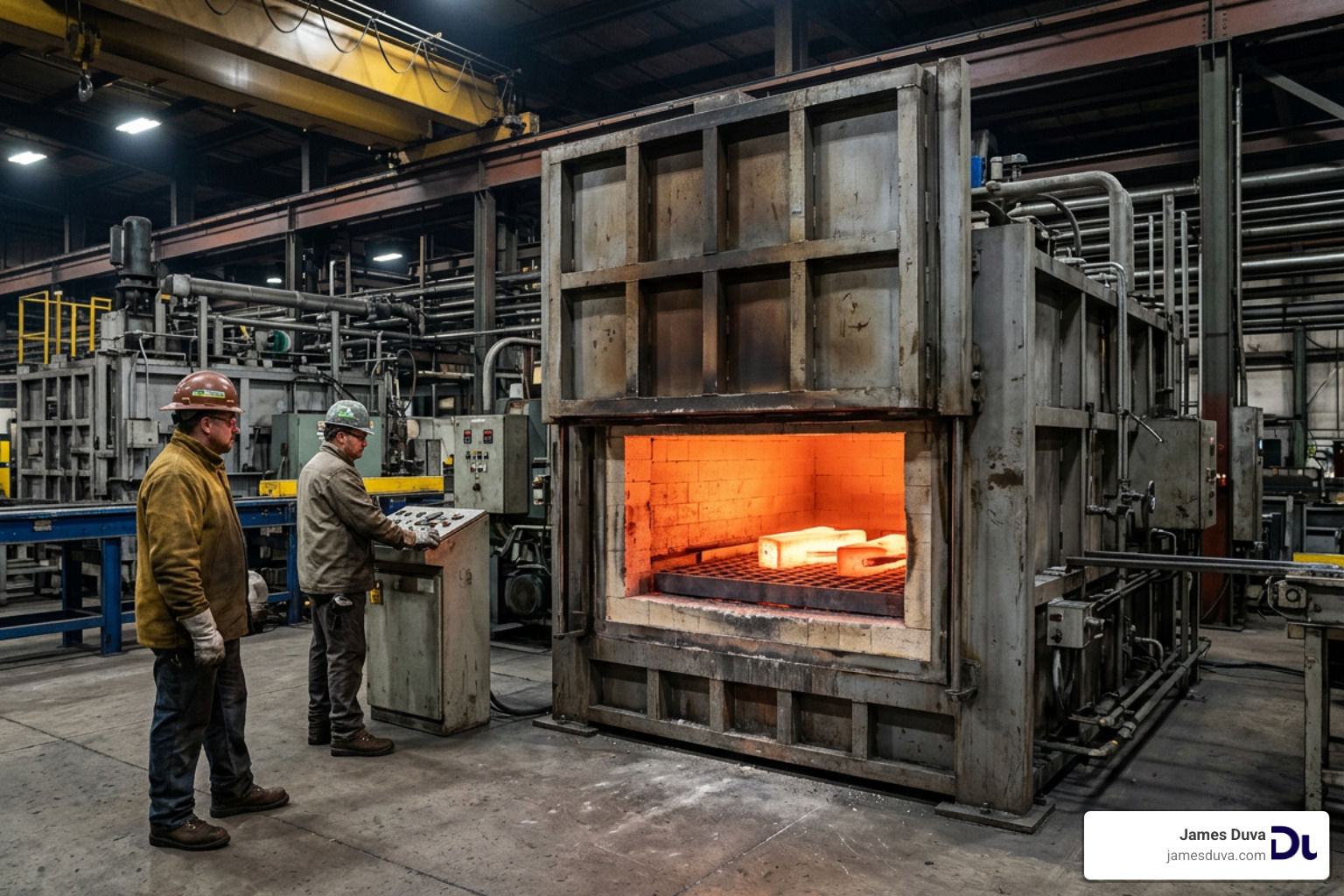
Hardening and Tempering Dynamics of Alloy 410 Stainless Steel
To harden Grade 410, the material must be heated slowly to the austenitizing temperature range of 1750°F to 1850°F (954°C to 1010°C), held to ensure uniform temperature, and then quenched in oil or air-cooled. Oil quenching is highly recommended for heavier sections to guarantee a complete martensitic transformation.
In its as-quenched state, the material is extremely hard and brittle, typically exhibiting a hardness of 38 to 45 HRC. To restore ductility and relieve internal stresses, it must be tempered immediately.
The choice of tempering temperature directly determines the final mechanical properties:
- Low-Temperature Tempering (400°F / 204°C): Yields maximum strength and hardness. In this condition, the alloy achieves a Rockwell hardness of approximately 43 HRC, a yield strength of 156 ksi (1076 MPa), and an ultimate tensile strength of 202 ksi (1399 MPa).
- High-Temperature Tempering (1200°F / 649°C): Restores maximum ductility and toughness at the expense of hardness. The hardness drops to around 98 HRB (approximately 21 HRC), with a yield strength of 42 ksi (290 MPa) and a tensile strength of 74 ksi (510 MPa).
These mechanical variations are thoroughly documented in the ATI Martensitic Stainless Steel Datasheet.
Avoiding Temper Embrittlement
When designing a heat treatment cycle for alloy 410 stainless steel, there is a critical temperature range that must be avoided. Tempering between 750°F and 1050°F (399°C to 566°C) causes temper embrittlement.
Tempering within this restricted zone leads to a severe drop in impact toughness and a significant reduction in corrosion resistance. This occurs because chromium carbides precipitate along the grain boundaries, depleting the surrounding matrix of the chromium needed to maintain the protective passive oxide film. Always specify tempering temperatures either below 700°F (370°C) or above 1100°F (593°C) to prevent premature component failure.
Welding Best Practices and Crack Prevention
Because of its high hardenability, Grade 410 is highly susceptible to cold cracking in the heat-affected zone (HAZ) of welds. When the weld area cools rapidly, it transforms into hard, brittle martensite, which can crack under residual tensile stresses.
To prevent cracking, follow these best practices:
- Preheating: Always preheat the workpiece to 350°F to 400°F (177°C to 204°C) before welding.
- Post-Weld Heat Treatment (PWHT): Immediately after welding — before the weldment has cooled below the preheat temperature — perform a full or sub-critical anneal at 1200°F to 1400°F (649°C to 760°C) to restore ductility and relieve stresses.
- Filler Metal Selection: Use matching AWS E410 or ER410 filler metals if the weldment must undergo subsequent hardening and tempering. If the joint does not require matching strength, high-nickel filler metals like Alloy 82 (AWS ERNiCr-3) or austenitic filler metals like 309L can be used to accommodate strain and reduce cracking risks.
For more information on welding and fabricating tubular assemblies, read A Practical Guide to Stainless Steel Tubing.
Machining and Cold Working Limitations
The machinability of Grade 410 depends heavily on its heat-treated state. Many engineers assume that the “dead soft” fully annealed condition is the easiest to machine, but this is a common misconception. In its softest state, the alloy is incredibly tough and “draggy,” which causes long, stringy chips to build up on the cutting tool, ruining the surface finish.
For cleaner cuts, better chip control, and superior surface finishes, it is best to machine Grade 410 in a cold-drawn or lightly heat-treated condition (up to approximately 35 HRC).
When machining:
- Maintain a constant feed to prevent work-hardening.
- Use surface speeds of 60 to 80 feet per minute when working with high-speed steel tools.
- If using carbide tooling, surface speeds can be increased by 2 to 3 times, paired with a 50% to 100% increase in feed rates.
Industrial Applications and Grade Comparisons
Due to its high mechanical strength and moderate corrosion resistance, Grade 410 is used across many heavy industries. It is particularly valued in high-stress applications where cost-efficiency is a priority. To see how this grade fits into your specific project requirements, refer to our resource: Which Stainless Steel Grade Is Best for Your Project?.
Corrosion and Oxidation Resistance
It is important to note that alloy 410 stainless steel displays its maximum corrosion resistance only after it has been fully hardened, tempered, and subsequently polished to a high finish. Polishing removes surface defects where corrosive agents can gather.
Grade 410 provides reliable resistance to:
- Fresh water and mild atmospheric conditions.
- Steam and hot gases.
- Mild acids, alkalies, and food acids.
- Deaerated oil and gas environments containing low hydrogen sulfide levels (meeting NACE MR-01-75 standards up to a maximum hardness of 22 HRC).
In terms of high-temperature service, Grade 410 has excellent scaling resistance. It can handle continuous temperatures up to 1200°F (649°C) and intermittent service up to 1500°F (816°C). However, it should not be used in highly oxidizing chloride environments, as it is prone to localized pitting and crevice corrosion. For a complete look at how different grades handle aggressive environments, read The Ultimate Guide to Stainless Steel Corrosion Resistance.
Comparing Grade 410 to Other Stainless Steel Alloys
When selecting a material, it is helpful to compare Grade 410 against other common stainless steel alloys to balance strength, corrosion resistance, and cost.
| Stainless Steel Grade | Alloy Type | Hardness / Strength | Corrosion Resistance | Primary Use Case |
|---|---|---|---|---|
| Alloy 410 | Martensitic | High (Heat-Treatable) | Moderate | Highly stressed valve parts, turbine blades, pump shafts |
| Alloy 304 | Austenitic | Moderate (Work-Hardens) | High | Piping, food processing, storage tanks |
| Alloy 420 | Martensitic | Very High | Moderate | Cutlery, plastic molds, surgical instruments |
| Alloy 440C | Martensitic | Extremely High | Low-Moderate | Ball bearings, valve seats, high-wear parts |
- vs. Grade 304: Grade 304 is non-magnetic and offers significantly better corrosion resistance. However, it cannot be hardened by heat treatment. If your project requires high yield strength under heavy loads, Grade 410 is the better choice. For more details on 304, read The Definitive Guide to 304 Stainless Steel Bar.
- vs. Grade 420 & 440C: These sister martensitic grades contain higher carbon levels. While they can be hardened to much higher levels than 410 (making them excellent for sharp cutting edges and bearings), they are more brittle, harder to weld, and have slightly lower corrosion resistance.
For a deeper dive into these material trade-offs, consult Grade 410 properties and alternatives.
Frequently Asked Questions About Grade 410
Is Grade 410 Stainless Steel Magnetic?
Yes, alloy 410 stainless steel is ferromagnetic. Because of its martensitic crystal structure, it exhibits a strong magnetic pull in all conditions, whether fully annealed, cold-worked, or fully hardened and tempered. This distinguishes it from standard 300-series austenitic stainless steels, which are non-magnetic in their annealed states.
What is the Difference Between 410 and 410S?
Grade 410S (UNS S41008) is a low-carbon modification of standard Grade 410. It contains a maximum of 0.08% carbon and often includes small additions of titanium or niobium.
These chemical changes prevent the material from forming austenite at high temperatures, which restricts its ability to harden. Because 410S remains soft and ductile even when cooled rapidly from high temperatures, it is much easier to weld and far less prone to cracking than standard 410.
What is the Maximum Service Temperature for Grade 410?
For continuous service in oxidizing atmospheres, the safe scaling limit for Grade 410 is 1200°F (649°C). For intermittent service, it can withstand temperatures up to 1500°F (816°C). Operating above these limits will result in rapid oxide scale formation and a severe loss of mechanical strength.
Conclusion
Alloy 410 stainless steel is a versatile engineering material that bridges the gap between high-strength carbon steels and highly corrosion-resistant austenitic stainless steels. By mastering its heat treatment requirements, avoiding the temper embrittlement range, and following proper preheating and welding protocols, you can unlock the full potential of this high-strength martensitic grade.
At James Duva Inc., based in Branchburg, NJ, we have been helping industrial piping and manufacturing businesses source the exact specialty metals they need since 1978. Whether you require high-grade plates, sheets, bars, or custom fittings, our team has the expertise to ensure your project succeeds.
To learn more about high-performance alloy alternatives, read our guide on Understanding Duplex 2205 Properties, Advantages, and Applications, or contact our team in New Jersey today to discuss your specific material requirements.
About James Duva Inc.
Since 1978, James Duva Inc. has been your trusted source for stainless steel and high-nickel alloy industrial products. Whether you’re in the water treatment, process or power industry, we pride ourselves on always having what you need. Say goodbye to your sourcing problems with just one call to James Duva.