
Inspect Sanitary Tubing Stainless Steel to Ensure Peak Hygiene
Nov 11, 2026
How to Inspect Stainless Steel Sanitary Tubing for Hygiene
When buying sanitary tubing stainless steel, confirm the alloy and dimensions, inspect the inside for damage or residue, and check that the ends are capped. Before installation, verify that any welds are smooth and cleanable. These checks help protect fluid lines used in food, beverage, and pharmaceutical processing.
I’m Billy Walker, vice president of James Duva Inc., where I help industrial buyers source stainless steel and specialty piping components. That experience shapes this guide to inspecting sanitary tubing stainless steel from delivery through installation.
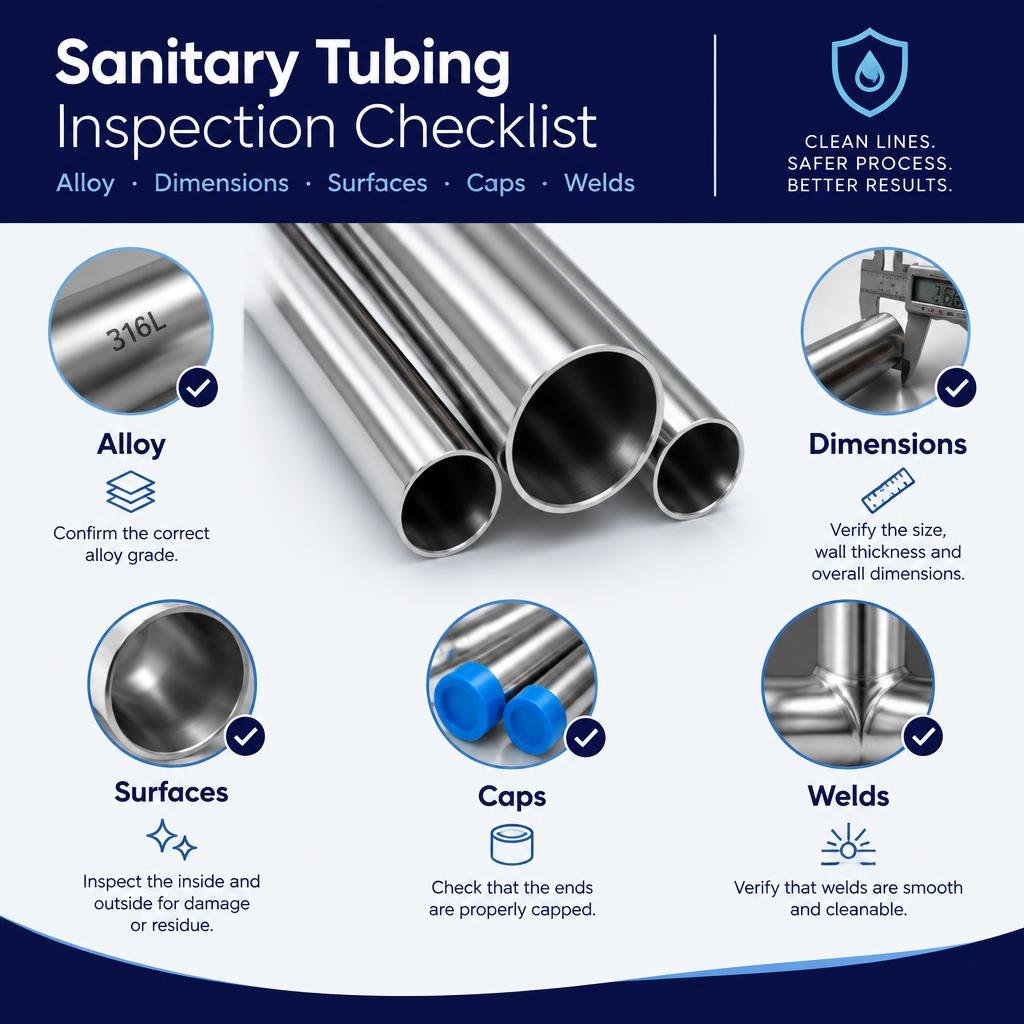
Simple sanitary tubing stainless steel glossary:
For broader context on how stainless steel alloys perform in hygienic service, the ASM International guide to stainless steel selection provides useful metallurgical background. You can review the ASM International stainless steel selection guide for additional technical detail.
Why Are Alloys So Valuable in Industry?
Pure metals like elemental iron are simply too soft for heavy mechanical loads and highly vulnerable to oxidation. When iron meets moisture and atmospheric oxygen, it quickly corrodes into brittle rust flakes.
Engineering alloys solve this fundamental vulnerability by blending base metals with specific alloying elements to dramatically elevate mechanical strength, thermal endurance, and corrosion resistance. Stainless steel alloys, for example, deliver superior durability and structural integrity compared to unalloyed metals.
In high-purity processing environments, standard stainless steel alloys such as SS304 and SS316 rely on a microscopic chromium oxide passive layer. When the alloy contains at least 10.5% chromium, this passive layer forms spontaneously across the surface upon exposure to oxygen. It acts as an impenetrable shield that blocks rust, prevents metallic leaching into process streams, and continuously heals itself if scratched or polished. To understand how these metallurgy fundamentals apply to fabrication and design, consult our technical resource on 304 stainless tubing.
Beyond sanitary processing, metallic alloys serve as the backbone of modern industrial infrastructure:
- Construction: Heavy structural steel beams, architectural support columns, and durable high-pressure piping frameworks.
- Oil & Gas: Forged pipeline fittings, high-strength structural flanges, and robust Ball Valves designed for harsh subsea or refinery manifolds.
- Automotive & Aerospace: Lightweight chassis frames, high-temperature jet engine turbine assemblies, and exhaust manifolds.
- Medical & Consumer Goods: Biocompatible orthopedic implants, precision surgical instrumentation, and commercial food-grade kitchenware.
Core Differences Between Sanitary and Standard Industrial Tubing
Industrial piping and sanitary tubing might look similar from the outside, but their internal surfaces and manufacturing standards are completely different. Standard pipe focuses primarily on structural strength and pressure containment, often leaving rough internal weld beads, mill scale, and micro-crevices. In an industrial water or gas line, minor surface roughness does not compromise system integrity.
In contrast, clean fluid transfer requires ultra-smooth surfaces to prevent product buildup and bacterial colonization. Properly specified stainless steel sanitary tubing is measured by its Roughness Average (Ra) on the internal finish. A lower Ra value indicates a smoother surface, which prevents microscopic biofilms from gaining a foothold inside the line.
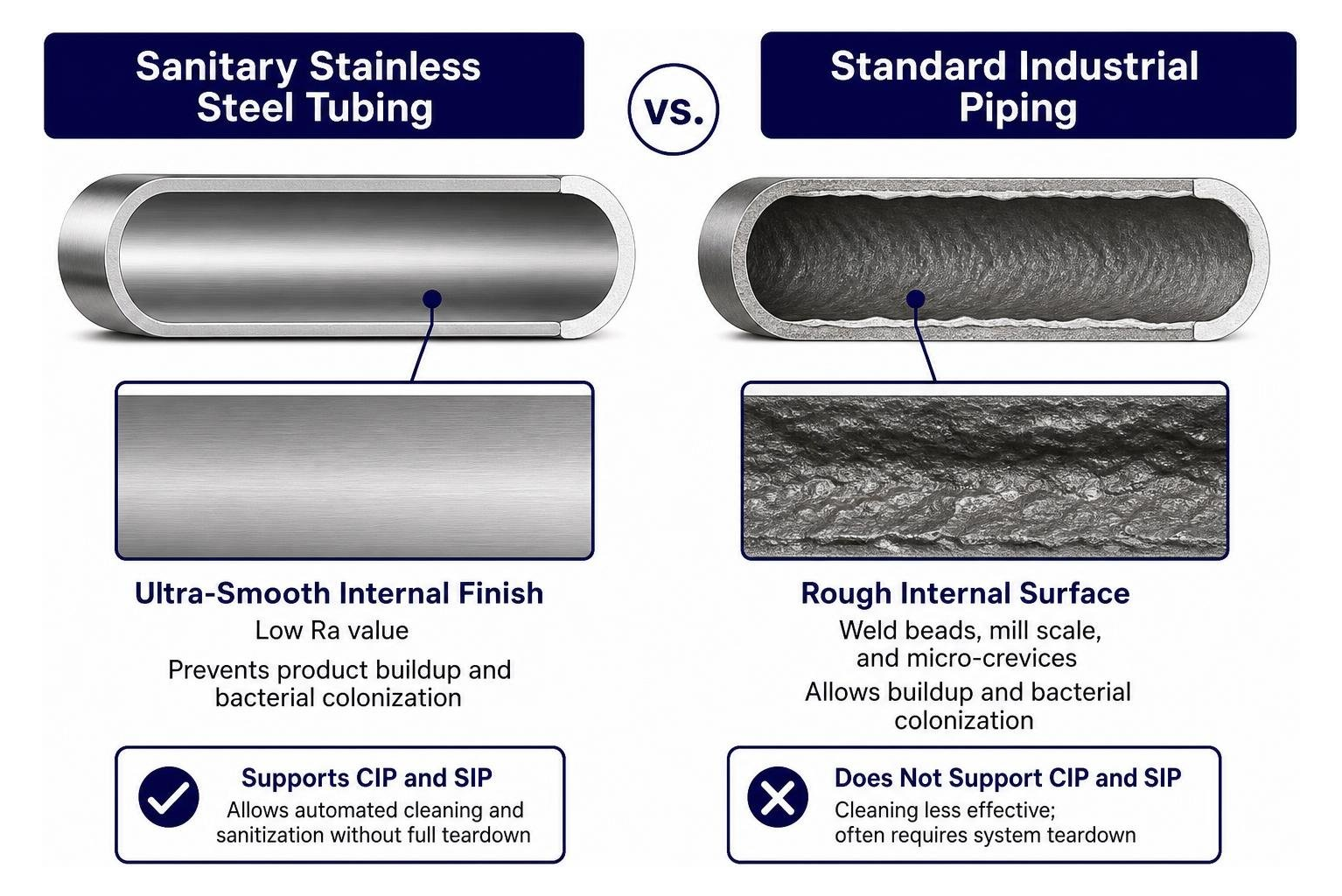
A smooth internal finish allows automated Clean-In-Place (CIP) and Steam-In-Place (SIP) cycles to sanitize the line without requiring full system teardown, demonstrating why sanitary tubing is essential for hygienic fluid transfer across high-purity food, dairy, and biotechnology operations.
| Feature | Standard Industrial Piping | Sanitary Stainless Steel Tubing |
|---|---|---|
| Primary Sizing Benchmark | Nominal Pipe Size (NPS) & Schedule Wall | Exact Outer Diameter (OD) & True Gauge Wall |
| Interior Surface Finish | Unpolished, mill-finish (Ra > 60 µin) | Polished or electropolished (Ra ≤ 20–32 µin) |
| Internal Weld Seam | Visible, non-flush weld bead | Fully bead-reduced, rolled flush, or seamless |
| Cleaning Capability | Manual flush or mechanical pigging | Automated Clean-In-Place (CIP) & SIP compatible |
| Primary Failure Risk | Mechanical burst or external fatigue | Product contamination and biofilm entrapment |
Surface Finish Standards for Sanitary Tubing Stainless Steel
To verify that every length of tubing meets rigorous hygiene criteria, global processing sectors rely on established sanitary finish standards.
Standard manufacturing specifications like ASTM A270 govern the mechanical, chemical, and dimensional tolerances of sanitary piping. In strict food and dairy facilities, equipment must also align with recognized 3A sanitary standards to guarantee that all fluid contact surfaces remain cleanable and corrosion-resistant.
For biopharmaceutical processing, ASME BPE (Bio-Processing Equipment) standards define strict limits for surface finishes. These range from mechanically polished finishes down to specialized electropolishing, which chemically smooths the metal grain and boosts chromium levels at the surface. Removing microscopic peaks and valleys eliminates entrapment zones, ensuring your lines pass swab tests and cleanability validations.
Key Standards and Technical Specifications for Sanitary Tubing Stainless Steel
Specifying the correct dimensions and grades is essential when engineering high-purity lines. For detailed technical background on sizing and material selection, consult our guide to stainless steel tubing.
Most food, beverage, and light chemical processing systems use austenitic SS304 stainless steel, which offers excellent corrosion resistance and structural durability. For aggressive environments—such as high-salinity foods or active pharmaceutical ingredients—SS316L is preferred for its added molybdenum content and superior pitting resistance.
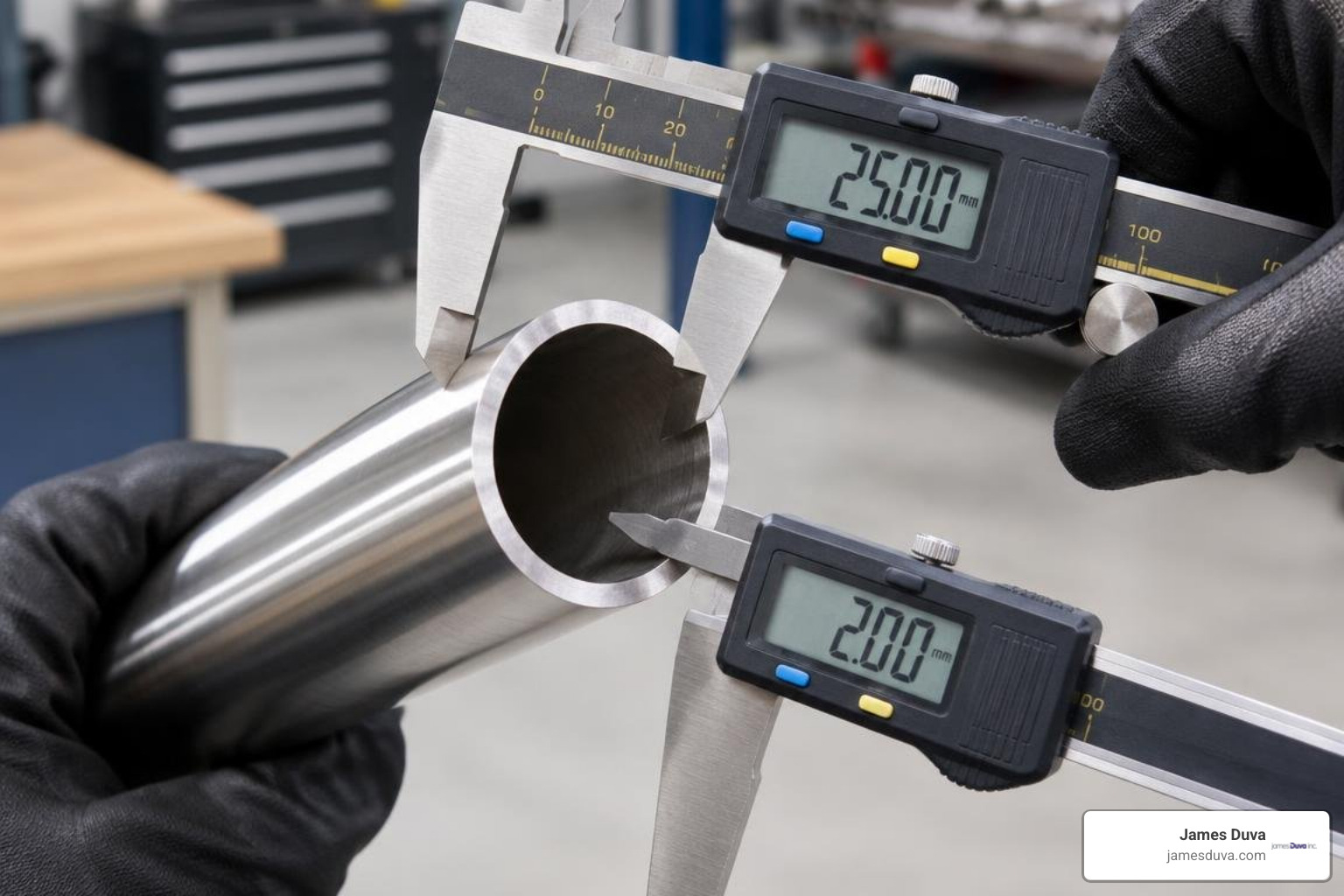
Sanitary rigid tubing is manufactured to specific outer diameter (OD) dimensions:
- Outer Diameter (OD) Sizes: Available in standard dimensions from 1 inch through 4 inches.
- Wall Thickness: Commonly manufactured with a uniform 0.065-inch nominal wall thickness (16-gauge).
- Available Lengths: Standard inventory spans from 12 inches up to 20 feet (240 inches), typically supplied in 1-foot increments.
Key Dimensional Tolerances of Sanitary Tubing Stainless Steel
Precise dimensional control ensures that mating tube faces line up cleanly during installation. Misaligned joints create internal steps or crevices that disrupt laminar flow and trap product.
Choosing the right precision stainless tubing requires strict manufacturing control. High-quality tube mills maintain tight tolerances across outer diameter roundness, concentricity, and wall gauge consistency.
When your installation requires custom tube spools, James Duva Inc. offers custom cutting services using precision orbital cutters. This orbital tooling produces clean, square cuts for $16.50 per cut, holding tolerances within plus or minus 1/4 inch so your pieces fit up smoothly on site.
Permanent Welds vs. Tri-Clamp Quick-Disconnect Fittings
Engineers selecting hygienic connections must balance ease of maintenance with long-term line integrity.
Tri-Clamp fittings use a mechanical clamp and an elastomeric gasket to join sanitary ferrules, making them simple to disassemble for routine line cleaning. However, elastomeric gaskets degrade over time due to thermal cycling and harsh chemical cleanings, requiring regular inspection and replacement.
By contrast, permanent orbital butt-welded lines joined to weld fittings create a continuous, crevice-free internal surface. Because welded lines eliminate elastomeric gaskets, they remove potential leak paths and lower recurring maintenance costs across long pipe runs.
How to Inspect and Maintain Hygiene from Transit to Installation
Maintaining clean tubing requires careful handling and packaging long before the material arrives at your jobsite.
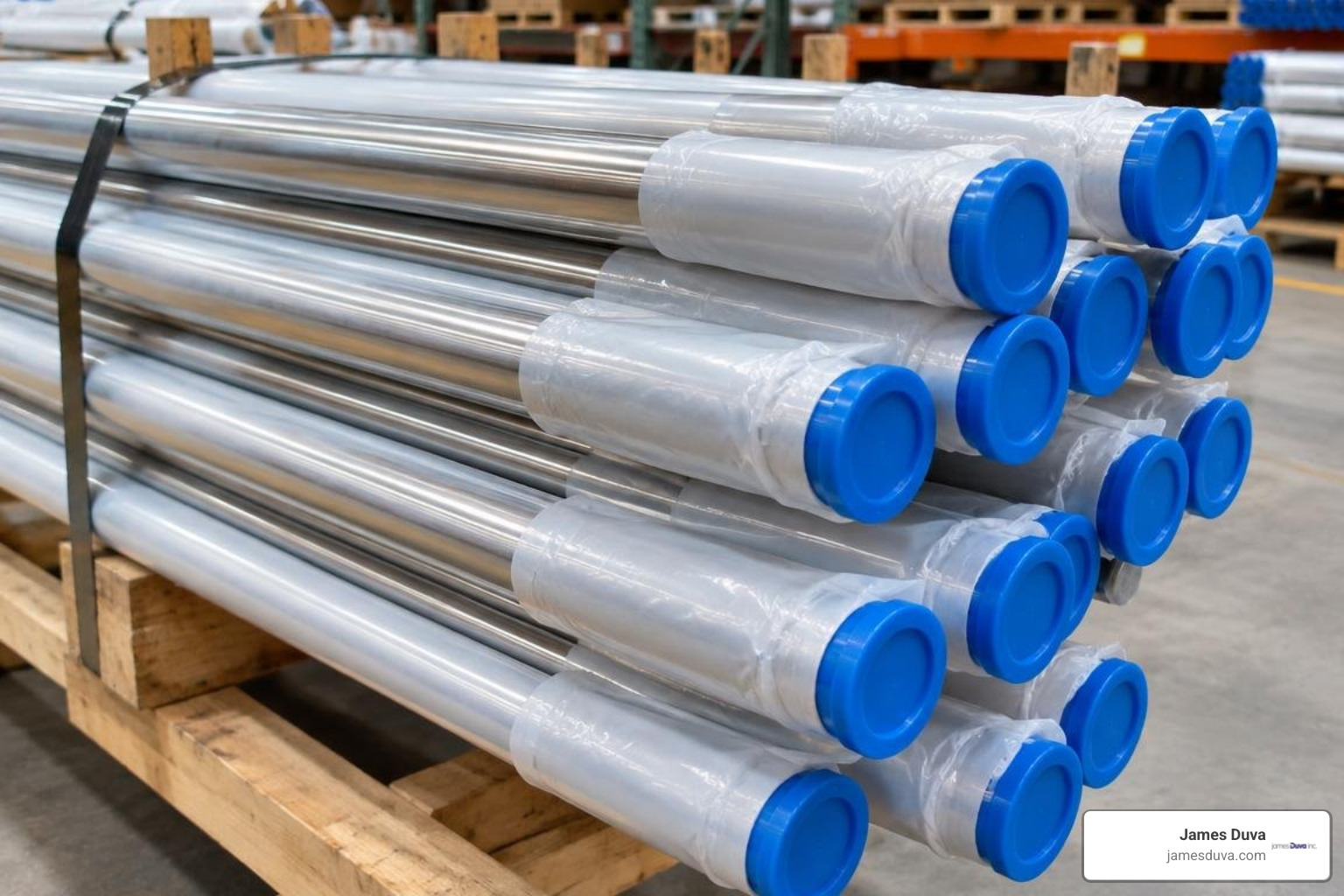
To protect the internal surface finish, every tube length should arrive fully enclosed in an individual 2-mil protective poly sleeve with snap-on plastic end caps firmly seated over both tube faces. These caps prevent airborne particulates, warehouse dust, moisture, and road grime from contaminating the polished interior during transit.
When receiving your delivery, run through this inspection checklist:
- Packaging Integrity: Confirm that protective 2-mil poly sleeves remain intact without large tears, punctures, or chemical stains.
- End-Cap Security: Check that plastic end caps are firmly secured on both ends of every tube length.
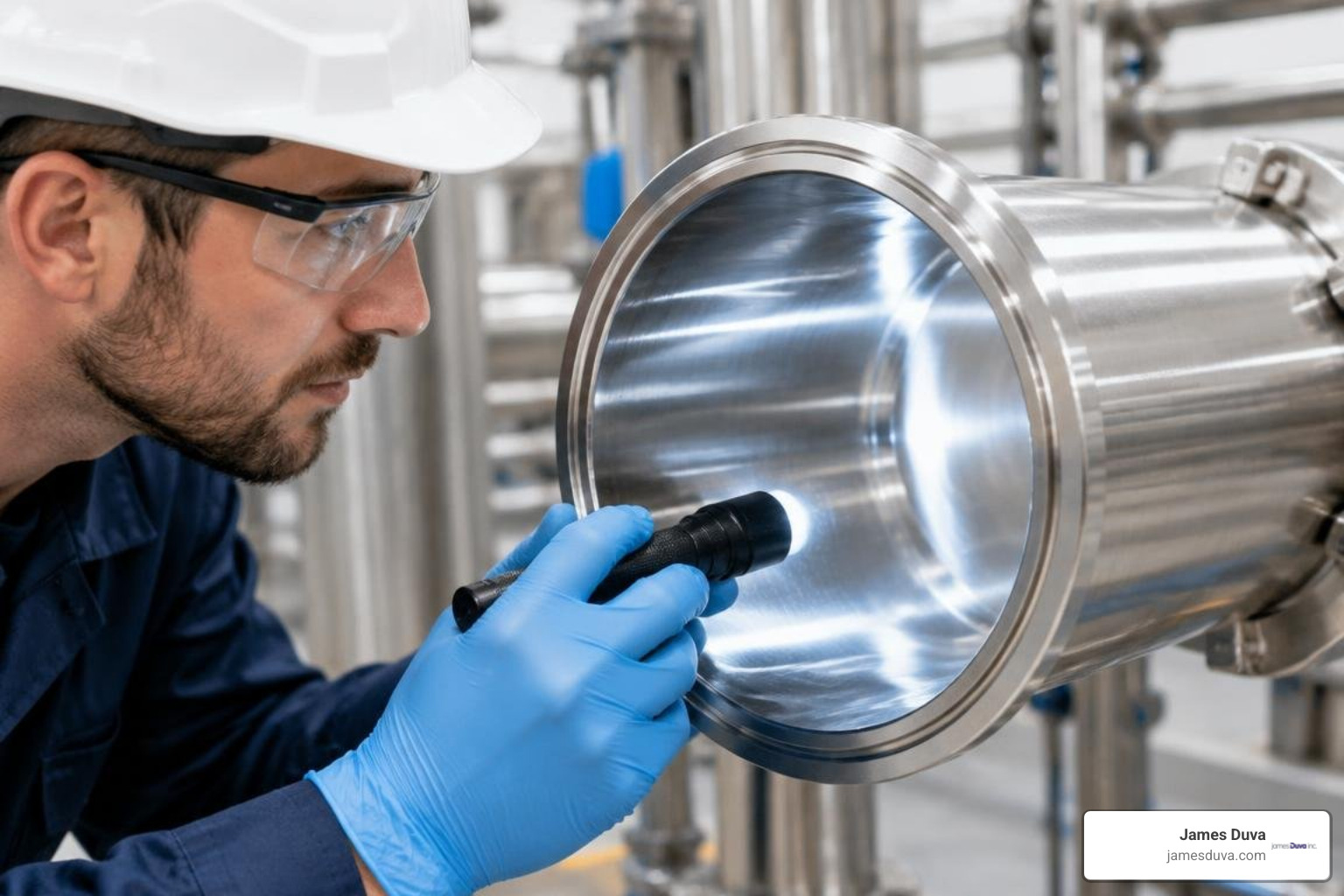
- Internal Bore Cleanliness: Pull a sample cap and inspect the internal bore using a clean inspection light to ensure the surface is free of grit, condensation, and residue.
- Alloy and Gauge Markings: Match the continuous ink-jet line markings (grade, heat number, ASTM specification, OD, and wall thickness) against your receiving documentation and Mill Test Reports (MTRs).
- Surface Check: Look over the exterior for denting, scratching, or bending that could compromise roundness or prevent clean orbital fit-up.
Because 20-foot (240-inch) tubing exceeds standard parcel limits, lengths over 8 feet ship via Less-Than-Truckload (LTL) freight rather than standard parcel carriers like FedEx. LTL freight allows long bundles to sit flat on heavy pallets, protecting them from bending in transit. Standard sanitary tubing products are backed by a 30-day return policy from the date of receipt, subject to a 15% restocking fee with return shipping covered by the customer.
Frequently Asked Questions about Sanitary Stainless Steel Tubing
Why does tubing over 8 feet require specialized LTL freight shipping?
Standard parcel carriers like FedEx have strict length and dimensional weight caps that max out near 8 feet (96 inches). Rigid sanitary tubing over 8 feet requires Less-Than-Truckload (LTL) freight shipping on dedicated flatbeds or enclosed dry-vans. This dedicated freight handling ensures the long, thin-walled tubing is properly cradled and secured to prevent bending, kinking, or surface crushing during transit.
What is the standard wall thickness for 304 sanitary stainless tubing?
The primary standard wall thickness for 304 sanitary stainless tubing across common sizes (1-inch to 4-inch OD) is 0.065 inches, which corresponds to 16-gauge wall thickness. This specific wall gauge offers the ideal balance of internal pressure containment, mechanical rigidity, thermal heat transfer during Clean-In-Place cycles, and structural compatibility with standard orbital butt-welding equipment.
Can sanitary tubing be custom cut before delivery?
Yes, standard rigid sanitary tubing can be custom cut to your exact project spool lengths prior to shipment. Precision orbital cutting services are available for $16.50 per cut, providing clean, square, weld-ready tube ends held to a tight tolerance within plus or minus 1/4 inch.
Conclusion
Maintaining peak hygiene in fluid processing requires careful attention to detail at every step—from selecting the right alloy grade and verifying surface finish to using proper end caps and orbital weld fit-ups. Confirming dimensional tolerances and inspecting packaging upon arrival protects your process against product contamination, unexpected downtime, and costly sanitation failures.
James Duva Inc. has supplied high-grade stainless steel and specialty alloy piping products from our Branchburg, NJ facility since 1978. Whether you need standard 20-foot lengths, custom-cut spools, or matching weld fittings, our team is ready to help you source the right components for your sanitary process.
Review our inventory of sanitary stainless steel components today to keep your hygienic processing lines running reliably.
About James Duva Inc.
Since 1978, James Duva Inc. has been your trusted source for stainless steel and high-nickel alloy industrial products. Whether you’re in the water treatment, process or power industry, we pride ourselves on always having what you need. Say goodbye to your sourcing problems with just one call to James Duva.