
The Essential Guide to Finding a Reliable 904L Pipe Supplier

Aug 5, 2026
When Standard Stainless Steel Isn’t Enough: Finding the Right 904L Pipe Supplier
Finding a dependable 904L pipe supplier is critical for any industrial operation where standard stainless steel grades simply won’t hold up. Whether you’re handling concentrated sulfuric acid, warm seawater, or other highly corrosive media, 904L is one of the few alloys built to take it.
Quick Answer: What to Look for in a 904L Pipe Supplier
| Factor | What to Check |
|---|---|
| Standards compliance | ASTM B677 (seamless), ASTM A312, ASTM B673 (welded) |
| Material certification | Mill Test Certificates (MTC) per EN 10204/3.1B |
| Chemical verification | Nickel 23–28%, Molybdenum 4–5%, Copper 1–2% |
| Pipe types available | Seamless, ERW, EFW, square, rectangular |
| Size range | 1/2″ to 16″ NB (seamless), up to 24″ (ERW) |
| Pricing (India, 2026) | ₹850–₹980/kg; imported pipes run 10–25% higher |
| Third-party testing | PMI, radiography, intergranular corrosion tests |
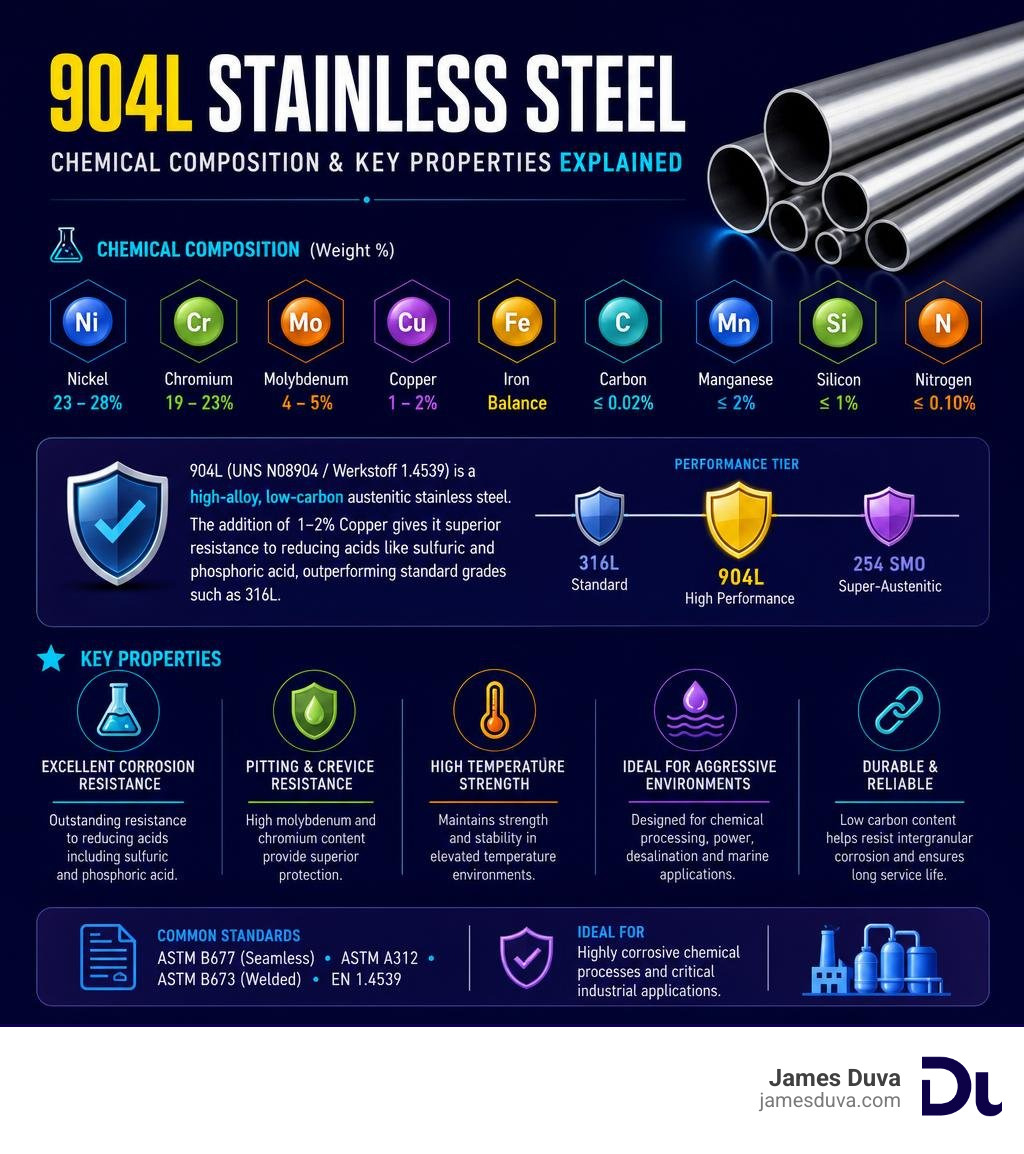
904L (UNS N08904 / Werkstoff 1.4539) is a high-alloy, low-carbon austenitic stainless steel. Its unique chemistry — especially the addition of 1–2% copper — gives it resistance to reducing acids like sulfuric and phosphoric acid that most standard grades can’t match. It sits in a performance tier above 316L, but below the 6% molybdenum super-austenitics like 254 SMO.
The challenge for procurement teams isn’t knowing that they need 904L. It’s finding a supplier who stocks the right sizes, holds proper certifications, and can deliver without delay.
I’m Billy Walker, Vice President of James Duva Inc., where I’ve spent years helping engineers and procurement specialists source specialty alloys — including as a trusted 904L pipe supplier — from leading mills like Sandvik and Salem Tube. James Duva Inc. has served the power, process, and water treatment industries since 1978, so the sourcing challenges you face are ones we know well.
904l pipe supplier helpful reading:
Why Are Alloys So Valuable in Industry?
To understand why we rely so heavily on specialized materials like 904L, we first have to look at the fundamental nature of metals. In their pure states, many elementary metals are poorly suited for the rigors of heavy industry. For example, pure iron is relatively soft, highly malleable, and incredibly prone to rust when exposed to oxygen and moisture.
Alloying is the process of melting and fusing two or more elements together to create a material with enhanced physical and chemical characteristics. By introducing elements like chromium, nickel, molybdenum, and copper, we transform simple iron into alloy steels and stainless steels that offer superior strength, hardness, and corrosion resistance.
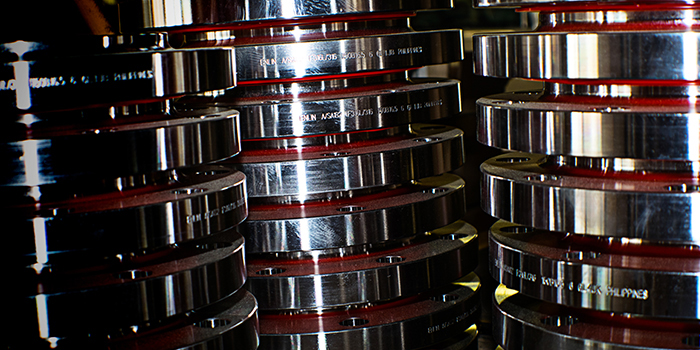
These engineered metals are the backbone of modern industrial infrastructure. Their value spans across several critical sectors:
- Construction: High-strength alloy steel beams, structural columns, and specialized piping systems form the load-bearing skeletons of skyscrapers, bridges, and industrial plants.
- Oil & Gas: High-performance alloy fittings, flanges, and process piping withstand the extreme pressures, elevated temperatures, and sour gas environments common in upstream and downstream operations.
- Automotive & Aerospace: Lightweight yet ultra-strong alloys are essential for fabricating aircraft frames, jet engines, and automotive crumple zones where failure is not an option.
- Medical & Consumer Goods: Biocompatible alloys are used for surgical implants and joint replacements, while durable, corrosion-resistant alloys form the basis of commercial kitchenware and food processing lines.
For a deeper dive into how industrial metals are categorized and sourced, read our article: A Comprehensive Guide to Industrial Metals Supplier USA.
Understanding Alloy 904L: Properties and Specifications
Alloy 904L (UNS N08904 / Werkstoff 1.4539) is a non-stabilized, high-alloy austenitic stainless steel designed specifically to survive under severely corrosive conditions. Originally developed to resist dilute sulfuric acid, it has become a standard material for handling some of the most aggressive chemicals in the processing industries.
The defining characteristic of 904L is its ultra-low carbon content (maximum 0.020%). During welding, standard stainless steels can suffer from carbide precipitation along the grain boundaries, leading to intergranular corrosion. Because 904L has so little carbon, it is highly resistant to this type of sensitization, allowing it to be welded and fabricated without losing its corrosion-resistant properties.
Additionally, the specific addition of 1.0% to 2.0% copper acts as a chemical shield, blocking attack from strong reducing acids like sulfuric, phosphoric, and acetic acids. For design engineers looking to implement this alloy in high-purity or high-pressure systems, sourcing from an experienced supplier who understands these characteristics is essential.
To learn more about how stainless steel tubing is manufactured and specified, see A Practical Guide to Stainless Steel Tubing.
Chemical Composition and Mechanical Properties of UNS N08904
The outstanding performance of 904L is a direct result of its highly alloyed chemistry. It contains high concentrations of nickel and chromium, balanced with molybdenum and copper:
- Nickel (Ni): 23.0% – 28.0%
- Chromium (Cr): 19.0% – 23.0%
- Molybdenum (Mo): 4.0% – 5.0%
- Copper (Cu): 1.0% – 2.0%
- Manganese (Mn): ≤ 2.0%
- Silicon (Si): ≤ 1.0%
- Carbon (C): ≤ 0.020%
- Phosphorus (P): ≤ 0.040%
- Sulfur (S): ≤ 0.030%
This chemical profile yields robust mechanical properties that remain stable across a wide temperature range:
- Tensile Strength (minimum): 490 MPa (71,000 psi)
- Yield Strength (0.2% Offset, minimum): 220 MPa (32,000 psi)
- Elongation (minimum): 35%
- Density: 8,000 kg/m³ (7.95 g/cm³)
- Elastic Modulus: 200 GPa (at room temperature)
Because of its fully austenitic structure, 904L is completely non-magnetic and retains excellent toughness even at cryogenic temperatures. It cannot be hardened by traditional heat treatments (like quenching and tempering); instead, maximum strength and stress corrosion cracking resistance are achieved through cold working, followed by solution annealing if necessary.
Key Specifications for a 904L Pipe Supplier
When sourcing 904L pipes, a reputable 904l pipe supplier must provide materials that strictly adhere to international manufacturing specifications. The most common standards include:
- ASTM B677 / ASME SB677: Standard specification for seamless UNS N08904 pipe and tube.
- ASTM A312 / ASME SA312: Standard specification for seamless, welded, and heavily cold worked austenitic stainless steel pipes.
- ASTM B673: Standard specification for welded UNS N08904 pipe.
- EN 10216-5: European standard for seamless steel tubes for pressure purposes.
To guarantee material traceability, a reliable supplier must provide Mill Test Certificates (MTC) conforming to EN 10204 3.1B. This documentation verifies the heat number, chemical composition limits, and mechanical test results (such as flattening, flaring, and hydrostatic tests), ensuring that the pipe you receive meets the exact requirements of your project.
Comparing 904L to Other High-Performance Alloys
When selecting a piping material, engineers must balance corrosion resistance, mechanical strength, and cost. How does 904L compare to standard grades and other specialty alloys?
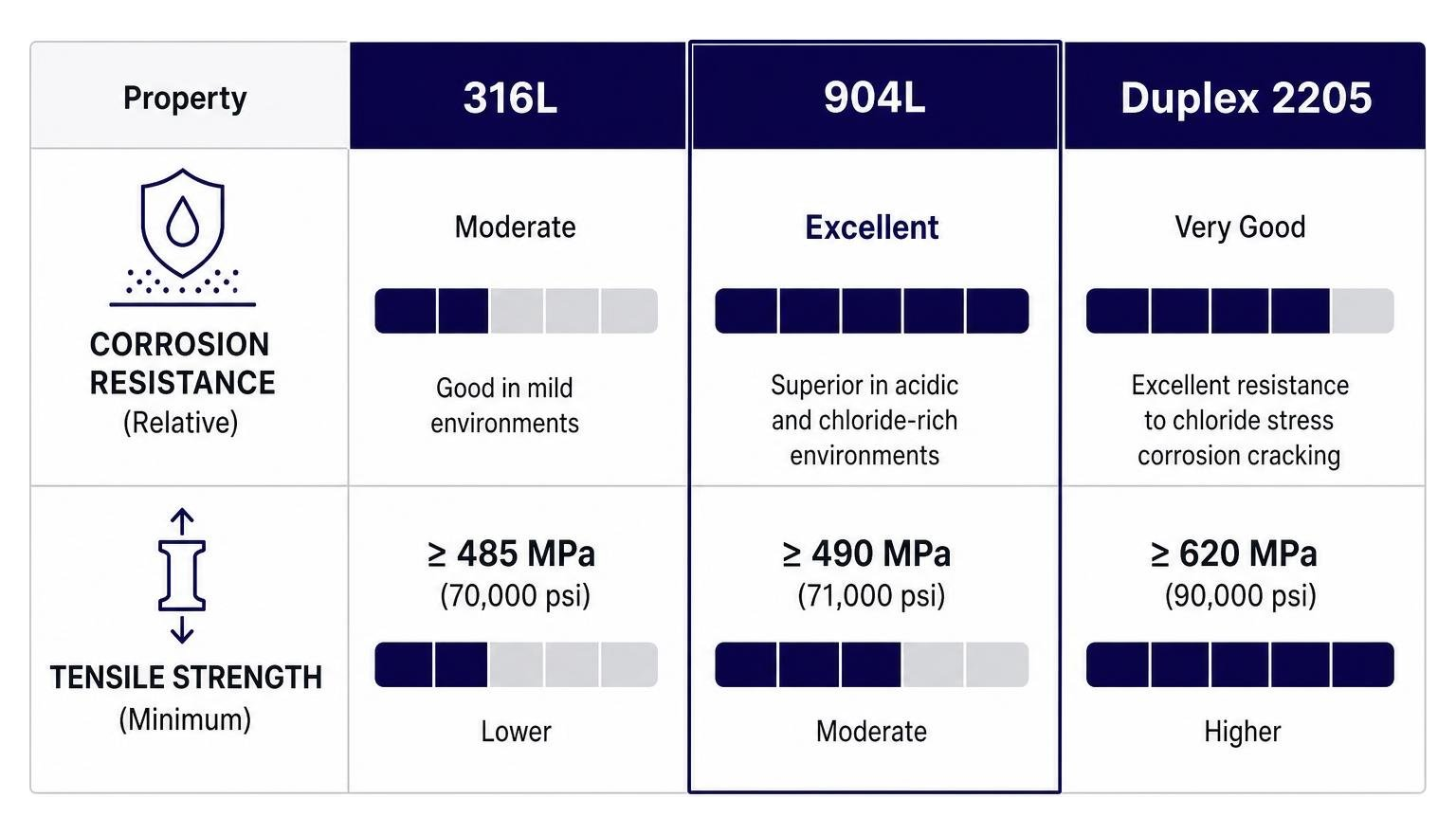
Historically, 904L was the go-to upgrade when standard 316L stainless steel failed due to pitting or stress corrosion cracking in chloride-rich environments. While 316L contains 2% to 3% molybdenum, 904L boasts 4% to 5% molybdenum and nearly double the nickel content. This chemical boost makes 904L vastly superior at resisting localized crevice corrosion and halide attacks.
However, the high nickel and molybdenum content makes 904L a premium, high-cost material. Today, many applications that historically employed grade 904L are being evaluated for replacement by low-cost duplex stainless steel 2205. Duplex 2205 has a mixed microstructure of austenite and ferrite, providing a minimum yield strength (~450 MPa) that is roughly double that of 904L (~220 MPa). While duplex 2205 is highly cost-effective and offers excellent resistance to chloride stress corrosion cracking, 904L remains the preferred choice for highly reducing acid environments (like concentrated sulfuric acid) and high-purity pharmaceutical systems where a fully austenitic structure is required.
In contrast, if your application involves extreme chloride exposure—such as warm seawater desalination plants—even 904L might face limitations. In these scenarios, super austenitic grades like 254 SMO (which contains 6% molybdenum and added nitrogen) or high-nickel alloys are utilized to prevent pitting.
For a comprehensive comparison of how seamless and welded manufacturing methods affect these alloys, read Seamless Pipe and Welded Pipe What’s the Difference.
Sourcing from a Reliable 904L Pipe Supplier
Sourcing specialty alloys is not just about finding the lowest price; it is about ensuring material integrity and long-term performance. Working with an experienced 904l pipe supplier ensures that your piping, fittings, and associated flow control components—such as Ball Valves—will function safely under pressure.

When evaluating potential suppliers, prioritize those who offer:
- Strict Material Traceability: Every pipe should be marked with its heat number, ASTM specification, and size, backed by certified mill test reports.
- In-House Testing Capabilities: Quality suppliers offer third-party or in-house testing, including Positive Material Identification (PMI), ultrasonic testing (UT), and radiography for welded seams.
- Comprehensive Processing Services: Look for suppliers who can perform precision cutting, beveling, threading, and custom bending to save fabrication time on-site.
Seamless vs. Welded 904L Pipes
The choice between seamless and welded 904L pipes depends heavily on your system’s operating pressure, design configuration, and budget.
- Seamless 904L Pipes (ASTM B677 / A312): Manufactured by heating a solid round steel billet and piercing it to form a hollow shell. Because there is no welded seam, seamless pipes eliminate the risk of weld-joint failure and are the standard choice for high-pressure, high-temperature, and critical chemical processing environments. Seamless 904L pipes are typically stocked in sizes up to 16 inches nominal bore (NB).
- Welded, ERW, and EFW 904L Pipes (ASTM B673 / A312): Produced by rolling flat strip or plate into a cylinder and welding the seam. Electric Resistance Welded (ERW) and Electric Fusion Welded (EFW) methods allow for the production of larger-diameter pipes (up to 24 inches for ERW and up to 100 inches for EFW). Welded pipes are highly cost-effective for structural, low-pressure, or large-diameter piping systems, provided the weld area is properly heat-treated to prevent localized corrosion.
Sourcing and Pricing Trends for a 904L Pipe Supplier in 2026
As of July 2026, the global market for specialty alloys remains sensitive to raw material fluctuations, logistics costs, and regional manufacturing capacities.
In major manufacturing hubs like India, the price of SS Seamless Pipe 904L as of early 2026 ranges between ₹850 to ₹980 per kilogram, depending on the pipe size, wall thickness (schedule), and order volume. For larger-diameter heavy-wall pipes (such as 4-inch and 6-inch NB), the material usage and fabrication complexity can push prices to ₹9,000 to ₹20,000 per meter.
For North American B2B buyers sourcing through domestic distributors in regions like New Jersey, several key factors influence the final landed cost:
- Mill Origin: Imported pipes from premium European or Japanese mills generally cost 10% to 25% more than domestic or standard Asian mill pipes due to brand pedigree, strict quality controls, and international logistics.
- Alloy Surcharges: Because 904L contains 23% to 28% nickel and 4% to 5% molybdenum, its price is highly tied to the global surcharges of these raw elements.
- Order Volume: Bulk ordering remains the most effective way to secure wholesale pricing and mitigate shipping premiums.
Frequently Asked Questions about 904L Stainless Steel Pipes
Why is copper added to Grade 904L stainless steel?
Copper (1.0% to 2.0%) is added to Grade 904L to dramatically improve its resistance to strong reducing acids, most notably sulfuric acid. While standard molybdenum-bearing stainless steels like 316L struggle in highly acidic environments, the copper in 904L acts as an active barrier that slows down chemical attack, making it suitable for processing battery acid, fertilizers, and inorganic chemicals.
How does 904L compare to Duplex 2205 in cost and performance?
Duplex 2205 has a higher yield strength (~450 MPa) and is a more cost-effective alternative for environments prone to chloride-induced stress corrosion cracking. To understand this material better, you can read our guide on understanding Duplex 2205 properties, advantages, and applications. However, 904L remains superior in highly reducing acid environments and applications requiring a fully non-magnetic, highly ductile austenitic structure.
What are the primary ASTM standards for 904L pipes?
The primary standards are ASTM B677 for seamless UNS N08904 pipes and tubes, and ASTM B673 or ASTM A312 for welded configurations. Always verify that your supplier provides mill test certificates confirming compliance with these standards before installation.
Conclusion
Sourcing high-alloy materials like 904L requires working with a partner who understands the technical demands of your industry. At James Duva Inc., based in Branchburg, NJ, we have spent nearly five decades building our reputation as a premier supplier of specialty stainless steel and nickel alloys.
Whether you need seamless 904L pipes for high-pressure chemical lines, corresponding fittings, or heavy-duty Ball Valves to complete your flow control system, we provide the material traceability, technical expertise, and personal service your projects deserve.
To explore alternative high-performance options for your project, read our detailed guide on understanding Duplex 2205 properties, advantages, and applications. Ready to source premium alloys? Contact James Duva Inc. today to request a quote.
About James Duva Inc.
Since 1978, James Duva Inc. has been your trusted source for stainless steel and high-nickel alloy industrial products. Whether you’re in the water treatment, process or power industry, we pride ourselves on always having what you need. Say goodbye to your sourcing problems with just one call to James Duva.