
The Ultimate Guide to Nickel Alloy Tubing and Its Extreme Benefits
Aug 3, 2026
What Is Nickel Alloy Tubing — and Why Does It Matter?
Nickel alloy tubing is a category of high-performance piping made from nickel combined with other elements — such as copper, chromium, iron, or molybdenum — to deliver exceptional strength and corrosion resistance in the most demanding industrial environments.
Here’s a quick summary of what you need to know:
| Feature | Details |
|---|---|
| Common Grades | UNS N02200, N02201, N04400, N08825, N08221, N06845 |
| Key Standards | ASTM B725 (welded), ASTM B423 (seamless) |
| Primary Strength | Resists acids, high heat, and corrosion where stainless steel fails |
| Typical Applications | Chemical processing, oil and gas, marine, aerospace |
| Available Forms | Welded pipe, seamless pipe, and small-diameter converter tubing |
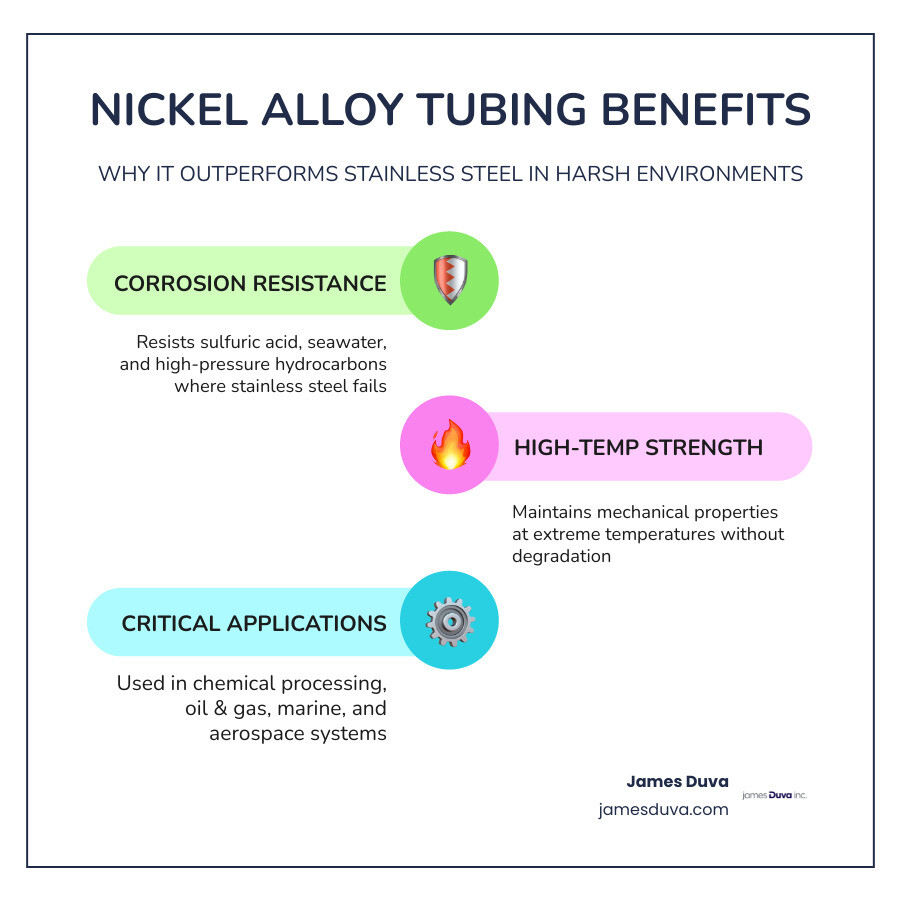
When dealing with highly corrosive media — sulfuric acid, seawater, high-pressure hydrocarbons — standard carbon steel or even stainless steel may simply not be enough. Nickel alloys hold their mechanical properties and resist chemical attack at temperatures and pressures that would degrade lesser materials. That combination of durability and chemical inertness is exactly why engineers in chemical processing and oil and gas rely on nickel alloy tubing as a go-to material for critical piping systems.
I’m Billy Walker, Vice President of James Duva Inc., where I’ve spent years helping industrial professionals source specialty nickel alloy tubing and high-grade stainless steel products for the power, process, and water treatment sectors. In the guide below, I’ll walk you through everything — from manufacturing standards and alloy grades to mechanical properties, testing requirements, and how to order correctly.
Nickel alloy tubing terms to learn:
Why Are Alloys So Valuable in Industry?
To understand why nickel alloy tubing is so critical, we first have to look at the fundamental chemistry of metals. Pure metals, such as pure iron, are often too soft for heavy industrial use. Furthermore, pure iron is highly susceptible to rust and oxidation when exposed to moisture and oxygen.
By combining different metallic elements, we create alloys. Alloys alter the crystalline structure of the base metal, introducing elements that block the movement of atoms under stress. This results in superior strength, higher durability, and dramatically improved resistance to chemical degradation. For example, adding carbon to iron gives us steel, and adding chromium and nickel to steel gives us stainless steel.
In demanding industrial fields, alloys are utilized across several sectors:
- Construction: Heavy structural beams and specialized piping require high-yield strength to support massive architectural loads.
- Oil & Gas: Severe downhole conditions demand robust fittings, flanges, and high-pressure tubing that won’t degrade under sour gas exposure.
- Automotive & Aerospace: Engine components, exhaust systems, and structural frames must survive extreme thermal cycles and mechanical stress.
- Medical & Consumer Goods: Biocompatible implants and durable kitchenware rely on alloys to prevent wear and resist localized corrosion.
While stainless steel is an excellent general-purpose material, there are times when industrial environments require even higher performance. To understand when to step up from standard steel, you can read our guide on When to Choose Nickel Alloys Over Stainless Steel in Industrial Applications.
Manufacturing Processes: Welded vs. Seamless Nickel Alloy Tubing
Choosing between welded and seamless nickel alloy tubing is one of the most important decisions in the engineering phase. The manufacturing process directly affects the mechanical integrity, maximum pressure limits, and cost of the piping system.
The primary standards governing these products are:
- ASTM B725: The standard specification for welded nickel and nickel-copper alloy pipe.
- ASTM B423: The standard specification for nickel-iron-chromium-molybdenum-copper alloy seamless pipe and tube.
For a deeper dive into the specific compliance standards, you can review the official documents for Welded Nickel (UNS N02200/UNS N02201) and Nickel Copper Alloy (UNS N04400) Pipe and Nickel-Iron-Chromium-Molybdenum-Copper Alloy (UNS N08825, N08221, and N06845) Seamless Pipe and Tube.
Welded Pipe Manufacturing (ASTM B725)
Welded nickel alloy pipe under ASTM B725 begins as flat-rolled sheet or strip. The alloy strip is formed into a cylindrical shape and welded using an automatic welding process. Crucially, this automatic welding is performed without the addition of filler metal.
Because welding introduces localized heat that can alter the grain structure of the metal, the pipe must be cold worked after welding and before final heat treatment. This cold working step is vital because it recrystallizes the weld zone, aligning its corrosion resistance and mechanical properties directly with the base metal.
To achieve a clean, scale-free finish without the need for subsequent chemical descaling, manufacturers often utilize bright annealing. For highly critical systems, purchasers can specify supplementary requirements, such as:
- No cold working of the weld.
- No final heat treatment.
- The addition of filler metal during welding (for specific structural designs).
If you want to understand how pure nickel grades perform in welded configurations, check out our resource on Nickel 200 Pipe Purity Performance and Piping Hot Benefits.
Seamless Pipe Manufacturing (ASTM B423)
Seamless tubing under ASTM B423 is manufactured without any welded seams, eliminating the risk of weld-zone failures. The process begins with a solid billet of nickel alloy, which is heated and extruded or rotary-pierced to form a hollow shell.
From there, the tube undergoes cold drawing or cold reducing to achieve its final dimensions. This cold working process refines the grain structure and increases the material’s mechanical strength. Finally, the tube is hot finished or cold finished and annealed to relieve internal stresses.
Because there is no weld seam, seamless pipe offers superior pressure-retaining capabilities and structural integrity, making it the preferred choice for high-pressure, hazardous, and deep-water oil and gas extraction environments. To learn more about the raw materials that feed into these processes, read about Nickel Alloy Round Rod and Bar Inconel Hastelloy and Beyond.
Chemical and Mechanical Specifications of Nickel Alloys
Different industrial challenges require different chemical recipes. ASTM B725 and ASTM B423 cover several distinct high-performance nickel alloy grades, each engineered to combat specific corrosive elements and mechanical stresses.
| UNS Designation | Common Name | Principal Elements | Primary Benefit |
|---|---|---|---|
| UNS N02200 | Nickel 200 | Min 99.0% Ni | Exceptional resistance to caustic alkalis and high purity. |
| UNS N02201 | Nickel 201 | Min 99.0% Ni, Max 0.02% C | Low-carbon version of Nickel 200; prevents graphite precipitation at high temperatures. |
| UNS N04400 | Monel 400 | 63.0% Min Ni, 28.0%–34.0% Cu | Outstanding resistance to marine environments and hydrofluoric acid. |
| UNS N08825 | Alloy 825 | 38.0%–46.0% Ni, 19.5%–23.5% Cr, Min 22.0% Fe | Superior resistance to sulfuric and phosphoric acids. |
| UNS N08221 | Alloy 821 | Ni-Fe-Cr-Mo-Cu | High resistance to stress corrosion cracking in chloride environments. |
| UNS N06845 | Alloy 6845 | Ni-Fe-Cr-Mo-Cu | Ultra-high yield strength and extreme resistance to localized pitting. |
Corrosion-Resistant Properties of Nickel Alloy Tubing
The chemical compositions of these alloys dictate where they can be safely deployed:
- UNS N02200 (Nickel 200): Known for its high purity, it offers excellent resistance to neutral and alkaline salt solutions. To master the technical terms associated with this grade, consult our Nickel 200 Properties Step by Step Guide to Terms Demystified.
- UNS N02201 (Nickel 201): The low-carbon version of Nickel 200. At temperatures above 600°F (315°C), carbon in standard Nickel 200 can precipitate as graphite, severely embrittling the metal. UNS N02201 keeps carbon to a maximum of 0.02%, preserving ductility at high temperatures.
- UNS N04400 (Monel 400): This nickel-copper alloy is highly resistant to rapidly flowing seawater, making it a staple in marine engineering. It also resists sulfuric, phosphoric, and hydrochloric acids under reducing conditions.
- UNS N08825 (Alloy 825): With a high nickel content, this alloy resists chloride-ion stress corrosion cracking. The addition of molybdenum and copper allows it to withstand aggressive reducing acids, while chromium provides resistance to oxidizing environments.
Mechanical Properties of Nickel Alloy Tubing by Grade
The mechanical properties of nickel alloy tubing vary depending on the alloy grade, manufacturing process, and heat treatment condition (such as annealed versus stress-relieved).
- UNS N02200 (Welded, Annealed): Has a minimum tensile strength of 55,000 psi (380 MPa) for sizes 5 inches (127 mm) and under in outside diameter.
- UNS N02200 (Welded, Stress-Relieved): Exhibits a minimum tensile strength of 65,000 psi (450 MPa) and a minimum yield strength of 40,000 psi (275 MPa).
- UNS N04400 (Welded, Annealed): Has a minimum tensile strength of 70,000 psi (480 MPa) and a minimum elongation of 35% in 2 inches (or 50 mm) for sizes 5 inches and under.
- UNS N08825 (Seamless, Cold-Worked Annealed): Delivers a minimum tensile strength of 85 ksi (586 MPa) and a minimum yield strength of 35 ksi (241 MPa).
- UNS N08825 (Seamless, Hot-Finished Annealed): Requires a minimum elongation of 30% in 2 inches (or 50 mm).
- UNS N06845 (Seamless, Cold-Finished Annealed): Achieves a minimum tensile strength of 100 ksi (690 MPa) and a minimum yield strength of 40 ksi (276 MPa).
These high mechanical thresholds are why nickel alloys are so widely used in critical, high-stress aerospace components. Learn more about these applications in our guide on Nickel Based Alloys in the Aerospace Industry.
Dimensional Tolerances and Converter Sizes
To ensure that pipes and tubes fit perfectly into complex industrial systems, ASTM standards specify strict limits on dimensional variations:
- Outside Diameter (OD): Permissible variations are tightly controlled based on the nominal size of the pipe.
- Wall Thickness: For welded nickel alloy pipe (ASTM B725), the wall thickness must not vary from the nominal thickness by more than ±12.5%.
- Length and Straightness: Standard cut lengths and straightness tolerances must conform to the general requirements of ASTM B829.
Converter Sizes
For small-diameter and light-wall tubing (typically 1.25 inches or 31.8 mm and under in outside diameter), ASTM B423 defines “converter sizes.” Because these tubes undergo extensive cold-drawing passes, they have distinct tolerances and mechanical properties. In converter sizes, the material is categorized by temper:
- No. 1 Temper: Annealed condition.
- No. 2 Temper: Half-hard condition.
- No. 3 Temper: Full-hard condition.
Testing, Quality Control, and Procurement Requirements
Because nickel alloy tubing is frequently used in high-risk environments, quality control testing is non-negotiable.

Both ASTM B725 and ASTM B423 require rigorous testing to ensure structural integrity. To understand why these quality controls are so critical for auxiliary components, read Why Nickel Alloy Fittings Are Essential for Demanding Environments.
Hydrostatic Testing and Allowable Fiber Stress
Every length of pipe or tube must undergo testing to verify it is leak-free. Under ASTM B725, testing is divided into two categories:
- Category 1: The pipe must undergo a hydrostatic, eddy-current, or ultrasonic test at the manufacturer’s option.
- Category 2: The pipe must undergo a hydrostatic test plus either an eddy-current or ultrasonic test.
For hydrostatic testing, the test pressure is calculated using the standard formula:
$$P = frac{2St}{D}$$
Where:
- $P$ = hydrostatic test pressure (psi or MPa)
- $S$ = allowable fiber stress (psi or MPa)
- $t$ = specified wall thickness (in. or mm)
- $D$ = specified outside diameter (in. or mm)
The allowable fiber stress ($S$) varies significantly by alloy and condition:
- Annealed Nickel (UNS N02200): Allowable fiber stress of 10,000 psi (70 MPa) for sizes 5 inches and under.
- Cold-Worked Annealed Alloy 825 (UNS N08825): Allowable fiber stress of 21,200 psi (146 MPa).
Under ASTM B423, the manufacturer and purchaser can agree to perform hydrostatic testing at up to 1.5 times the standard allowable fiber stress for extreme high-pressure validation. Any tube exhibiting leaks or permanent deformation is immediately rejected.
Mechanical Deformation Tests for Welded Pipe
Welded pipe must undergo physical deformation tests to ensure the weld zone is as strong as the base metal:
- Flattening Test: A section of the pipe is flattened laterally between parallel plates. The weld must be positioned 90 degrees from the direction of the applied force to ensure the weld joint itself is subjected to maximum bending stress.
- Transverse Guided Bend Test: At the manufacturer’s option, a transverse guided bend test can be substituted for the flattening test. This test physically bends a specimen of the pipe weld around a mandrel to inspect for cracking or weld separation.
- Product Analysis: A chemical check analysis can be performed on the finished tube to verify that the chemical composition remains within the strict limits of the standard.
Procurement and Ordering Guidelines
When sourcing nickel alloy tubing in July 2026, clear procurement specifications are essential to avoid project delays or material non-compliance. When placing an order under ASTM B725 or ASTM B423, the purchaser must specify:
- Alloy Name or UNS Number: (e.g., UNS N04400, UNS N08825).
- ASTM Standard: (e.g., ASTM B725 or ASTM B423).
- Dimensions: Nominal pipe size (NPS) and Schedule (per ANSI B36.19), or precise outside diameter and wall thickness.
- Condition: Annealed, stress-relieved, cold-worked, or hot-finished.
- Testing Requirements: Specify Category 1 or Category 2 testing for welded pipe, or indicate a preference for hydrostatic vs. nondestructive electric testing.
- Certification: Specify whether a certified material test report (MTR) or product analysis is required.
To streamline this process, you can read our professional sourcing guide: 5 Ways to Find Nickel Alloy Suppliers Like a Pro.
Frequently Asked Questions about Nickel Alloy Tubing
What is the difference between ASTM B725 and ASTM B423?
ASTM B725 covers welded nickel (UNS N02200, N02201) and nickel-copper (UNS N04400) pipes, which are manufactured from flat-rolled strip and welded without filler metal. ASTM B423 covers seamless nickel-iron-chromium-molybdenum-copper (UNS N08825, N08221, N06845) pipes and tubes, which are extruded and cold drawn without any weld seams. Seamless pipes generally support higher operating pressures, while welded pipes are typically more cost-effective for larger diameters.
Can Schedules 5S and 10S nickel alloy pipes be threaded?
No. The wall thicknesses of Schedule 5S and Schedule 10S pipes are too thin to permit safe threading in accordance with ANSI B1.20.1. Attempting to thread these light-wall pipes will compromise their structural integrity. Instead, these schedules must be joined using socket-weld or butt-weld fittings, or paired with high-performance Ball Valves using welded connections.
What are converter sizes in seamless nickel tubing?
Converter sizes refer to small-diameter and light-wall seamless tubing (1.25 inches and under in outside diameter) that has undergone specialized cold-drawing cycles. Because of the intensive cold working required to produce these small sizes, they have unique dimensional tolerances and are classified under specific temper designations (No. 1, No. 2, or No. 3 Temper) to match their mechanical strength to the application.
Conclusion
Sourcing the right piping material is a critical engineering decision. Whether your project requires welded nickel-copper pipe per ASTM B725 to survive marine corrosion, or seamless Alloy 825 per ASTM B423 to handle aggressive acids, understanding these technical standards ensures your systems remain safe, compliant, and highly durable.
Since 1978, James Duva Inc. has served as a trusted partner and one-stop shop for high-grade stainless steel and nickel alloy industrial products. Operating out of our facility in Branchburg, NJ, we specialize in supplying fully certified materials to demanding sectors like chemical processing, oil and gas, and water treatment.
To simplify your procurement process, check out our guide on One Stop Solution Sourcing Stainless Steel and Nickel Alloy Products Made Easy or read our A-Z Guide to Nickel Alloy Suppliers.
If you’re ready to secure high-performance piping and tubing that meets the most rigorous ASTM standards, explore our options for Sourcing High-Grade Tubing Solutions or contact our team of specialists in New Jersey today.
About James Duva Inc.
Since 1978, James Duva Inc. has been your trusted source for stainless steel and high-nickel alloy industrial products. Whether you’re in the water treatment, process or power industry, we pride ourselves on always having what you need. Say goodbye to your sourcing problems with just one call to James Duva.