
The Chemistry of Corrosion: Why Chemical Processing Demands 316 Stainless Steel

Jun 22, 2026
Why 316 Stainless Steel Is the Go-To Material for Chemical Processing
316 stainless steel chemical processing applications demand a material that can take a beating — constant exposure to acids, chlorides, high temperatures, and aggressive cleaning cycles — without failing. That material is almost always 316 stainless steel.
Here’s a quick summary of why 316 stainless steel dominates chemical processing:
| Factor | What It Means for Chemical Processing |
|---|---|
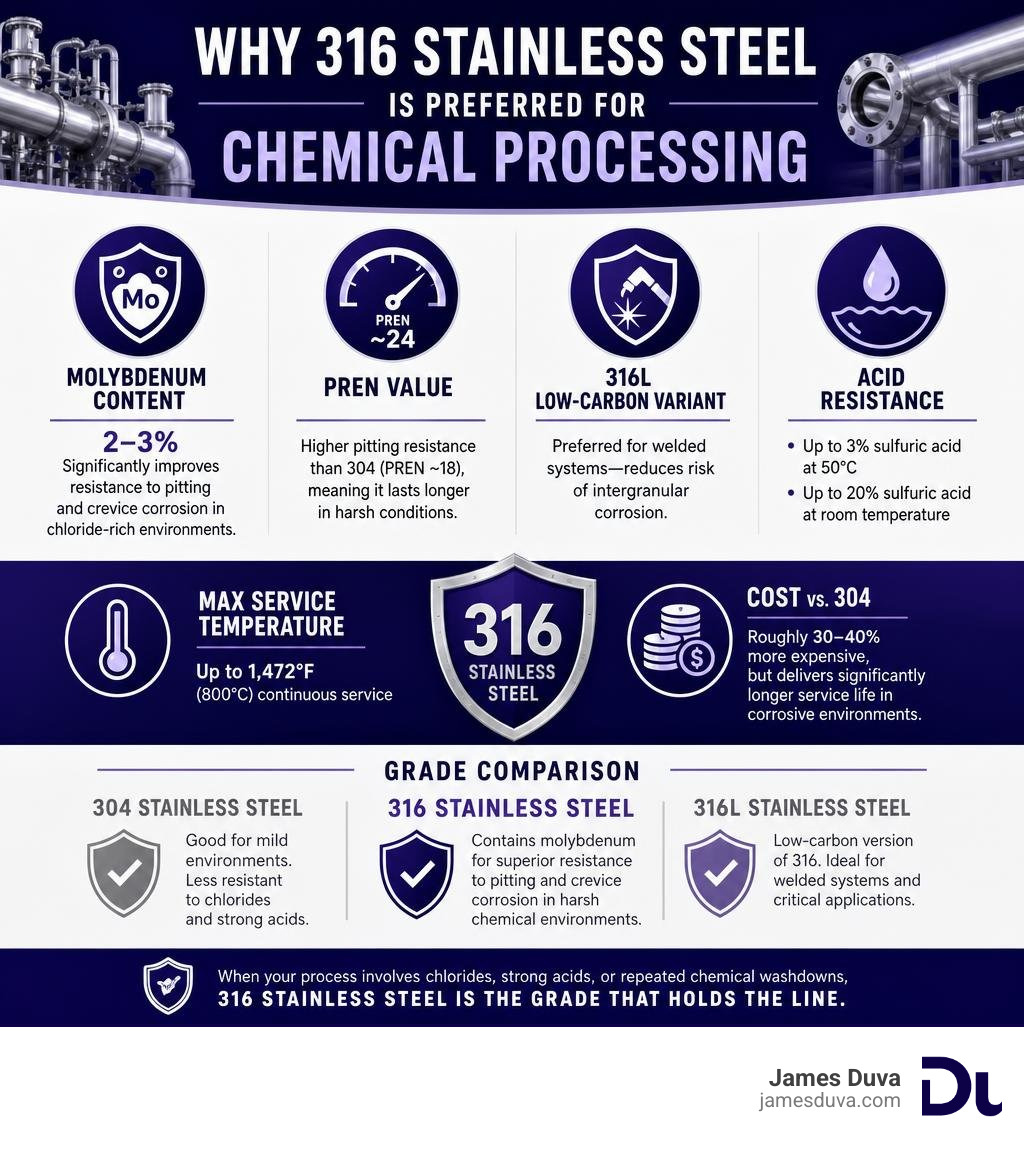
| Molybdenum content (2-3%) | Significantly improves resistance to pitting and crevice corrosion in chloride-rich environments |
| PREN value ~24 | Higher pitting resistance than 304 (PREN ~18), meaning it lasts longer in harsh conditions |
| 316L low-carbon variant | Preferred for welded systems — reduces risk of intergranular corrosion |
| Acid resistance | Handles up to 3% sulfuric acid at 50°C and 20% sulfuric acid at room temperature |
| Max service temperature | Up to 1,472°F (800°C) continuous service |
| Cost vs. 304 | Roughly 30-40% more expensive, but delivers significantly longer service life in corrosive environments |
Pure iron corrodes quickly. Grade 304 stainless handles mild conditions well. But when your process involves chlorides, strong acids, or repeated chemical washdowns, 316 is the grade that holds the line.
The difference often comes down to one element: molybdenum. Without it, even a good austenitic stainless steel can pit and fail in months. With it, you get a material engineered to survive the environments that destroy lesser alloys.
I’m Billy Walker, Vice President of James Duva Inc., where I’ve spent years helping engineers and procurement professionals in the power, process, and water treatment industries source the right specialty alloys — including 316 stainless steel for chemical processing applications — from trusted domestic manufacturers. If you’re specifying materials for a corrosive chemical system, this guide covers everything you need to make the right call.
316 stainless steel chemical processing vocab explained:
Why Are Alloys So Valuable in Industry?
In industrial settings, pure metals are rarely up to the task. While pure iron is abundant, it is inherently soft, mechanically weak, and highly susceptible to rust when exposed to oxygen and moisture. To build systems that can withstand high pressures, extreme temperatures, and aggressive chemical environments, we rely on alloy engineering. By combining pure metals with other elements, metallurgists create materials with vastly superior structural integrity, tensile strength, and corrosion resistance.
To understand how these altered metals perform under stress, you can read our In-Depth Guide to Stainless Steel Alloy Properties.
Pure Metals vs. Alloys
The difference between pure metals and alloys lies in their microscopic chemical bonding and lattice structures. In a pure metal like iron, the atoms are arranged in a highly regular, uniform lattice. Because the atoms are all the same size, the planes of atoms can easily slide past one another when force is applied, making the metal soft and easily deformable.
When we introduce alloying elements, we disrupt this uniform lattice. For example, adding carbon to iron creates carbon steel, where the smaller carbon atoms wedge themselves into the gaps of the iron lattice, locking the planes in place and significantly increasing mechanical strength.
To achieve corrosion resistance, we add chromium. When chromium is introduced to the alloy at a minimum concentration of 10.5%, it reacts with atmospheric oxygen to form an ultra-thin, self-healing passive chromium oxide layer on the metal’s surface. This passive layer acts as an impermeable barrier, preventing oxygen and corrosive chemicals from reaching the underlying steel.
Key Industrial Applications of Alloys
Alloys are the backbone of modern infrastructure, with distinct formulations tailored to specific demands across multiple sectors:
- Construction: Heavy-duty structural steel beams and concrete reinforcing bars provide the load-bearing capacity required for high-rise buildings and bridges, while stainless steel piping ensures durable fluid transport.
- Oil & Gas: High-strength low-alloy (HSLA) steels and nickel alloys are fabricated into specialized fittings, flanges, and downhole tools capable of resisting extreme pressures and sour gas environments.
- Automotive & Aerospace: Titanium, aluminum, and advanced high-strength steel alloys are utilized to construct lightweight vehicle frames and high-temperature jet engine components where failure is not an option.
- Medical & Consumer Goods: Biocompatible cobalt-chrome and titanium alloys are used for surgical implants, while standard stainless steel alloys form hygienic kitchenware and food processing lines.
For a broader look at how these materials are distributed across various sectors, check out our guide on Stainless Steel Applications for Every Industry.
The Science of Corrosion in 316 Stainless Steel Chemical Processing
Chemical processing plants are hotbeds for material degradation. Systems are continuously exposed to aggressive acids, alkalis, and chloride-rich process fluids. When stainless steel is specified for these environments, it must maintain its passive oxide layer under constant chemical attack. If the passive layer is compromised, rapid chemical degradation can occur, leading to catastrophic leaks, product contamination, and unscheduled shutdowns.
To navigate the initial phases of material selection for these environments, you can consult our resource on How to Select the Right Stainless Steel Grade for Chemical Processing Plants.

Molybdenum and Pitting Resistance in 316 Stainless Steel Chemical Processing
In environments containing chlorides—such as brine solutions, marine atmospheres, or chlorinated solvents—standard stainless steels are highly vulnerable to localized corrosion. Chloride ions are uniquely aggressive; they penetrate the passive chromium oxide layer at microscopic weak points, initiating localized attack. This results in pitting and crevice corrosion, where deep, narrow cavities form rapidly while the rest of the surface remains completely untouched.
The addition of 2% to 3% molybdenum in 316 stainless steel chemical processing systems is what mitigates this vulnerability. Molybdenum stabilizes the passive film, making it significantly more robust against chloride penetration.
To quantify a material’s resistance to localized chloride attack, metallurgists use the Pitting Resistance Equivalent Number (PREN), calculated using the following formula:
$$text{PREN} = % text{Cr} + 3.3 times % text{Mo} + 16 times % text{N}$$
Standard 304 stainless steel, which lacks molybdenum, typically yields a PREN of 18 to 20. In contrast, 316 stainless steel achieves a PREN of 23 to 30. This higher value reflects its superior ability to resist pitting and crevice corrosion in stagnant, chloride-rich process streams.
To dive deeper into how this metallurgy translates to real-world performance, see our 316 Stainless Steel Corrosion Resistance In-Depth Guide to Performance.
Comparing 316 vs 304 in Corrosive Environments
When comparing 304 and 316 stainless steel, the decision frequently comes down to a balance between upfront material cost and long-term service life. Grade 304 is the workhorse of the sanitary and food industries, offering excellent formability and moderate corrosion resistance at a lower price point. However, in the presence of aggressive chemicals or chloride concentrations exceeding 200 ppm, 304 can pit and fail within months.
While 316 stainless steel typically carries a 30% to 40% price premium over 304, this cost is easily justified in harsh chemical environments. Choosing 316 over 304 can double or triple the service life of process piping, heat exchangers, and storage vessels, drastically reducing maintenance overhead and preventing costly environmental cleanups.
For a practical look at how these two materials compare under hygienic and industrial washdown conditions, you can read the Practical Comparison of AISI 316L vs AISI 304 by NHK Group. For detailed technical data on how both grades perform under CNC machining and fabrication, refer to the 304 vs 316 Stainless: Corrosion & CNC Guide (2026).
To explore the broader spectrum of stainless alloys beyond these two standard grades, read our Detailed Guide to Stainless Steel Types.
Decoding the 316 Family: 316, 316L, 316H, and 316Ti
The standard 316 grade belongs to the austenitic family of stainless steels, known for their excellent ductility, toughness, and non-magnetic properties in the annealed state. Over time, specialized variations of the chemistry have been developed to address specific engineering challenges, such as weld sensitization, high-temperature creep, and intergranular corrosion.
| Grade | Carbon (C) | Chromium (Cr) | Nickel (Ni) | Molybdenum (Mo) | Other Elements | Key Mechanical Properties | Primary Use Case |
|---|---|---|---|---|---|---|---|
| 316 | 0.08% max | 16.0 – 18.0% | 10.0 – 14.0% | 2.0 – 3.0% | — | Tensile: 515 MPa Yield: 205 MPa |
General chemical processing, non-welded parts |
| 316L | 0.03% max | 16.0 – 18.0% | 10.0 – 14.0% | 2.0 – 3.0% | — | Tensile: 485 MPa Yield: 170 MPa |
Welded vessels, heavy-wall piping, sanitary systems |
| 316H | 0.04 – 0.10% | 16.0 – 18.0% | 10.0 – 14.0% | 2.0 – 3.0% | — | Tensile: 515 MPa Yield: 205 MPa |
High-temperature reactors, power generation |
| 316Ti | 0.08% max | 16.0 – 18.0% | 10.0 – 14.0% | 2.0 – 3.0% | Ti: $5 times (text{C}+text{N})$ min to 0.70% max | Tensile: 515 MPa Yield: 205 MPa |
High-temperature welded parts, acidic exhaust systems |
Selecting the Right Grade for 316 Stainless Steel Chemical Processing
Choosing the correct variant within the 316 family is critical to ensuring the structural integrity of your system:
- 316L (Low Carbon): When standard 316 is welded, the high heat causes carbon to react with chromium, forming chromium carbides along the grain boundaries. This process, known as sensitization, depletes the surrounding metal of chromium, leaving the weld heat-affected zone (HAZ) highly vulnerable to intergranular corrosion. By limiting carbon to 0.03% maximum, 316L prevents carbide precipitation, making it the industry standard for welded chemical processing systems. For an exhaustive breakdown of this dynamic, read our Detailed Guide to 316L vs 316 Stainless Steel.
- 316H (High Carbon): In high-temperature applications exceeding 1,000°F (538°C), low-carbon grades lack the necessary mechanical strength. The higher carbon content of 316H provides superior creep strength and elevated-temperature tensile properties, making it ideal for thermal reactors and high-temperature pressure vessels.
- 316Ti (Titanium Stabilized): This grade introduces a small amount of titanium, which has a much higher affinity for carbon than chromium does. Titanium carbides form preferentially, leaving the chromium in solution to maintain the passive layer. This stabilization allows 316Ti to resist sensitization during extended exposure to elevated temperatures in the 800°F to 1500°F (427°C to 816°C) range.
Mechanical Properties and Chemical Composition
Understanding the mechanical baselines of these materials is essential for pressure vessel design and piping layouts. Standard 316 offers a minimum yield strength of 205 MPa (30 ksi) and a minimum tensile strength of 515 MPa (75 ksi) in the annealed condition. While the low-carbon 316L variant exhibits slightly lower strength values in its fully annealed state, it can be cold-worked to achieve higher mechanical properties.
These alloys maintain their structural stability and oxidation resistance up to a maximum service temperature of approximately 1,472°F (800°C) for continuous service, though allowable design stresses decrease significantly at elevated temperatures under ASME codes.
To compare these mechanical limits against ferritic, martensitic, and duplex alloys, refer back to our Detailed Guide to Stainless Steel Types.
Fabrication, Surface Finish, and Maintenance Best Practices
The performance of 316 stainless steel in chemical processing is determined not only by its alloy composition but also by how it is fabricated, finished, and maintained. Poor welding practices, rough surface finishes, or inadequate post-fabrication cleaning can compromise even the highest-grade alloys, leading to premature localized failures.
To see how these manufacturing choices impact long-term operations across various industries, read our guide on Stainless Steel Applications for Every Industry.
Welding Quality and the Role of L-Grades
During the welding of stainless steel, the material adjacent to the weld bead is subjected to temperatures within the sensitization range of 800°F to 1500°F (427°C to 816°C). In standard 316, this thermal exposure results in chromium carbide precipitation within the heat-affected zone (HAZ). Under corrosive service conditions, these sensitized zones can experience rapid intergranular attack, causing the joint to fail while the weld metal and the base plate remain completely unaffected.
Using low-carbon 316L filler metals and base plates is the primary method for preventing this issue. The reduced carbon content slows the kinetics of carbide formation, ensuring the weldment remains corrosion-resistant without requiring post-weld solution annealing.
When designing high-pressure piping systems, specifying ASTM A312 TP316L seamless or welded tubing ensures that both the longitudinal and field welds maintain the necessary resistance to localized corrosion. For more technical details on specifying tubing for demanding fluid systems, consult Stainless Steel Tubing and Aluminum Tubing for Chemical Processing.
Surface Finish, Passivation, and Cleanability
The surface finish of a stainless steel component directly influences its cleanability and resistance to localized corrosion. Rough surfaces with high Roughness Average (Ra) values contain microscopic crevices where process chemicals, chlorides, and particulate matter can accumulate. Over time, these stagnant pockets deplete local oxygen levels, preventing the passive layer from reforming and initiating crevice corrosion.
For aggressive chemical environments, specifying smooth surface finishes—such as those achieved through mechanical polishing or electropolishing—is highly recommended. Electropolishing chemically removes microscopic high points, leaving a smooth, mirror-like finish that minimizes chemical adhesion and facilitates effective Clean-in-Place (CIP) cycles.
To understand how surface finishes are specified for industrial vessels, you can read Choosing the Best Stainless Steel Tank for Your Operations and explore options for Stainless Steel Chemical Tanks.
Following fabrication, machining, or welding, the stainless steel surface must undergo a chemical passivation treatment. Machining tools and steel handling equipment can leave trace amounts of free iron embedded in the stainless steel surface. If left untreated, this free iron will rust in moist environments, disrupting the surrounding passive film and initiating localized pitting.
Passivation typically involves treating the fabricated component with a nitric or citric acid solution to dissolve surface contaminants and free iron, followed by thorough rinsing. This process accelerates the natural formation of a clean, continuous, and highly protective chromium oxide passive layer.
To learn more about industrial surface processing capabilities, you can visit Amerinox Processing or look into localized New Jersey metal finishing services at Stainless Steel Processing | New Jersey. For sourcing verified, pre-finished materials, you can search the 316 Stainless Steel Manufacturers Suppliers Directory.
Frequently Asked Questions about 316 Stainless Steel
What is the main difference between 304 and 316 stainless steel?
The primary difference is the addition of 2% to 3% molybdenum in 316 stainless steel. This single alloying element raises the material’s Pitting Resistance Equivalent Number (PREN) from approximately 18 to 24, providing vastly superior resistance to chloride-induced pitting and crevice corrosion compared to 304. While 316 carries a 30% to 40% cost premium, it is required for environments involving salt spray, chlorinated solvents, or chemical washdowns.
When is Alloy 20 preferred over 316L in chemical processing?
While 316L offers excellent resistance to organic acids and dilute mineral acids, it struggles in highly aggressive acidic environments, particularly sulfuric acid. Alloy 20—a nickel-iron-chromium austenitic alloy stabilized with niobium—contains higher levels of nickel, chromium, and copper. It is specifically formulated to withstand boiling sulfuric acid up to 40% concentration, making it the preferred choice for sulfuric acid processing, pickling lines, and highly aggressive chemical reactors where 316L would experience rapid uniform corrosion.
Why is passivation necessary after machining or welding 316 stainless steel?
Passivation is a critical post-fabrication chemical treatment that restores the material’s protective passive layer. During machining, cutting, or welding, the surface of the stainless steel can become contaminated with free iron from tooling. If this iron is not removed, it will oxidize in service, creating localized galvanic cells that break down the passive chromium oxide layer and initiate pitting. Passivation with nitric or citric acid cleanly dissolves this surface iron without attacking the underlying alloy, ensuring a continuous, corrosion-resistant surface.
Conclusion
Selecting the right materials for highly corrosive environments is a balance of metallurgy, fabrication quality, and long-term cost management. Grade 316 stainless steel, with its targeted molybdenum addition, remains the baseline standard for chemical processing systems, protecting critical infrastructure from localized pitting, crevice corrosion, and premature failure.
At James Duva Inc., based in Branchburg, NJ, we have been delivering high-grade stainless steel and nickel alloy industrial products since 1978. As a trusted one-stop shop with decades of specialized expertise, we supply the piping, fittings, flanges, and high-performance Ball Valves required to keep your chemical systems running safely and efficiently.
For additional engineering guidelines and research on materials used in high-consequence industries, you can review this US Government research report.
If you are currently sourcing materials or mapping out your next project, read The Complete Guide to Stainless Steel Suppliers or explore our extensive range of technical resources in our Stainless Steel Category. Contact our team in Branchburg, New Jersey, to discuss your specific alloy requirements today.
About James Duva Inc.
Since 1978, James Duva Inc. has been your trusted source for stainless steel and high-nickel alloy industrial products. Whether you’re in the water treatment, process or power industry, we pride ourselves on always having what you need. Say goodbye to your sourcing problems with just one call to James Duva.