
Why Engineers Trust Monel 400 When Ordinary Stainless Steel Fails
Oct 29, 2026
Why Engineers Choose Monel 400 for Harsh Environments
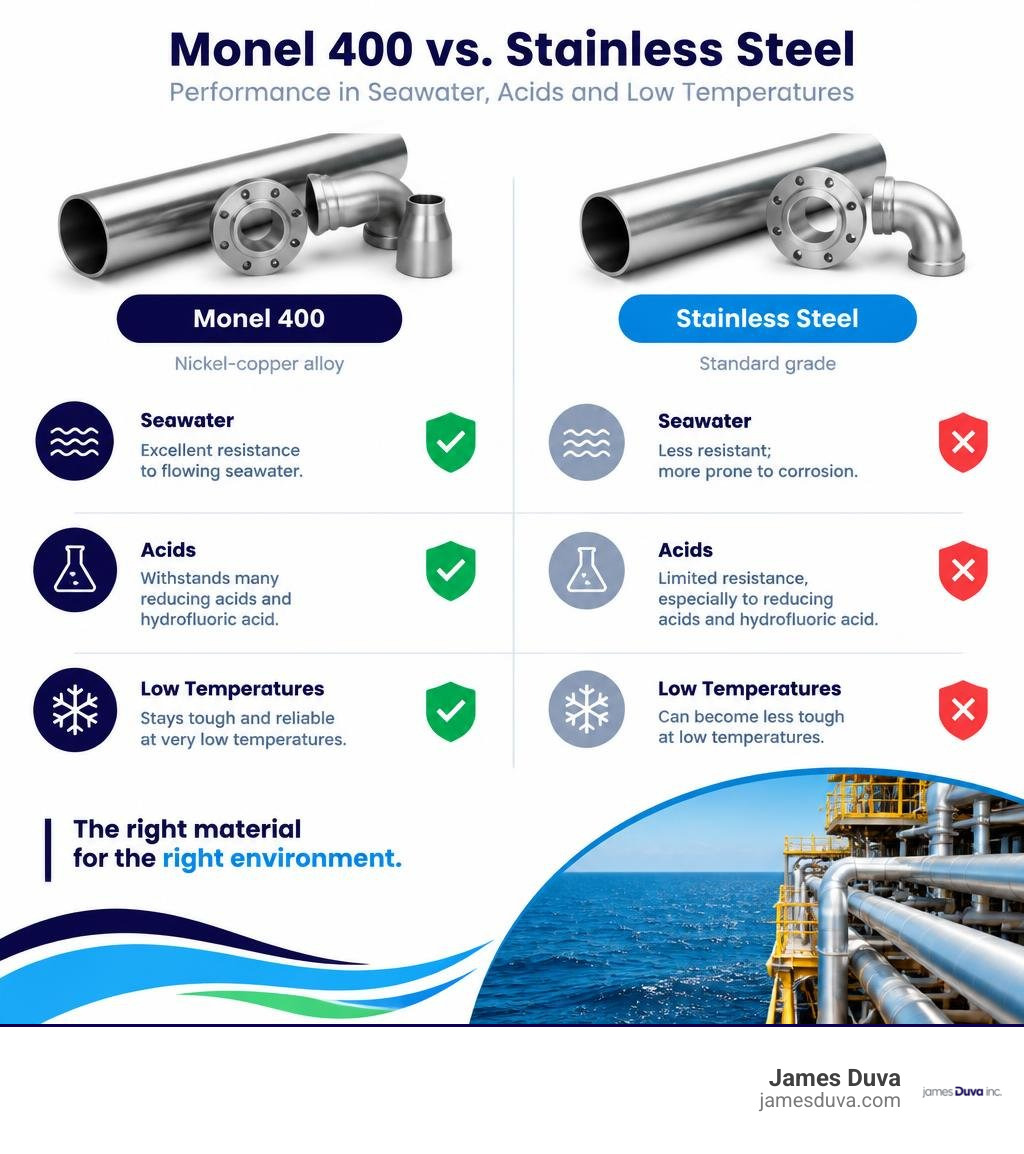
Monel 400 is a nickel-copper alloy used when corrosion makes ordinary stainless steel a poor choice. It resists flowing seawater, many reducing acids, and hydrofluoric acid, while staying tough at very low temperatures. Engineers use it for pump shafts, valves, piping, and heat exchangers. It is not immune to corrosion: stagnant seawater can cause localized attack, so the service conditions still matter.
The right choice also depends on the strength, product form, and fabrication method your project needs. This guide covers those factors so you can judge where Monel 400 fits.
I’m Billy Walker, Vice President of James Duva Inc. My experience helping industrial customers source specialty piping components and high-nickel alloys shapes this practical look at Monel 400.
Why Are Alloys So Valuable in Industry?
Pure elemental metals possess distinct, highly specific atomic structures, but they rarely deliver the balanced performance required in modern industrial engineering. Pure metals like iron are often too soft or prone to rust, whereas alloys like steel offer superior strength and durability. To build lasting systems, engineers turn to alloying—combining base metals with carefully measured elements to achieve enhanced mechanical strength, thermal stability, and environmental resistance.
In broad industrial applications, selecting the appropriate material system is critical:
- Construction: Structural beams and heavy utility piping rely on carbon and alloy steels to handle massive load-bearing stresses without premature failure.
- Oil & Gas: Severe downhole and refining environments demand corrosion-resistant fittings, flanges, and robust piping to prevent catastrophic blowout and chemical attack.
- Automotive & Aerospace: Airframes, vehicle frames, and high-performance engines require lightweight, heat-tolerant superalloys to maintain structural integrity under extreme thermal cycling.
- Medical & Consumer Goods: Specialized biocompatible alloys and stainless formulations are essential for surgical implants and sanitary commercial kitchenware.
While standard stainless steels introduce chromium to form a protective oxide film, harsh industrial processes often exceed their performance thresholds. In reducing chemical solutions or dynamic marine environments, understanding when to consider upgrading from stainless steel to nickel alloys helps avoid unexpected downtime and structural degradation. Solid-solution nickel-copper formulations eliminate the vulnerabilities inherent to standard austenitic steels.
Chemical Composition and Mechanical Properties of Monel 400
Monel 400 (designated as UNS N04400, Werkstoff 2.4360, and NiCu30Fe-Alloy400) is a single-phase, solid-solution binary alloy. Its face-centered cubic (FCC) lattice structure, with a lattice parameter of 3.534 Å, provides remarkable structural stability across wide temperature spectrums.
The primary matrix consists of approximately two-thirds nickel and one-third copper. Controlled additions of iron and manganese refine the grain boundary structure and improve tensile response, while trace amounts of carbon, silicon, and sulfur are kept strictly within metallurgical thresholds to prevent embrittlement.
| Element | ASTM / ASME Composition Limits (wt%) |
|---|---|
| Nickel (Ni + Co) | 63.0% min. |
| Copper (Cu) | 28.0% – 34.0% |
| Iron (Fe) | 2.5% max. |
| Manganese (Mn) | 2.0% max. |
| Carbon (C) | 0.3% max. |
| Silicon (Si) | 0.5% max. |
| Sulfur (S) | 0.024% max. |
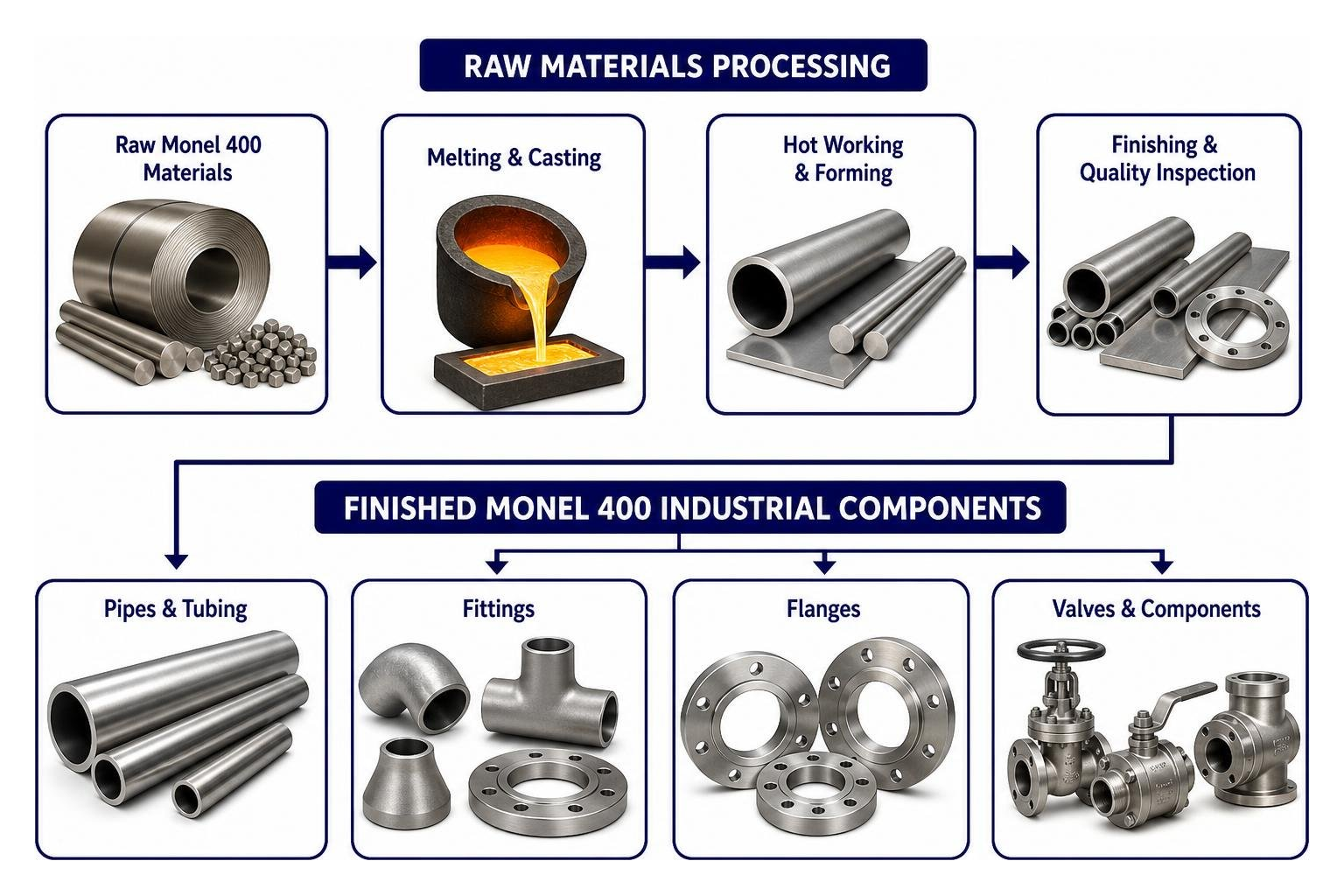
Standard manufacturing governed by ASTM/ASME specifications ensures uniform metallurgical properties across product forms, including ASTM B127 for plate/sheet/strip, ASTM B164 for nickel alloy round rod and bar, and ASTM B165 for seamless pipe and nickel alloy tubing.
Physical and Mechanical Characteristics
Because Alloy 400 is a single-phase solid-solution alloy, it cannot be strengthened or hardened via thermal precipitation treatments. Increased mechanical properties are achieved exclusively through cold work:
- Density: 8.80 g/cm³ (0.318 lb/in³)
- Modulus of Elasticity (Tension): 182 kN/mm² (26.0 × 10³ ksi)
- Poisson’s Ratio: 0.32
- Tensile Strength (Annealed Sheet): 70 – 85 ksi (482 – 586 MPa)
- Yield Strength (0.2% Offset, Annealed Sheet): 25 – 45 ksi (172 – 310 MPa)
- Elongation (Annealed Sheet): 35% – 50%
- Spring Temper Strip Tensile Strength: 100 – 140 ksi (690 – 965 MPa)
- Spring Temper Strip Yield Strength: 90 – 130 ksi (621 – 896 MPa)
- Hardness: 60 – 80 HRB in the annealed state; up to 20 – 30 HRC when heavily cold worked.
Thermal and Electrical Constants
Monel 400 maintains predictable thermal dissipation and electrical properties, making it useful in both structural and electrical hardware:
- Melting Range: 1300°C – 1350°C (2370°F – 2460°F)
- Thermal Conductivity (at 20°C / 70°F): 23.0 W/m·K (22.0 W/m·°C)
- Specific Heat (at 20°C / 70°F): 452 J/kg·K (0.102 Btu/lb/°F)
- Electrical Resistivity (at 20°C / 70°F): 51.3 µΩ·cm (0.511 µΩ·m)
- Electrical Conductivity: 19.8 MS/m (34.0% IACS)
- Mean Coefficient of Linear Thermal Expansion (0–100°C): 13.9 × 10⁻⁶/°C
- Curie Temperature: 20°C – 50°C (70°F – 120°F)
Because its Curie temperature range directly spans ambient room temperatures, subtle compositional variations dictate whether a given heat is slightly ferromagnetic or completely non-magnetic at room temperature.
Corrosion Resistance: How Alloy 400 Outperforms Stainless Steel

Austenitic stainless steels (such as 304 and 316) rely on a chromium-oxide passivation film. In the presence of aqueous chlorides, reducing acids, or severe mechanical stress, this passive layer breaks down, leading to rapid pitting, crevice attack, and chloride-induced stress corrosion cracking (SCC).
Monel 400 delivers superior resistance in non-oxidizing, reducing environments where standard steels fail. To review other alloys designed for aggressive chemicals, explore our comprehensive guide to corrosion-resistant nickel alloys.
| Environment / Medium | 316 Stainless Steel Performance | Monel 400 Performance | Primary Mechanism |
|---|---|---|---|
| Hydrofluoric Acid (all conc. up to boiling) | Rapid failure / severe dissolution | Superior resistance (<0.05 mm/yr) | Formation of stable nickel-copper fluoride passive barrier |
| Flowing Seawater (>1.5 m/s) | Moderate risk of localized pitting | Exceptional (<0.02 mm/yr) | Inherently low corrosion rate; anti-biofouling |
| Hot Chloride Solutions | High susceptibility to SCC | Fully immune to chloride SCC | Absence of critical chromium depletion zones |
| Boiling Sulfuric Acid (Reducing, <20%) | Rapid active corrosion | Low, predictable corrosion rate | Nickel matrix stability in non-oxidizing acids |
| Anhydrous Fluorine Gas (to 650°C) | Catastrophic oxidation | Highly resistant | Dense protective fluoride layer prevents deep scaling |
Resistance to Hydrofluoric Acid and Fluorine
Hydrofluoric acid (HF) is one of the most hazardous media used in industrial chemistry, attacking glass, reactive metals, and stainless steels. Monel 400 is an industry-standard choice for handling hydrofluoric acid across all commercial concentrations, up to its atmospheric boiling point. The alloy reacts with initial fluorides to form an insoluble, dense surface film that arrests further base-metal degradation.
Additionally, technical data from Special Metals engineering bulletins shows Monel 400 handles dry fluorine gas at temperatures up to 650°C (1202°F), making it an essential material for nuclear fuel enrichment and specialty fluorochemical synthesis.
Performance in Marine and Chloride Environments
In marine engineering, Monel 400 demonstrates exceptional endurance in dynamic, high-velocity seawater. Its corrosion rate in flowing seawater typically measures below 0.025 mm per year, resisting cavitation erosion on pump impellers and propeller shafts.
However, engineers must account for hydrodynamic conditions: in stagnant or low-velocity seawater, marine biofouling and silt deposition can initiate localized crevice and pitting corrosion. Maintaining continuous flow or applying cathodic protection safeguards components in submerged installations.
Industrial Applications and Product Forms
Engineering design requires matching specific process parameters with the correct metallurgical grades, a principle detailed in our guide to alloy selection for chemical processing.
Marine, Chemical Processing, and Oil Refining Uses
- Marine Propulsion & Handling: Propeller shafts, pump shafts, seawater valves, deaerator trays, and splash-zone sheathing for offshore structures.
- Petroleum Refining: Hydrofluoric acid alkylation units, crude petroleum distillation column tower internals, and boiler feedwater heaters.
- Chemical Processing: Heat exchangers handling sulfuric acid streams, reaction vessels, chlorinated solvent handling, and pumps.
- Nuclear Fuel Enrichment: Uranium hexafluoride piping systems, distillation units, and fluorine handling infrastructure.
Available Forms, Dimensions, and Manufacturing Tolerances
Standard structural forms include seamless nickel 200 pipe and tube, plate, strip, hexagonal bar, forging billets, and custom shapes. Sizing covers thin precision foil up to heavy-wall forged rings. Engineers looking for detailed profile options can consult our review on comprehensive Monel 400 product forms.
Precision cold-rolled strip and sheet adhere to rigorous dimensional categories:
- Standard Tolerance: ±0.025 mm on thin strip.
- Extreme Tolerance: Down to ±0.001 mm for specialized instrumentation diaphragms.
- Width Tolerances: Typically maintained at +0.2 mm / -0.0 mm.
Fabrication, Heat Treatment, and Extreme Temperature Behavior
Working with Monel 400 requires careful handling during thermal cycles and cutting operations:
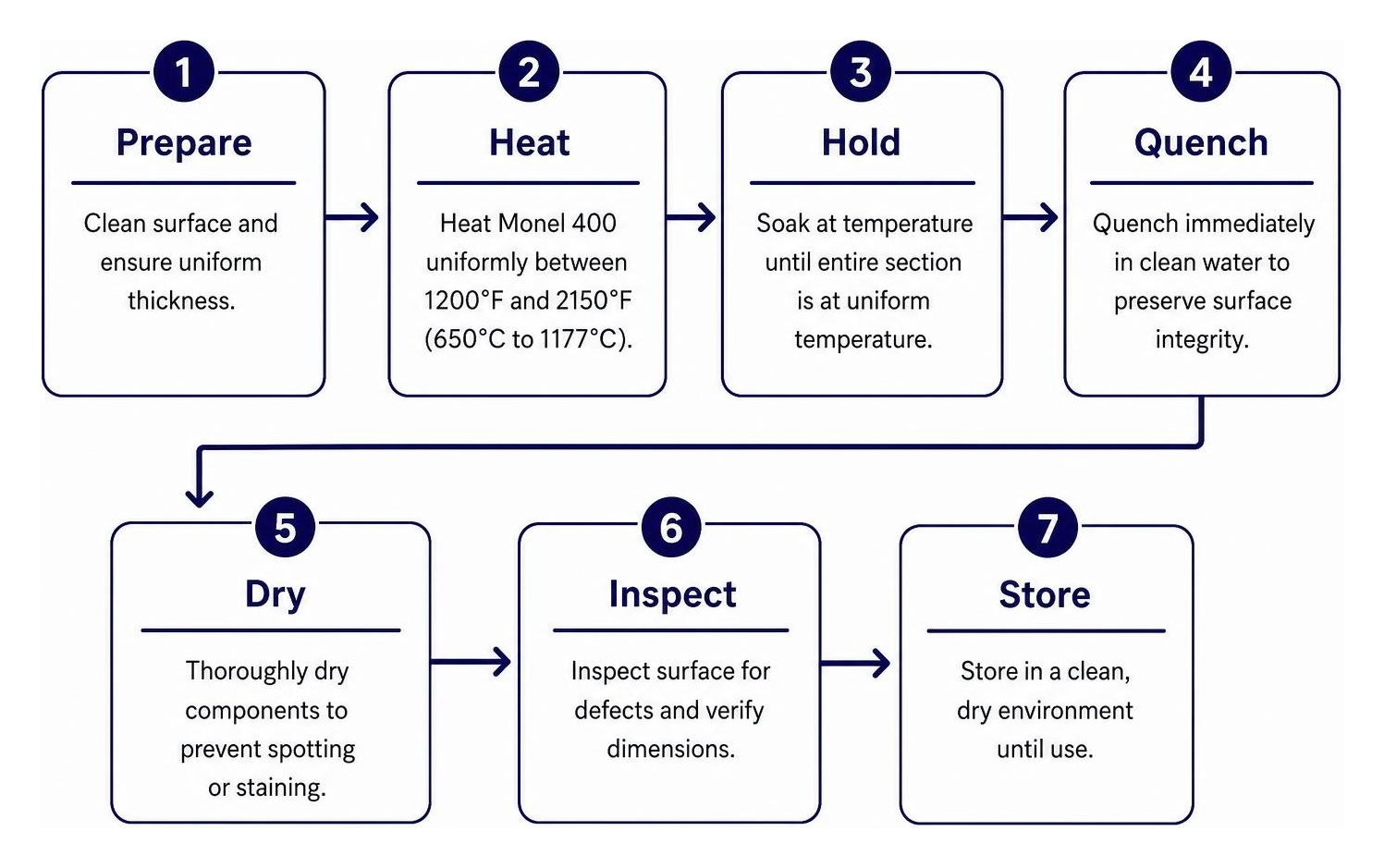
Fabrication, Machining, and Welding Monel 400
Because nickel-copper alloys work-harden rapidly, machining requires rigid tooling setups, sharp positive-rake cutters, continuous cutting feeds, and flood lubrication to prevent surface glazing.
- Hot Forming: Must be performed between 1200°F and 2150°F (650°C to 1177°C). Do not heat above 2150°F (1177°C) to avoid catastrophic grain boundary damage.
- Welding: Readily joined using Gas Tungsten Arc Welding (GTAW/TIG), Gas Metal Arc Welding (GMAW/MIG), or Shielded Metal Arc Welding (SMAW) using matching AWS A5.14 ERNiCu-7 filler metals.
- Heat Treatment: Full recrystallization annealing requires open furnace heating at 1600°F – 1800°F (871°C – 982°C) for 2 to 10 minutes, or box annealing at 1400°F – 1500°F (760°C – 816°C) for 1 to 3 hours.
- Quenching: Rapid cooling or direct quenching in a 2% alcohol-water solution minimizes surface oxidation, ensuring a bright, clean surface without heavy scale.
- Stress Relief: Post-fabrication stress relief at ~575°F (302°C) for 3 hours prevents dimensional distortion following heavy machining.
Cryogenic and High-Temperature Performance of Monel 400
Unlike ferritic, martensitic, and duplex steels, Monel 400 undergoes no ductile-to-brittle transition when cooled. At liquid hydrogen temperatures (-423°F / -253°C), its tensile strength, yield strength, and hardness increase significantly while retaining high ductility and Charpy V-notch impact toughness.
At elevated temperatures, annealed Monel 400 rod exhibits a high-cycle fatigue strength (10⁸ cycles) of 33.5 ksi (fatigue ratio of 0.41). It handles moderate load-bearing service up to 1000°F (538°C) in reducing atmospheres, offering stable creep and rupture resistance before long-term oxidation necessitates higher-nickel superalloys.
Frequently Asked Questions
What is the chemical composition of Monel 400?
Monel 400 is composed primarily of at least 63% nickel (plus cobalt) and 28% to 34% copper by weight. The remaining balance includes controlled limits of iron (up to 2.5%), manganese (up to 2.0%), carbon (0.3% max), silicon (0.5% max), and sulfur (0.024% max).
Can Monel 400 be hardened by heat treatment?
No. Monel 400 is a single-phase solid-solution alloy and does not respond to precipitation-hardening heat treatments. It can be hardened only through cold working, such as cold drawing, rolling, or swaging.
Is Monel 400 magnetic at room temperature?
Its Curie temperature falls between 20°C and 50°C (70°F to 120°F). Due to slight variations within standard manufacturing chemistry tolerances, some heats of Monel 400 are slightly magnetic at ambient room temperature, while others remain entirely non-magnetic.
Conclusion
When harsh industrial environments rule out ordinary stainless steels, Monel 400 provides proven resistance against reducing acids, dynamic marine corrosion, and extreme sub-zero temperatures. Balancing its higher upfront raw material cost against minimal maintenance, eliminated downtime, and long equipment service life makes it a dependable choice for mission-critical infrastructure.
At James Duva Inc., our team in Branchburg, NJ has helped engineers and procurement specialists navigate material selection since 1978. Whether your process demands custom-cut pipe, high-pressure fittings, or certified Ball Valves, we supply fully traceable, high-nickel alloy piping products configured to your engineering specifications.
About James Duva Inc.
Since 1978, James Duva Inc. has been your trusted source for stainless steel and high-nickel alloy industrial products. Whether you’re in the water treatment, process or power industry, we pride ourselves on always having what you need. Say goodbye to your sourcing problems with just one call to James Duva.