
Stop Rust Before It Starts with Modern Oil and Gas Piping Solutions

Oct 29, 2026
How to Choose Corrosion-Resistant Pipe for Oil and Gas
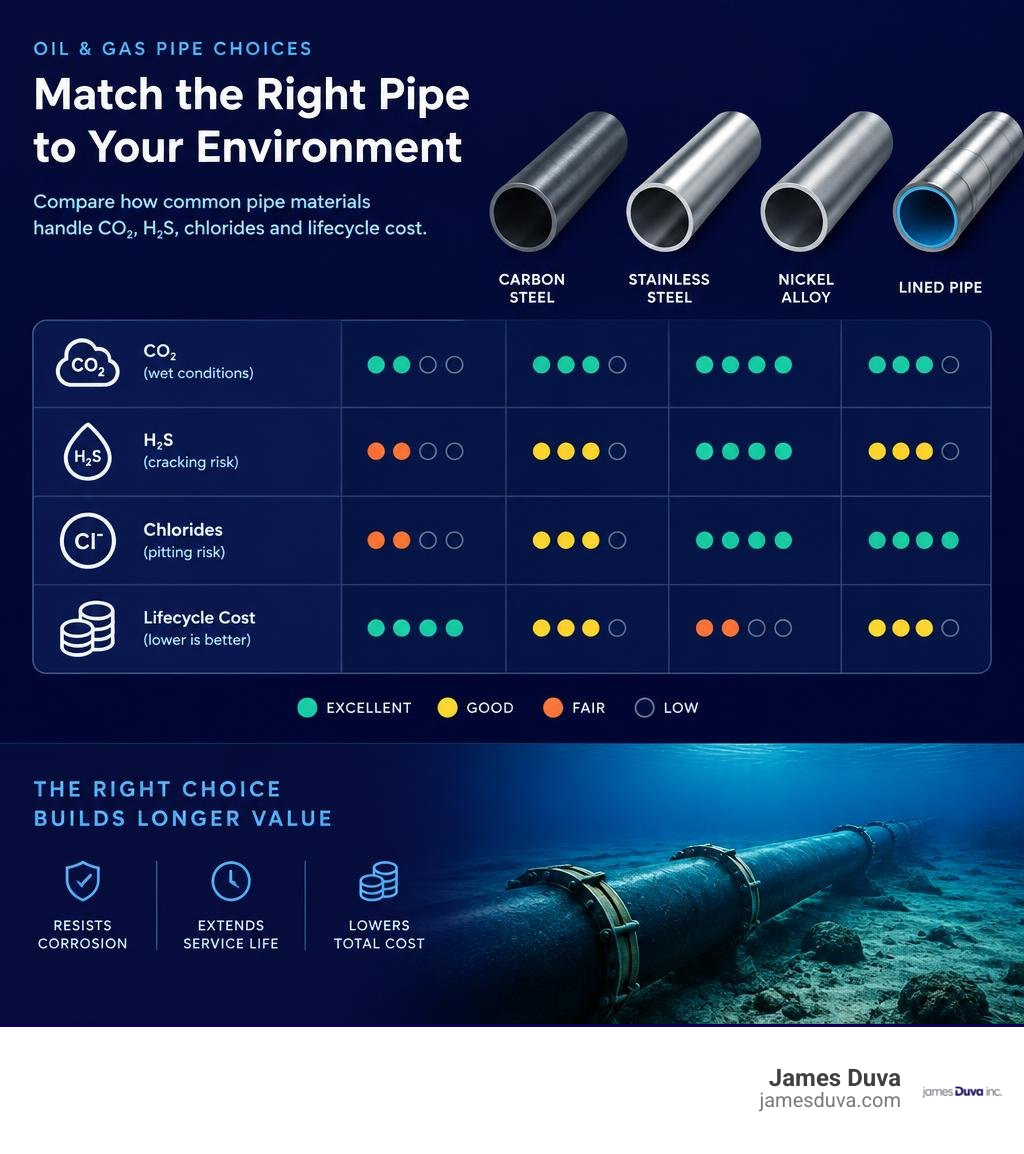
Start with the fluid inside the pipe. Wet CO2 can corrode steel, while hydrogen sulfide can cause cracking. Chlorides add a risk of pitting, especially at higher temperatures. Carbon steel may be the lowest-cost choice when corrosion can be controlled. For harsher service, compare qualified stainless steels, nickel alloys, and pipes with corrosion-resistant liners. Check the full operating conditions and weld requirements before choosing a grade. When selecting corrosion resistant pipe, oil and gas operators must match the alloy to the fluid chemistry and operating environment.
The right choice is not always the most expensive alloy. Pipe price, installation weight, inspection, and expected service life all affect the total cost.
I’m Billy Walker, vice president of James Duva Inc., where I help industrial buyers source stainless steel and high-nickel alloy piping components. That sourcing experience shapes this guide to help operators navigate alloy selection and lifecycle considerations.
Why Are Alloys So Valuable in Industry?
Pure metals rarely survive the punishing conditions of industrial service. Pure elemental iron, for instance, is often too soft, mechanically weak, and prone to rust from oxygen and moisture. Left unprotected, iron oxidizes into brittle iron oxide flakes, compromising structural integrity within months.
To withstand harsh chemical environments, engineers rely on metallic alloys like steel that offer superior strength and durability. By combining a base element like iron or nickel with specific alloying additions, metallurgists synthesize metals that can take the heat and the rust. These advanced compositions combine high tensile strength, fatigue resistance, and chemical passivity across key sectors:
- Construction: Structural beams, industrial piping, and architectural supports rely on alloy steels for high load-bearing capacity and weather resistance.
- Oil & Gas: Process piping, heavy-duty flanges, critical fittings, and flow control systems like Ball Valves rely on corrosion-resistant alloys to contain aggressive hydrocarbons under intense pressure.
- Automotive & Aerospace: High-strength alloy frames, drive shafts, and high-performance jet engines withstand extreme cyclic mechanical stress and combustion heat.
- Medical & Consumer Goods: Biocompatible surgical implants and sterile commercial kitchenware demand the non-reactive surfaces of specialized stainless grades.
The chemical magic of an alloy lies in its constituent elements. Chromium reacts spontaneously with ambient oxygen to generate an invisible, self-healing oxide film (Cr₂O₃) that blocks electrochemical attack. Nickel stabilizes the face-centered cubic (austenitic) crystal matrix, delivering toughness at sub-zero temperatures and resistance to stress corrosion cracking. Molybdenum strengthens the passive film against localized chloride breakdown, preventing pitting and crevice corrosion.
Degradation Mechanisms in Upstream and Midstream Pipeline Environments
Pipelines transporting raw wellstream fluids face dynamic chemical attacks. Unrefined hydrocarbons carry a corrosive blend of water, acid gases, and dissolved mineral salts.
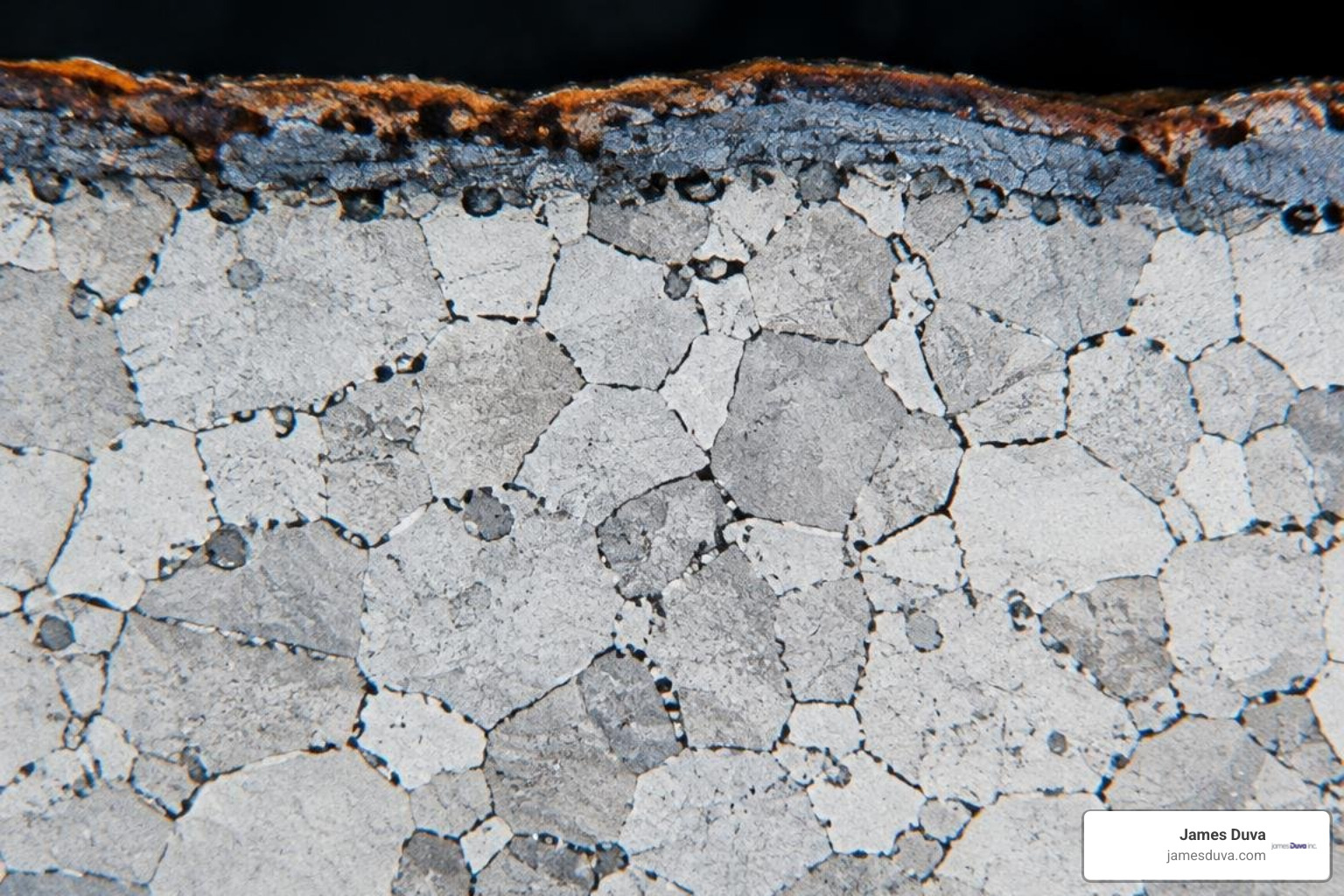
Sweet corrosion occurs when dissolved carbon dioxide (CO2) forms carbonic acid (H2CO3), leading to rapid metal loss and localized mesa attack on standard carbon steel. The severity of sweet corrosion depends directly on CO2 partial pressure, operating temperature, and flow velocity. When high concentrations of salts are present, chloride ions penetrate weak points in passive films, causing localized pitting and crevice corrosion. A fundamental look at the chemistry of corrosion shows that localized pitting can quickly lead to stress concentrations and premature wall perforation.
Material Degradation and Environmental Challenges
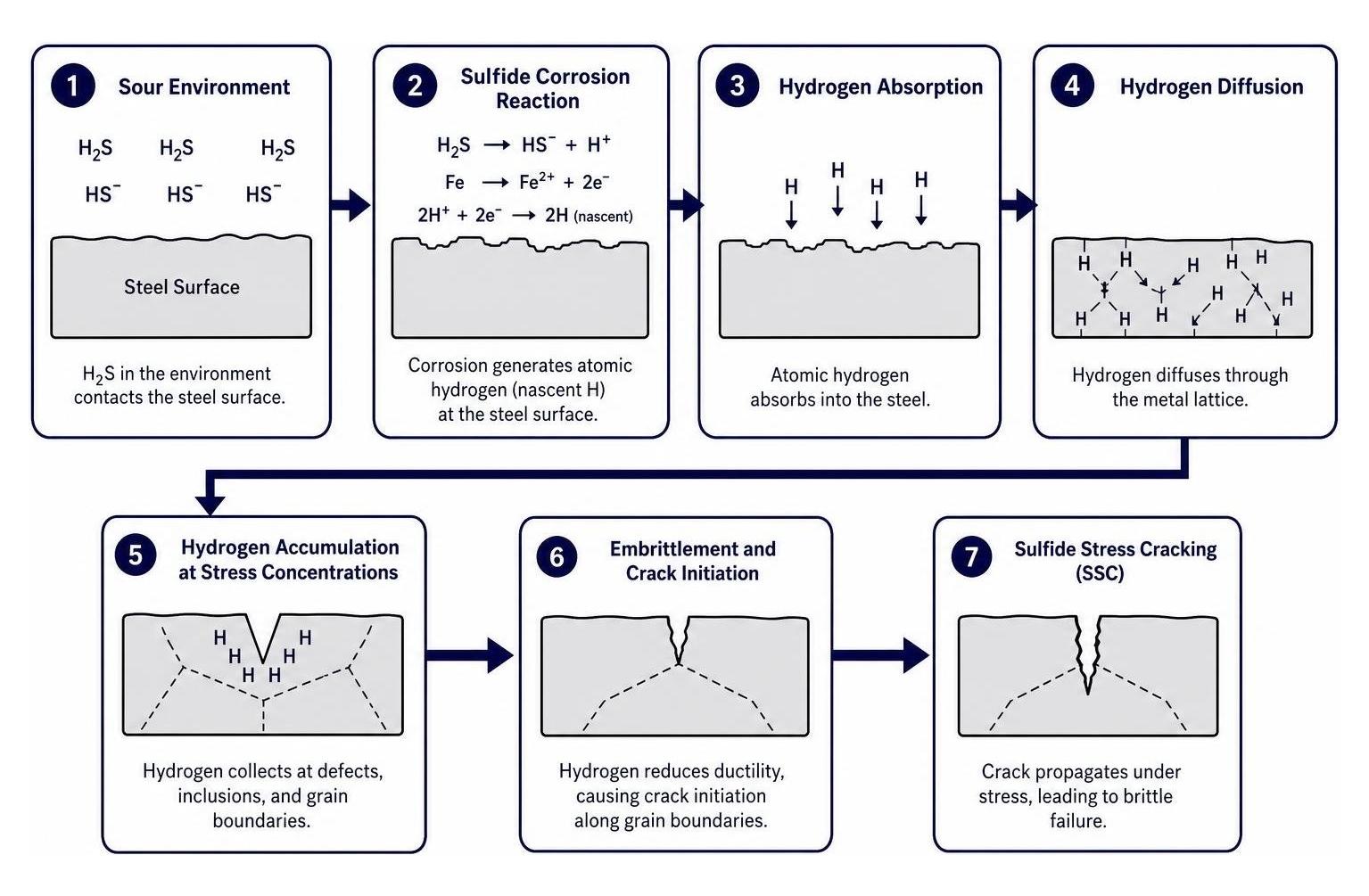
Sour service presents an even more dangerous challenge due to the presence of hydrogen sulfide (H2S). When atomic hydrogen generated during the sulfide corrosion process diffuses into the steel’s crystal lattice, it causes rapid, brittle failure known as Sulfide Stress Cracking (SSC) or Hydrogen-Induced Cracking (HIC).
To mitigate catastrophic failures, operators design systems under stringent industry standards:
- NACE MR0175/ISO 15156: Governs material selection and limits environmental severity (pH, H2S partial pressure, temperature, and chloride content) for equipment used in H2S-containing environments.
- API 5CRA: Defines rigorous manufacturing, testing, and quality control requirements for corrosion-resistant alloy seamless tubes used as casing, tubing, and coupling stock.
Material resistance to localized pitting in sour, chloride-rich production is quantified using the Pitting Resistance Equivalent Number (PREN). The PREN is calculated by adding the percentage of chromium to 3.3 times the combined percentage of molybdenum plus half the tungsten, and then adding 16 times the percentage of nitrogen.
A higher PREN correlates with a higher Critical Pitting Temperature (CPT)—the threshold below which pitting corrosion will not initiate. For example, high-grade alloys like Sanicro® 42 for OCTG (UNS N08825) provide a minimum PREN of 32 and a CPT of 44°C (tested per ASTM G150 in 1M NaCl). This alloy maintains crack-free performance in severe sour environments containing over 100 psi H2S and 1,000 psi CO2 at 218°C.
Material Comparison: Selecting Pipe Alloys for Oil and Gas Operations
Pipeline engineers balance initial material costs against structural strength, fabrication complexity, and field longevity. Knowing when to choose nickel alloy vs stainless steel helps optimize project capital expenditure without compromising safety.
| Material Class | Typical Grades | Yield Strength (MPa) | Weldability | Relative Cost | Best Suited Applications |
|---|---|---|---|---|---|
| Standard Carbon Steel | API 5L X65 | 450–600 | Excellent | Baseline ($) | Dry gas, treated crude, sweet service with chemical inhibitors |
| High-Strength Carbon Steel | API 5L X80 | 555–705 | Good (Requires preheat) | Low ($$) | Deepwater risers, high-pressure sweet/mild sour flowlines |
| Martensitic Stainless Steel | Super 13Cr, Modified 13Cr | 550–750 | Moderate to Specialized | Moderate ($$$) | Wet CO2 gathering lines, mild sour downhole OCTG tubing |
| Duplex Stainless Steel | 22Cr Duplex, 25Cr Super Duplex | 450–750 | Good (Strict heat input control) | High ($$$$) | Subsea manifolds, high-chloride flowlines, offshore top-sides |
| Nickel-Based Alloys | Alloy 825, Alloy 625, Alloy C-276 | 240–965 | Good (Requires clean prep) | Premium ($$$$$) | Extreme sour wells (H2S greater than 10 bar), high-temp downhole casing |
For extreme sour, high-temperature, high-pressure (HPHT) environments, exploring corrosion resistant nickel alloys provides the ultimate defense against cracking and degradation.
High-Strength Carbon Steels vs. Corrosion-Resistant Alloys
In mild to intermediate sour environments (NACE Regions 1 & 2), upgrading from standard X65 to high-strength X80 line pipe delivers major structural and economic advantages. Modern microalloyed X80 pipe allows engineers to reduce wall thickness by up to 20% while maintaining identical internal design burst pressures.
According to technical research on cost-effective X80 line pipe, substituting X80 for X65 in an offshore steel lazy wave riser reduced wall thickness from 41 mm to 32 mm. This structural thinning eliminated the need for external buoyancy modules, shedding over 2,000 metric tons of steel from the design. The reduced tonnage saved approximately $2,800 per ton in direct material costs and trimmed offshore installation schedules by 12 vessel days, preventing up to 3,500 metric tons of marine operational CO2 emissions.
Martensitic Stainless Steels and Advanced CRA Solutions
When CO2 partial pressures cause uninhibited carbon steel to corrode rapidly, 13Cr martensitic stainless steels offer an effective solution. However, traditional 13Cr steels suffer from poor field weldability and are susceptible to strain age hardening during subsea reel-lay installation.
Recent advancements detailed in martensitic stainless steel patent specifications overcome these limitations. By microalloying low-carbon martensitic steel with Vanadium (0.01–0.05%), Zirconium (0.16–0.30%), and Tantalum (0.01–0.05%), metallurgists stabilize interstitial carbon and nitrogen atoms without creating embrittling titanium precipitates. This formulation achieves yield strengths between 600 and 700 MPa, keeps the weld heat-affected zone (HAZ) hardness below 350 HV (eliminating field post-weld heat treatment), and restricts corrosion rates to 0.02 mm/year in wet CO2 environments.
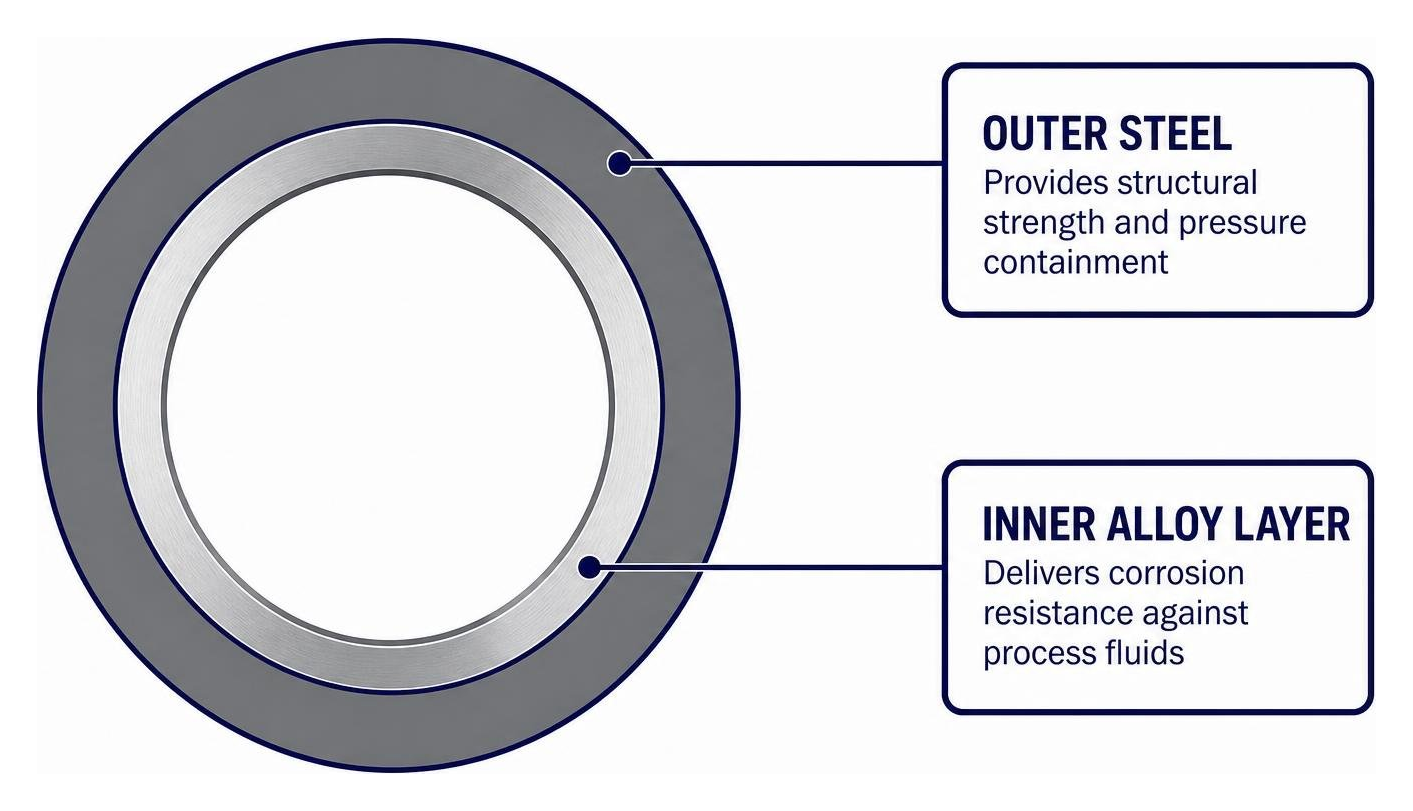
Where pure bulk alloy piping is economically impractical, mechanically lined pipe (MLP) and metallurgically clad pipes offer an optimized alternative. These composite pipes combine a heavy-wall carbon steel outer pipe for structural pressure containment with a thin (typically 3 mm) internal corrosion-resistant alloy liner—such as Alloy C-276 seamless pipe or Alloy 625—to handle the corrosive process fluid.
Manufacturing, Fabrication, and Welding Best Practices
Maintaining corrosion resistance requires careful control over pipe manufacturing and field fabrication. When deciding on production methods, choosing the right welded pipe versus seamless pipe depends on operating pressure, required wall tolerances, and severe sour cracking risks.
- Manufacturing & Strengthening: High-alloy seamless pipes are typically cold-worked to achieve target yield strengths (such as 110 ksi or 125 ksi ratings for downhole OCTG casing). Heat treatment through precise quenching and tempering homogenizes the microstructure and dissolves undesirable intermetallic phases.
- Welding Parameters: When joining high-strength steels or CRA pipe, Gas Metal Arc Welding (GMAW) or Gas Tungsten Arc Welding (GTAW) should use qualified matching or over-alloyed filler wires. Maintaining a strict preheating temperature (typically at least 125°C for heavy-wall X80) controls cooling rates and prevents hydrogen embrittlement.
- Hardness Control: In sour service pipelines, the Heat-Affected Zone (HAZ) hardness must remain strictly below NACE and DNV limits (typically no more than 290–300 HV10 for carbon steels and no more than 350 HV for modified martensitic grades) to prevent immediate sulfide stress cracking. Using precision-engineered components, such as verified nickel alloy fittings, ensures joint integrity across the entire piping system.
Evaluating Economic Trade-offs in High-Performance Piping
Material selection is an exercise in total lifecycle cost analysis (LCCA). While carbon steel offers the lowest initial purchase price, it often requires chemical corrosion inhibitor injection, continuous ultrasonic wall monitoring, frequent pigging routines, and costly early replacement cycles.
Selecting corrosion-resistant pipes lowers operational overhead by:
- Eliminating continuous chemical inhibitor injection programs and chemical storage infrastructure.
- Preventing unplanned production shutdowns and pipeline leaks.
- Reducing riser weight, which lowers offshore installation vessel mobilization time.
- Extending asset operating lifespans beyond 25–30 years without internal wall degradation.
Frequently Asked Questions About Oil and Gas Pipeline Corrosion
How does H2S partial pressure dictate material qualification under NACE MR0175/ISO 15156?
NACE MR0175/ISO 15156 categorizes sour service severity into four distinct regions based on in-situ pH and H2S partial pressure. When H2S partial pressure exceeds 0.05 psi (0.3 kPa), materials enter sour service classification, triggering mandatory sulfide stress cracking testing, strict hardness maximums, and specialized alloy qualification limits.
What are the primary advantages of mechanically lined pipe over solid CRA pipe?
Mechanically lined pipe pairs an economical carbon steel outer pipe that provides the required pressure containment with a thin internal liner of high-grade alloy (such as Alloy 825, 625, or C-276). This composite design offers the corrosion resistance of solid CRA at a 20% to 40% reduction in total material cost.
How does upgrading to X80 grade pipe reduce offshore installation costs?
X80 grade line pipe provides higher yield strength than traditional X65 steel, allowing designers to reduce pipe wall thickness by up to 20%. This weight reduction cuts total steel volume, eliminates the need for expensive subsea buoyancy modules, and speeds up offshore welding, saving costly installation days on pipelay vessels.
Conclusion
Preventing pipeline failure requires matching metallurgy to operating chemistry, pressures, and temperatures. Whether your project calls for high-strength line pipe, modified martensitic stainless steel, or high-performance nickel alloys, choosing qualified materials protects your investment and ensures operational safety.
At James Duva Inc., our team in Branchburg, NJ has helped engineers and procurement specialists source certified corrosion-resistant piping, fittings, flanges, and valves since 1978. Contact us today to discuss your project requirements and secure the right materials for long-term asset integrity.
About James Duva Inc.
Since 1978, James Duva Inc. has been your trusted source for stainless steel and high-nickel alloy industrial products. Whether you’re in the water treatment, process or power industry, we pride ourselves on always having what you need. Say goodbye to your sourcing problems with just one call to James Duva.