
Stainless Steel or Carbon Steel Explained Simply
Oct 13, 2026
Stainless Steel vs Carbon Steel: Which Should You Choose?
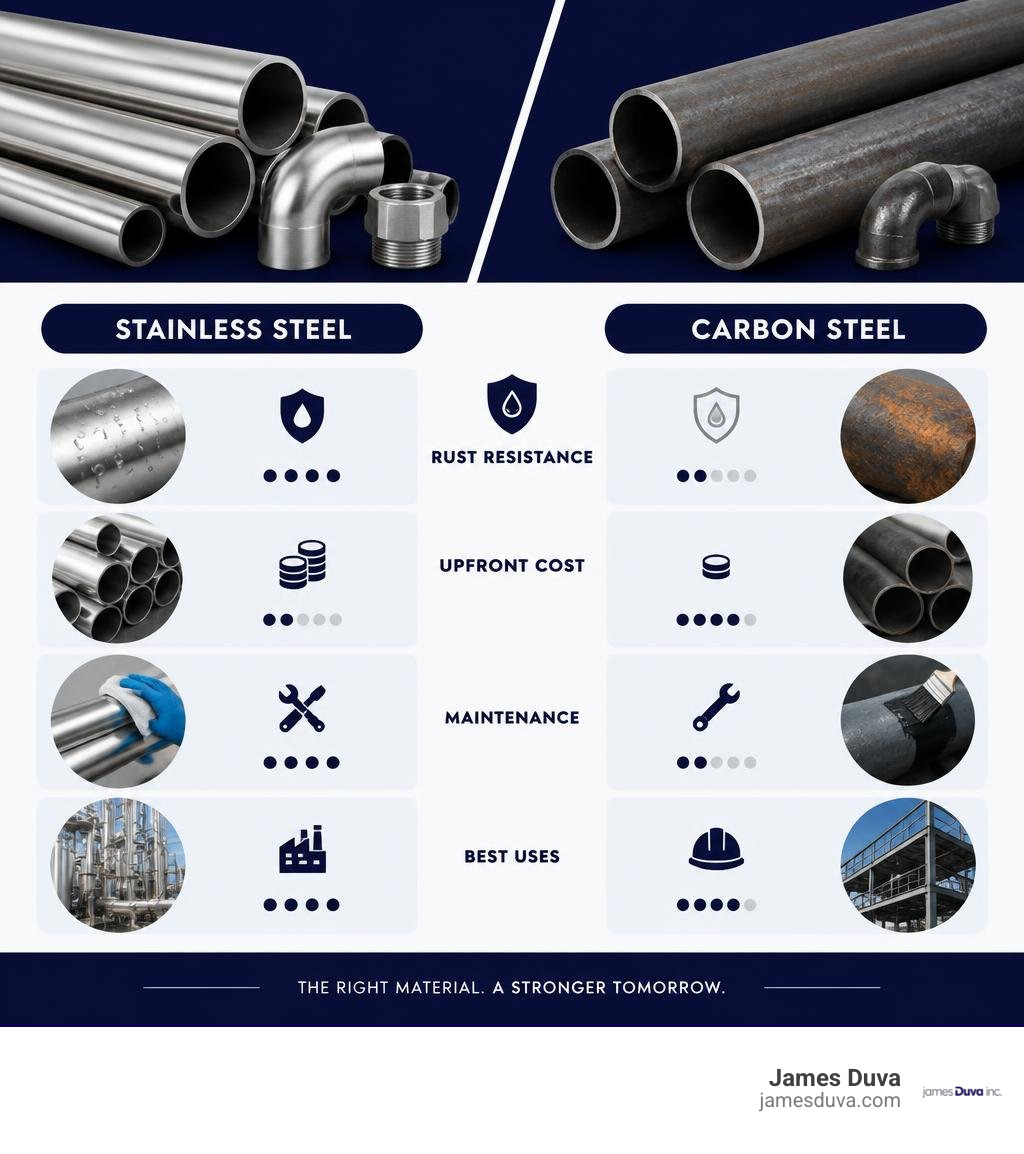
Choose stainless steel when moisture, chemicals, or frequent cleaning make rust a concern. Choose carbon steel when upfront cost matters most and the part can stay dry or be protected with a coating. Neither is always stronger: strength depends on the grade and how it is made.
The main difference is corrosion resistance. Stainless steel contains at least 10.5% chromium, which forms a thin protective layer. Carbon steel lacks that built-in protection, so it usually needs paint, galvanizing, or other care in wet settings. For industrial equipment, the best choice also depends on maintenance access and the cost of downtime.
I’m Billy Walker, Vice President of James Duva Inc., where I help customers source stainless steel and specialty piping components for power, process, and water treatment projects. My experience with stainless steel vs carbon steel starts with a practical question: What will the material face in service?
Related James Duva resources cover how to choose stainless steel grade, stainless steel corrosion resistance, and types of stainless steel.
Why Are Alloys So Valuable in Industry?
To understand how modern engineering materials work, we have to start with elemental iron. Pure iron is abundant, but in its natural state, it is relatively soft, mechanically weak, and notoriously susceptible to oxidation. When exposed to oxygen and ambient humidity, pure iron quickly corrodes into iron oxide (rust), flaking away until structural integrity fails entirely.
Alloying solves this fundamental problem. By melting iron and precisely blending it with other elements, metallurgists create metals with vastly superior strength, toughness, and longevity. The simplest and most prolific alloy is carbon steel, where introducing small fractions of carbon into the iron lattice prevents iron atoms from sliding past one another. This transformation turns a soft, malleable element into a robust material capable of supporting skyscrapers, bridges, and industrial machinery.
These advantages explain why alloys are used across critical industries:
- Construction: Steel beams, structural columns, and piping systems rely on alloy strength and predictable performance.
- Oil & Gas: Alloy fittings, flanges, and pressure components help contain demanding fluids under high pressure and corrosive exposure.
- Automotive & Aerospace: Frames, engines, landing gear, and high-temperature components depend on alloys that balance strength, weight, fatigue resistance, and heat tolerance.
- Medical & Consumer Goods: Stainless alloys are used in implants, surgical tools, kitchenware, and appliances where hygiene, durability, and corrosion resistance matter.
When engineers introduce elements such as chromium, nickel, and molybdenum into the mix, the alloy gains exceptional resistance to environmental degradation. In our guide on metals that resist rust and heat, we examine how tailored alloy chemistry allows materials to endure severe temperatures and harsh chemical exposures without breaking down.
Core Differences: Stainless Steel vs Carbon Steel
While both alloy families rely on an iron base, their internal chemistry and surface metallurgy create stark operational differences:
Composition and Metallurgy: Stainless Steel vs Carbon Steel
The defining boundary between these two metals is alloy composition. Carbon steel is composed primarily of iron and varying amounts of carbon—ranging from low-carbon mild steel (under 0.25% carbon) to high-carbon tool steel (up to 2.0% carbon). It contains negligible amounts of other alloying additions, which keeps raw material production costs low and mechanical behavior predictable.
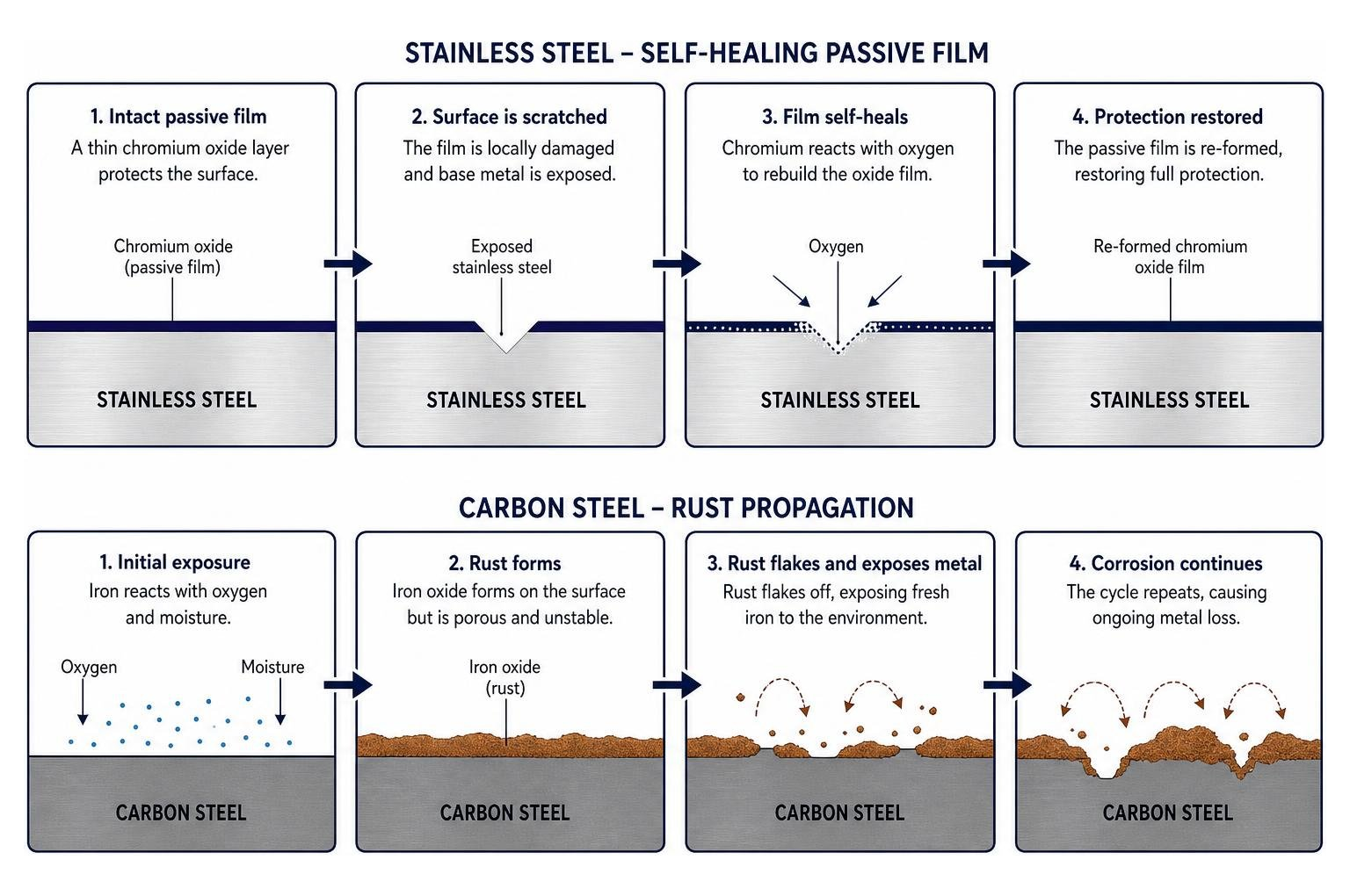
Stainless steel, by contrast, must contain a minimum of 10.5% chromium by weight. This chromium content completely alters how the metal interacts with its environment. When exposed to oxygen, chromium reacts spontaneously to form an ultra-thin, chemically stable chromium oxide layer across the surface. This microscopic barrier prevents oxygen and moisture from reaching the underlying iron.
Understanding this passive barrier is critical when specifying alloys for demanding infrastructure. To dive deeper into how this protective layer behaves under aggressive conditions, consult our guide to stainless steel corrosion resistance.
Corrosion Protection Mechanisms and Oxidation
When untreated carbon steel encounters water and atmospheric oxygen, oxidation occurs across the entire exposed surface. Because iron oxide occupies more volume than the underlying base metal, it flakes off continuously, exposing fresh layers of iron to progressive corrosion. To survive in humid or wet environments, carbon steel relies entirely on external protection systems:
- Industrial paints and epoxy coatings
- Hot-dip galvanizing (sacrificial zinc layers)
- Cathodic protection systems
- Engineered corrosion allowances (adding extra wall thickness to account for metal loss over time)
Stainless steel protects itself intrinsically. If its surface is scratched, machined, or gouged, the exposed chromium immediately reacts with ambient oxygen to self-heal the passive oxide layer within seconds.
In aggressive industrial environments containing chlorides, acids, or sea spray, standard stainless grades like 304 can experience localized breakdown (pitting). In these severe conditions, upgrading to molybdenum-bearing grades provides an added layer of defense. You can review the specific chemical dynamics in our overview of 316 stainless steel corrosion performance.
Mechanical, Thermal, and Fabrication Properties Compared
Selecting the correct alloy requires balancing structural loading requirements, thermal behavior, and ease of manufacturing.
| Property Metric | Mild Carbon Steel (e.g., A36 / AISI 1020) | High-Carbon Steel (e.g., AISI 1080) | Austenitic Stainless (e.g., 304 / 316) | Martensitic Stainless (e.g., 410) |
|---|---|---|---|---|
| Yield Strength (psi) | 36,000 – 42,000 | 70,000 – 90,000 | 30,000 – 45,000 | 45,000 – 100,000+ |
| Tensile Strength (psi) | 58,000 – 65,000 | 120,000 – 140,000 | 75,000 – 95,000 | 70,000 – 130,000+ |
| Hardness Range | 120 – 160 HB | Up to 60+ HRC (quenched) | 150 – 190 HB (70–90 HRB) | Up to 45–55 HRC |
| Thermal Conductivity | ~51 – 55 W/(m·K) | ~48 – 52 W/(m·K) | ~15 – 16 W/(m·K) | ~24 – 28 W/(m·K) |
| Relative Raw Cost | Baseline ($) | Low-Moderate ($$) | Moderate-High ($$$$) | Moderate ($$$) |
For a broader industry perspective on these core property distinctions, engineers often consult resources like Know Steel’s comprehensive comparison of carbon steel and stainless steel.
Strength, Hardness, and Ductility Across Grades
A common misconception is that stainless steel is universally stronger or harder than carbon steel. In reality, mechanical properties vary dramatically depending on the specific grade and its heat-treatment condition:
- Low-Carbon (Mild) Steel: Highly ductile and easily formed, with moderate tensile strength (~65,000 psi). It is ideal for structural framing where yield behavior prevents sudden catastrophic failure.
- High-Carbon Steel: Capable of being heat-treated and quenched to extreme hardness (exceeding 60 HRC). It excels at edge retention and wear resistance, but sacrifices ductility and impact toughness.
- Austenitic Stainless Steel (300 Series): Exhibits excellent elongation, high impact toughness even at cryogenic temperatures, and significant work-hardening capacity, though unworked yield strength is relatively modest (~35,000 psi).
- Martensitic Stainless Steel (400 Series): Can be heat-treated to high strength and hardness levels, making it popular for industrial valves, turbine blades, and cutlery.
When projects demand both extreme tensile strength and superior corrosion resistance, advanced hybrid alloys offer an ideal solution. Learn how duplex alloys bridge this gap in our breakdown of double strength duplex steel benefits.
Thermal Conductivity and Expansion
Thermal properties influence how materials behave in heat exchangers, boiler lines, and high-temperature piping systems:
- Thermal Conductivity: Standard carbon steel conducts heat rapidly at roughly 55 W/(m·K). Austenitic stainless steel (304/316) is far more thermally resistant, conducting heat at approximately 15 W/(m·K). This difference means carbon steel transfers heat over three times faster, while stainless steel retains localized heat.
- Thermal Expansion: Austenitic stainless steels expand significantly more than carbon steel when heated (with a coefficient of thermal expansion roughly 50% higher). In mixed-metal assemblies or rigid piping systems, this expansion differential can generate high thermal stresses, requiring flexible expansion joints or specialized pipe loops to avoid structural distortion.
Fabrication: Machining, Forming, and Welding Considerations
Fabricating stainless steel requires different shop practices than working with carbon steel:
- Machining and Work Hardening: Austenitic stainless steels work-harden rapidly under cutting tools. If tooling rubs rather than bites into the metal, the surface work-hardens into a tough, glazed layer that accelerates tool wear. Machining stainless requires rigid setups, sharp tool geometry, lower speeds, and heavy, positive feeds.
- Welding and Cross-Contamination: Carbon steel welds readily with minimal fuss, though thick sections may require preheating. Welding stainless steel requires careful shielding gas management and strict heat-input control to prevent carbide precipitation.
- Tool Segregation: Carbon steel grinding dust or wire brushes should never be used on stainless steel components. Free iron particles embedded in a stainless surface will rust when exposed to moisture, compromising the underlying passive film.
For fabrication best practices on pressure-retaining infrastructure, read our definitive guide to welded pipelines.
Practical Applications: Industrial Equipment to Everyday Kitchen Tools
Because their performance profiles are so distinct, carbon steel and stainless steel serve complementary roles across global infrastructure and commercial manufacturing.
Industrial Piping, Structural Beams, and Pressure Vessels
In heavy industrial settings, material selection is dictated by fluid chemistry, temperature, and atmospheric exposure:
- Construction & Infrastructure: Carbon steel remains the undisputed backbone of building construction, accounting for roughly 90% of global steel use. Structural I-beams, foundation pilings, and bridge trusses rely on mild carbon steel for its high strength-to-weight ratio, structural ductility, and cost efficiency.
- Oil, Gas & Petrochemical: Long-distance transmission lines handling non-corrosive hydrocarbons use heavy-wall carbon steel pipe. However, offshore processing units, high-temperature distillation columns, and chemical transfer lines mandate corrosion-resistant alloys. In these systems, stainless flow-control components—such as industrial Ball Valves—ensure reliable containment without the risk of internal wall thinning.
- Process and Food Manufacturing: Clean-in-place (CIP) washdowns and sanitizing chemicals quickly strip protective paints off carbon steel. Sanitary operations rely entirely on austenitic stainless steel piping, fittings, and tubing to ensure zero metallic contamination.
To explore specific alloy families across these sectors, review our detailed guide to stainless steel types or explore instrumentation options in our stainless steel tubing applications guide.
Knife and Cookware Performance: Stainless Steel vs Carbon Steel
The performance differences between these alloys are especially clear in consumer cutlery and professional cookware:
- Kitchen and Field Knives: Carbon steel blades (such as 1095 or Japanese White/Blue paper steels) are celebrated by professional chefs and field sportsmen for their ultra-fine grain structure. They take a razor-sharp edge quickly on sharpening stones. However, they oxidize rapidly when slicing acidic items like citrus or tomatoes, requiring immediate hand-washing, thorough drying, and regular mineral oil application. Over time, carbon steel develops a dark, protective oxidation layer called a patina. Stainless steel knives (using alloys like VG-10, AEB-L, or 440C) resist food acids and moisture, making them the standard choice for busy home kitchens.
- Cookware and Sauté Pans: In professional kitchens, carbon steel pans are prized for their responsive heat handling and high-heat searing capabilities. While stainless steel tri-ply pans take roughly 58 seconds to recover heat after introducing a cold steak, carbon steel pans recover in a fraction of that time, preserving the sear. You can read detailed empirical findings on this performance in ShopBirdy’s heat recovery cookware test. Conversely, stainless steel pans are non-reactive workhorses ideal for simmering acidic wine pan sauces and tomato reductions that would otherwise strip a carbon steel pan’s seasoning.
Lifecycle Cost, Durability, and Material Selection Guide
When evaluating project economics, evaluating only upfront material pricing ($/lb) often leads to flawed engineering decisions. A true life-cycle cost assessment factors in procurement, installation, ongoing maintenance, and downtime expenses over the expected service life:
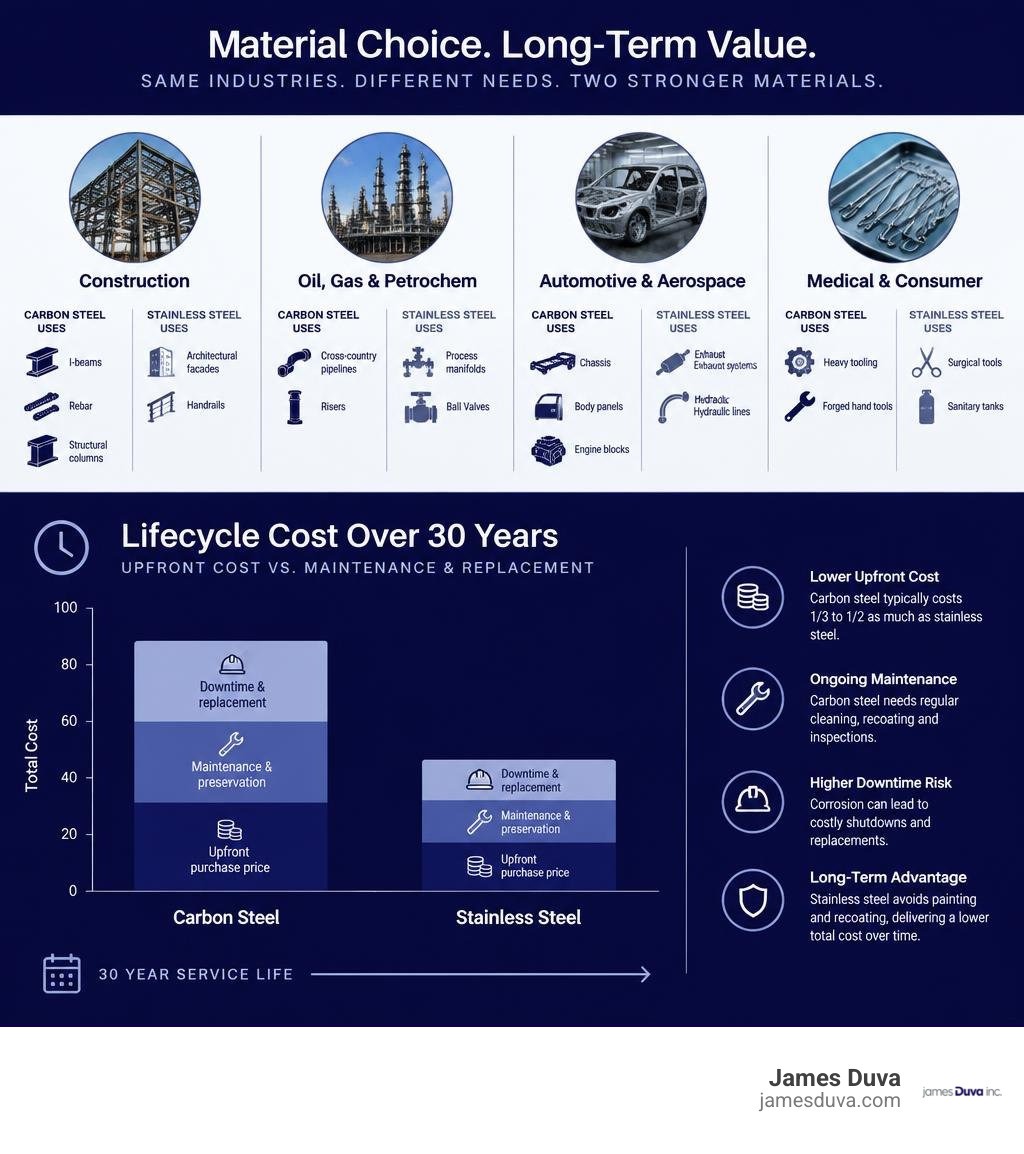
- Upfront Purchase Price: Unalloyed carbon steel is significantly cheaper up front, often costing one-third to one-half the raw material price of standard 304 or 316 stainless steel.
- Maintenance and Preservation Expenses: Carbon steel exposed to outdoor, coastal, or industrial atmospheres requires continuous upkeep: surface blast cleaning, primer reapplication, recoating every 5 to 10 years, and routine ultrasonic wall-thickness inspections.
- Downtime and Replacement Costs: If a carbon steel cooling line corrodes through inside a running chemical plant, the cost of shutting down the facility to weld in a replacement pipe dwarfs the original material savings.
- The Stainless Advantage: Stainless steel eliminates external painting and recurring recoating expenses. In wet, mildly corrosive, or inaccessible installations, stainless steel typically delivers a lower total cost of ownership over a 20- to 40-year design window.
To determine which alloy profile balances your capital expenditures with required operational life, consult our guide on selecting the right stainless steel grade.
Frequently Asked Questions About Stainless Steel and Carbon Steel
Does carbon steel rust faster than stainless steel?
Yes, carbon steel rusts significantly faster because it lacks the protective chromium content needed to form a self-healing passive barrier. When bare carbon steel meets ambient moisture and oxygen, it begins oxidizing immediately, forming visible surface rust within hours if left unprotected. Stainless steel remains stable because its passive chromium oxide layer continually shields the underlying iron from oxidation.
Which material is easier to sharpen and maintain?
Carbon steel is generally easier to sharpen to a fine edge because of its uniform iron-carbon matrix and absence of hard chromium carbides. However, carbon steel requires considerably more daily maintenance, including immediate drying, regular oiling, and seasoning to keep rust at bay. Stainless steel takes more time to sharpen on whetstones, but requires virtually zero routine corrosion maintenance beyond hand washing.
Can you weld carbon steel to stainless steel?
Yes, but joining these dissimilar metals requires careful filler metal selection and proper welding procedures. Welds between carbon steel and stainless steel are typically made using an over-alloyed filler metal, such as 309L stainless steel, to prevent crack-sensitive metallurgical phases upon cooling. Additionally, engineers must consider the risk of galvanic corrosion if the joint operates in a conductive fluid, as the carbon steel side will act as a sacrificial anode relative to the nobler stainless steel.
Conclusion
Both carbon steel and stainless steel are essential industrial alloys, but each serves distinct design priorities:
- Carbon Steel delivers high structural strength, ease of forming, and cost efficiency for dry, indoor, or well-coated structural and mechanical assemblies.
- Stainless Steel provides clean, self-healing corrosion resistance, hygiene, and low maintenance across chemical, marine, sanitary, and severe operating environments.
Matching the alloy to your operating environment, fluid chemistry, and total cost targets ensures your project operates safely and cost-effectively for years to come.
Since 1978, James Duva Inc. has provided technical guidance and precision alloy distribution from our headquarters in Branchburg, NJ. When you need piping components that perform reliably in demanding service conditions, explore industrial stainless steel products with our team to find the right alloy for your operational needs.
About James Duva Inc.
Since 1978, James Duva Inc. has been your trusted source for stainless steel and high-nickel alloy industrial products. Whether you’re in the water treatment, process or power industry, we pride ourselves on always having what you need. Say goodbye to your sourcing problems with just one call to James Duva.