
Surviving the Furnace with Top High Temperature Stainless Steel Grades
Oct 23, 2026
Why Are Alloys So Valuable in Industry?
High temperature stainless steel grades such as 304H, 310S, 321, 347, and 446 are engineered to resist heat, oxidation, and mechanical degradation in demanding industrial service. Austenitic grades like 304H, 310S, 321, and 347 combine chromium and nickel to maintain creep strength and form protective oxide scales, while ferritic grade 446 offers high-chromium scaling resistance in sulfur-bearing or reducing atmospheres. These alloys retain structural integrity at continuous service temperatures from about 650°C to 1150°C, depending on grade and environment.
Pure chemical elements rarely possess the balanced mechanical and chemical characteristics required for demanding industrial applications. Pure iron, for instance, is relatively soft, mechanically yielding, and exceptionally vulnerable to atmospheric corrosion and high-temperature scaling. When exposed to heat and oxygen, unalloyed iron rapidly converts into loose iron oxides that flake away, causing catastrophic loss of cross-sectional area and structural failure.
Industrial engineering relies on alloying—the deliberate blending of base iron with precise quantities of carbon, chromium, nickel, molybdenum, and other elements—to transform basic metals into materials that exhibit superior strength, structural stability, and resistance to environmental degradation. By introducing solute atoms of different atomic radii into the iron crystal lattice, metallurgists induce solid solution strengthening. This distorts the crystal matrix, creating localized stress fields that inhibit dislocation movement and prevent premature mechanical yielding.
Furthermore, targeted additions of strong carbide-forming elements create stable precipitate dispersions that lock grain boundaries in place, preventing structural collapse under sustained stress. Across global manufacturing, selecting specialized metals engineered to withstand heat and oxidation ensures that industrial equipment retains dimensional integrity, ductile toughness, and chemical resistance in environments that would destroy base metals.
Today, these advanced alloy formulations serve distinct roles across multiple sectors:
- Construction: Heavy structural beams, high-strength load-bearing rebar, and architectural piping systems engineered for environmental resilience and load retention.
- Oil & Gas: High-pressure fittings, process flanges, wellhead manifolds, downhole instrumentation, and fluid-control components such as industrial Ball Valves operating in sour and thermal recovery wells.
- Automotive & Aerospace: High-integrity airframe components, structural engine cradles, exhaust manifolds, turbocharger housings, and jet engine turbine casings exposed to severe mechanical and thermal fatigue.
- Medical & Consumer Goods: Biocompatible orthopedic implants, surgical instrumentation, sanitary food-processing equipment, and durable commercial kitchenware.
Core Properties of High Temperature Stainless Steel Grades
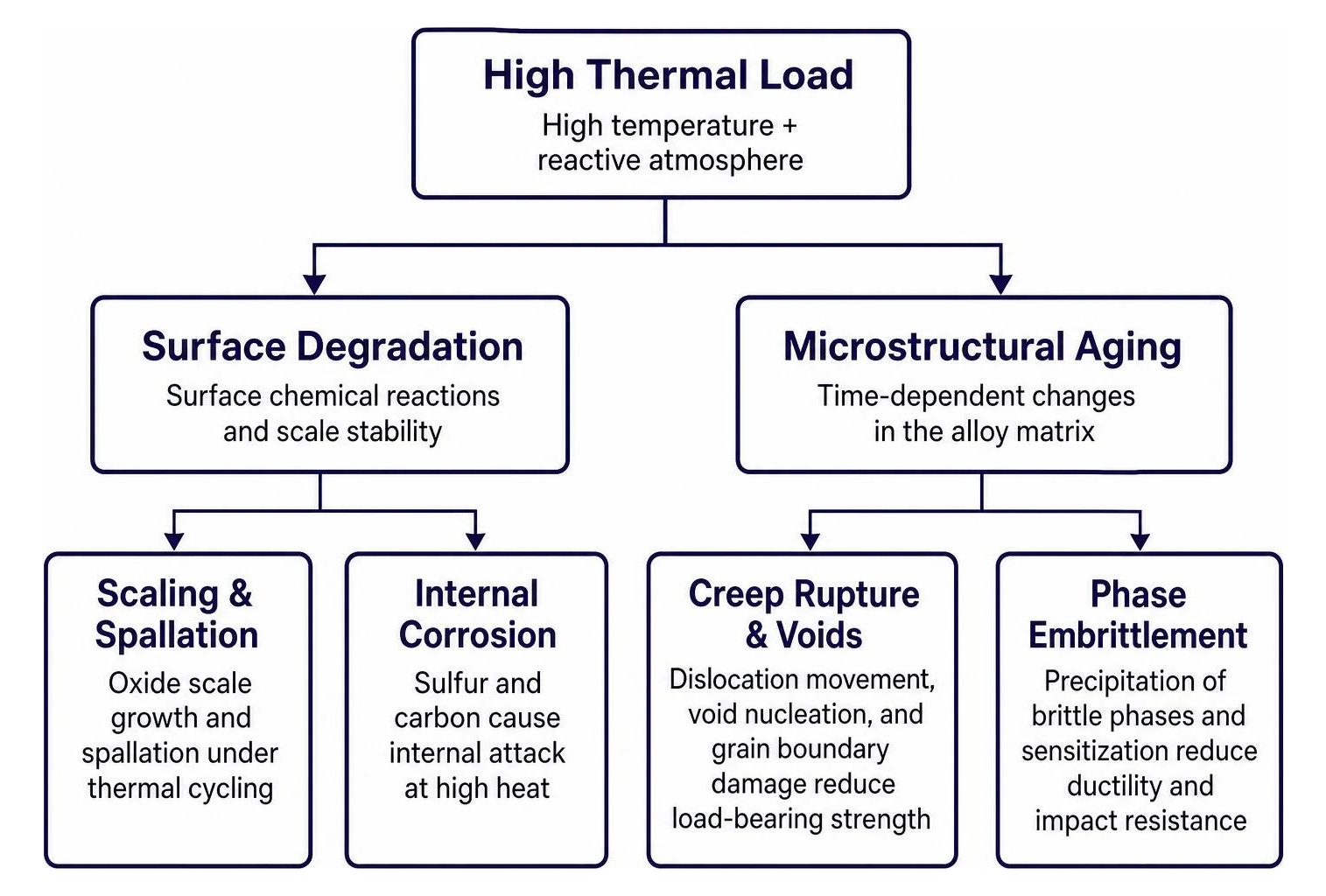
Standard stainless steels typically contain around 18% chromium and offer superior corrosion resistance compared to plain carbon steel, requiring a baseline of at least 11% chromium to form a protective surface oxide layer. However, high-temperature service demands far more than basic room-temperature corrosion resistance. When operating temperatures surpass 500°C (932°F), materials encounter severe thermodynamic and kinetic challenges that degrade mechanical properties and accelerate surface chemical reactions.
Understanding these behaviors requires reviewing the fundamentals outlined in our in-depth guide to stainless steel alloy properties. To survive continuous thermal service, high-temperature alloys rely on three core metallurgical properties:
- Creep Rupture Strength: Creep is the slow, time-dependent, permanent deformation of a material subjected to constant mechanical stress below its yield strength at elevated temperatures. High-temperature grades maintain their internal crystal lattice to resist dislocation movement, void nucleation, and premature rupture across thousands of operating hours.
- Cyclic Oxidation and Scaling Resistance: Under high heat, atmospheric oxygen reacts directly with the alloy surface. Heat-resistant grades form a dense, adherent, and chemically stable chromium oxide (Cr2O3) or silicon-modified passivating scale. This layer prevents inner metal atoms from diffusing outward and stops oxygen from diffusing inward, resisting scale spallation during rapid thermal cycling.
- Thermal and Microstructural Stability: Prolonged exposure to intermediate and elevated heat can cause microstructural degradation, such as the precipitation of brittle intermetallic phases or grain boundary sensitization. High-temperature alloys remain microstructurally stable, maintaining their ductile toughness, impact resistance, and mechanical load-bearing capacity without becoming dangerously brittle over extended lifecycles.
Alloying Chemistry: How Chromium, Nickel, and Silicon Resist Extreme Heat
The high-temperature performance of stainless steel depends directly on its alloying elements. Each addition modifies either the external protective oxide scale or the underlying crystal lattice:
- Chromium (Cr): The primary element responsible for high-temperature oxidation resistance. At temperatures above 550°C, chromium reacts with environmental oxygen to form a continuous, thermodynamically stable chromia (Cr2O3) scale. Increasing chromium content from 18% up to 25–27% extends an alloy’s maximum service temperature by maintaining protective scale renewal even under minor surface spallation.
- Nickel (Ni): A powerful austenite-stabilizing element. Nickel stabilizes the ductile face-centered cubic (FCC) crystal structure, which provides inherently higher creep strength and thermal stability than body-centered cubic (BCC) ferritic structures. Furthermore, nickel significantly improves resistance to high-temperature carburization and nitridation by reducing carbon and nitrogen diffusion rates into the metal matrix.
- Silicon (Si): Silicon acts as a deoxidizer and builds oxidation resistance. At high operating temperatures, silicon forms an adhesive, subscale silica (SiO2) barrier layer directly beneath the primary chromium oxide scale. This dual-layer scale configuration prevents scale spallation during rapid thermal cycling and provides protection against carburizing and oxidizing furnace gases.
- Molybdenum (Mo), Tungsten (W), and Nitrogen (N): Molybdenum and tungsten provide solid solution strengthening within the austenitic matrix, raising high-temperature tensile yield points. Nitrogen provides interstitial strengthening, improving creep resistance while stabilizing the austenitic matrix. Specialized alloy formulations combine carbon, nitrogen, and molybdenum to improve high-temperature strength while controlling secondary phase kinetics, as documented in technical references such as heat-resistant austenitic stainless steel patent data.
- Titanium (Ti) and Niobium (Nb): Strong carbide-stabilizing elements. Titanium and niobium have a higher chemical affinity for carbon than chromium does. By forming stable titanium carbides (TiC) or niobium carbides (NbC), they prevent the formation of brittle chromium carbides along grain boundaries, avoiding intergranular sensitization.
- Rare Earth Metals (REM) and Reactive Elements (Cerium, Lanthanum): Trace additions of reactive rare earth elements improve scale adhesion. These elements segregate to the metal-oxide interface, neutralizing the sulfur impurities that often weaken scale adhesion. This helps prevent scale cracking and spallation during rapid thermal cycles.
High-Temperature Failure Mechanisms: Creep, Oxidation, and Thermal Fatigue
Operating metallic components in high-temperature environments exposes them to distinct degradation mechanisms. Selecting the right alloy requires understanding how these failure modes develop over time:
- Creep and Creep Rupture: Under sustained mechanical load and continuous high temperatures, metals deform via dislocation climb and grain boundary sliding. Over thousands of operating hours, micro-voids nucleate along transverse grain boundaries, link together into micro-cracks, and eventually cause creep rupture without warning.
- High-Temperature Oxidation and Scaling: In oxidizing environments, non-protective iron oxides can form if chromium levels are insufficient or depleted. This leads to continuous scale growth, loss of wall thickness, and eventual pressure failure.
- Carburization and Metal Dusting: In carbon-rich environments (such as petrochemical cracking furnaces and gas carburizing retorts), carbon diffuses into the metal matrix at high temperatures. This forms coarse internal carbides that deplete chromium and cause severe embrittlement. Under high carbon activity, metal dusting can occur, disintegrating the alloy into a fine powder of carbon and metal particles.
- Thermal Fatigue: Rapid, repeated heating and cooling cycles generate cyclic thermal stress due to internal temperature gradients and constrained thermal expansion. Over time, these thermal cycles initiate surface micro-cracks that propagate inward, causing premature mechanical failure.
- Intermetallic Phase Embrittlement (Sigma Phase): Prolonged thermal exposure within the 600°C to 850°C (1112°F to 1562°F) range can cause high-chromium alloys to precipitate a hard, brittle, non-magnetic intermetallic iron-chromium phase known as sigma phase. Sigma phase reduces room-temperature impact toughness, making components susceptible to cracking during maintenance shutdowns.
- Sensitization and Intergranular Attack: When standard austenitic stainless steels dwell between 450°C and 850°C (842°F to 1562°F), carbon diffuses to the grain boundaries and bonds with chromium to form chromium carbides (Cr23C6). This depletes chromium from adjacent regions, making the alloy vulnerable to intergranular corrosion upon exposure to moisture, as discussed in our guide to superior high-temperature corrosion resistance.
Selecting Heat-Resistant Alloys Across Critical Industries
Choosing an alloy for elevated-temperature service requires evaluating mechanical loads, thermal cycle frequencies, peak temperatures, and furnace gas chemistry. An alloy that performs reliably in a steady oxidizing air furnace may fail rapidly in a reducing sulfur atmosphere or under rapid thermal cycling.
Consulting resources on selecting the best stainless steel grade for your project helps clarify how mechanical demands and environmental exposures guide alloy selection.
| Grade | Microstructure | Typical Composition (wt. %) | Max Continuous Temp (°C / °F) | Primary Advantages | Common Applications |
|---|---|---|---|---|---|
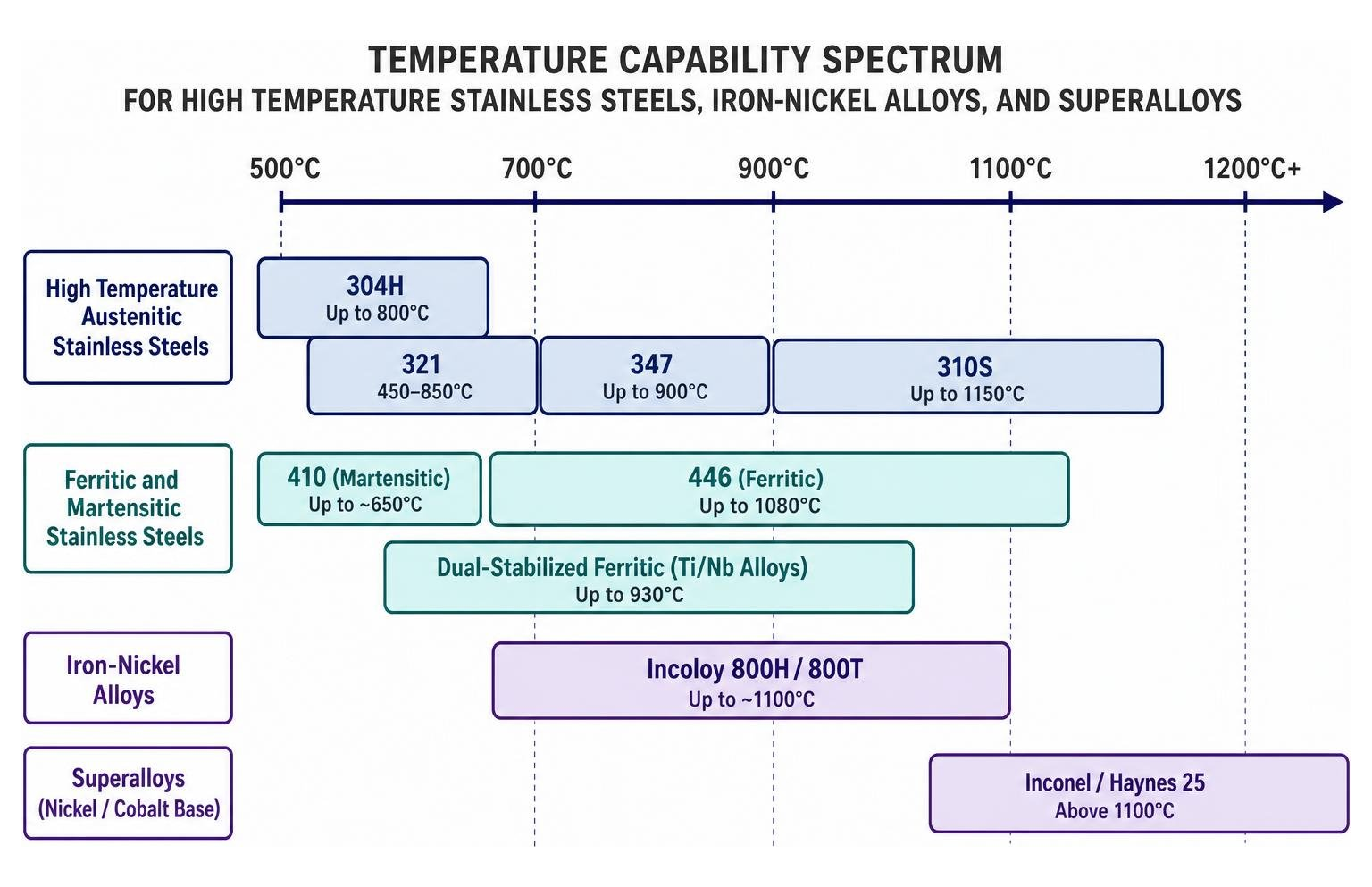
| 304H | Austenitic | 18Cr – 8Ni – 0.04-0.10C | 800°C / 1472°F | Controlled carbon enhances creep strength above 500°C | Boiler tubes, superheater headers, petrochemical piping |
| 310S | Austenitic | 25Cr – 20Ni – 1.5Si – ≤0.08C | 1150°C / 2100°F | High chromia/silica scaling resistance, carburization protection | Radiant tubes, furnace muffles, flare tips, kilns |
| 321 | Austenitic | 18Cr – 9Ni – Ti stabilized | 850°C / 1562°F | Ti prevents carbide sensitization; good cyclic strength | Aircraft exhaust manifolds, expansion joints, stack liners |
| 347 | Austenitic | 18Cr – 10Ni – Nb stabilized | 850°C / 1562°F | Nb stabilization preserves weld integrity; high creep resistance | Heavy welded reactors, refinery piping, rocket engine parts |
| 410 | Martensitic | 12Cr – 0.15C | 650°C / 1200°F | High quench-and-temper strength, erosion resistance | Steam turbine blades, valve stems, pump shafts |
| 446 | Ferritic | 25Cr – ≤0.20C – 1.0Mn – 1.0Si | 1080°C / 1975°F | High sulfur/reducing gas resistance, low thermal expansion | Recuperators, soot blowers, sulfur burner nozzles |
Comparing Austenitic High Temperature Stainless Steel Grades: 304H, 310S, 321, and 347
Austenitic stainless steels are the most widely specified materials for high-temperature service due to their face-centered cubic structure, which retains high creep-rupture strength, ductility, and toughness at elevated temperatures.
- Grade 304H (UNS S30409): Grade 304H is a high-carbon variant of standard 304 stainless steel, with carbon content controlled between 0.04% and 0.10%. This controlled carbon level provides higher creep and stress-rupture strength at temperatures above 500°C (932°F). It is widely used in power generation boiler tubing, steam headers, and petrochemical process piping operating up to 800°C (1472°F), where mechanical load-bearing capacity is required without the cost of high-nickel alloys.
- Grade 310S (UNS S31008): With 25% chromium and 20% nickel, Grade 310S is engineered for high-temperature service up to 1150°C (2100°F) in continuous oxidizing atmospheres. Its high chromium and nickel content forms an adherent, protective oxide scale that resists scaling, cyclic oxidation, and carburization. Grade 310S is standard for furnace structural supports, radiant tubes, heat treatment retorts, petrochemical flare tips, and fluid catalytic cracking (FCC) regenerators. You can read more about why grade 310 stainless steel excels in extreme heat.
- Grade 321 (UNS S32100): Grade 321 is an 18/8 austenitic alloy stabilized with titanium additions (where titanium is at least 5 times the carbon content). Titanium binds with carbon to form stable titanium carbides, preventing chromium carbide precipitation within the 450°C to 850°C (842°F to 1562°F) sensitization range. This stabilization ensures high resistance to intergranular attack in welded fabrications. Grade 321 is widely used in aerospace exhaust manifolds, bellows, expansion joints, and thermal oxidizers.
- Grade 347 (UNS S34700): Similar to Grade 321, Grade 347 uses niobium (columbium) for stabilization (where niobium is at least 10 times the carbon content). Niobium carbides remain stable at higher processing temperatures than titanium carbides, giving Grade 347 slightly higher creep strength and stress-rupture properties than Grade 321. It is often preferred for heavy-wall welded pressure vessels, refinery cracking units, and high-temperature chemical piping that cannot undergo post-weld solution annealing.
Ferritic and Martensitic High Temperature Stainless Steel Grades: 410, 446, and Advanced Alloys
While austenitic grades provide high creep strength, ferritic and martensitic alloys offer specific mechanical and physical advantages, including lower coefficients of thermal expansion, higher thermal conductivity, and resistance to high-temperature sulfur corrosion.
- Grade 410 (UNS S41000): Grade 410 is a 12% chromium martensitic stainless steel that can be heat-treated through quenching and tempering to achieve high mechanical strength, hardness, and wear resistance. While its maximum oxidation resistance is limited to approximately 650°C (1200°F), its high yield strength makes it suitable for steam turbine blades, high-temperature valve trim, fasteners, and pump components operating under combined mechanical stress and moderate heat. Learn more in our complete guide to grade 410 martensitic stainless steel.
- Grade 446 (UNS S44600): Grade 446 is a high-chromium (23–27% Cr) ferritic stainless steel with oxidation and scaling resistance up to 1080°C (1975°F). Because it contains virtually no nickel, Grade 446 resists high-temperature sulfidation, reducing gases, and molten copper or brass attack far better than austenitic grades. Its low thermal expansion reduces thermal stress during thermal cycling. However, because ferritic grades have lower creep strength at elevated temperatures and are susceptible to 475°C embrittlement and sigma phase formation, Grade 446 is primarily used for non-structural, low-stress applications such as soot blowers, furnace dampers, recuperators, and thermocouple protection tubes.
- Dual-Stabilized Ferritic Alloys (e.g., 17% Cr Ti/Nb Alloys): Modern alloy developments include advanced ferritic stainless steels with dual titanium and niobium stabilization, such as those described in stabilized ferritic alloy specifications. These alloys provide creep resistance up to 930°C along with improved thermal fatigue life compared to standard intermediate-chromium grades. Their lower thermal expansion reduces thermal stress in cyclic service, allowing automotive exhaust manifolds, converters, and industrial heat exchangers to use thinner gauges while maintaining service life.
Performance Comparisons, Standards, and Global Supply Considerations
Procuring alloys for high-temperature service requires balancing operational life, mechanical performance, design codes, and supply chain logistics.
Stainless Steel vs. Superalloys: Cost, Temperature Limits, and Upgrades
When process operating temperatures exceed 1000°C (1832°F) or sustained mechanical pressures exceed the creep-rupture strength of austenitic stainless steels, engineers must evaluate the transition from iron-base stainless steels to nickel- or cobalt-base superalloys.
| Material Class | Typical Alloys | Base Metal | Max Continuous Temp | Primary Advantages | Cost Index |
|---|---|---|---|---|---|
| Heat-Resistant Stainless | 304H, 310S, 321, 347 | Iron (Fe) | Up to 1150°C / 2100°F | Lower cost, standard fabrication, good general oxidation resistance | Base (1x) |
| High-Temp Iron-Nickel | Incoloy 800H / 800T | Iron-Nickel (Fe-Ni-Cr) | Up to 1000°C / 1832°F | Controlled Al+Ti gives high creep strength; carburization resistance | Moderate (3x – 4x) |
| Nickel Superalloys | Inconel 600, 625, 718 | Nickel (Ni) | Up to 1100°C / 2012°F | High creep strength, handles cyclic stress and aggressive environments | High (6x – 10x) |
| Cobalt Superalloys | Haynes Alloy 25 (L-605) | Cobalt (Co) | Up to 1000°C+ / 1832°F+ | High sulfidation and wear resistance under extreme thermal stress | Premium (12x – 18x) |
For intermediate transitions where standard stainless steels show high creep rates, iron-nickel-chromium alloys like Alloy 800H/800T offer a balanced upgrade. With controlled aluminum and titanium content, these alloys maintain microstructural stability and high 10,000-hour creep rupture strength between 600°C and 900°C.
For severe mechanical loads and cyclic stress above 1000°C, nickel-base superalloys (such as Inconel) provide solid solution strengthening and precipitate hardening (gamma prime and gamma double prime phases) that prevent dislocation movement under high pressure. When you need to determine the right transition point between alloy families, review our guide on when to upgrade from stainless steel to nickel alloys.
For critical high-pressure and high-temperature service, examine high-temperature nickel alloys that resist pressure alongside specialized resources covering cobalt-based Haynes Alloy 25 capabilities.
Manufacturing Standards, Heat Treatment, and Supply Chain Factors
Producing and certifying high-temperature stainless steel components involves strict manufacturing controls, standardized heat treatments, and compliance with major industrial codes:
- Melting and Refining: High-temperature stainless steels are melted in Electric Arc Furnaces (EAF) and refined through Argon Oxygen Decarburization (AOD) or Vacuum Oxygen Decarburization (VOD) to control tramp elements (such as sulfur, phosphorus, and lead) that degrade high-temperature ductility.
- Heat Treatment and Grain Size Control: For creep-resistant grades like 304H, 310S, and 800H, solution annealing is critical. Annealing at 1120°C to 1220°C dissolves coarse precipitates and establishes an ASTM No. 7 or coarser grain size. Coarser grains reduce grain boundary surface area, helping inhibit grain boundary sliding under sustained creep loads.
- Governing Standards and Codes: Key material specifications include ASTM A240 (pressure vessel plate/sheet), ASTM A312 (seamless/welded pipe), ASTM A182 (forged fittings and flanges), and ASME Boiler and Pressure Vessel Code (BPVC) Sections II and VIII, which establish maximum allowable stress values across operating temperatures. International fabrications often reference material grouping systems such as ISO 15608.
- Welding and Fabrication Practices: Austenitic high-temperature alloys have lower thermal conductivity and higher thermal expansion coefficients than carbon steel, increasing their susceptibility to distortion and hot cracking during welding. Recommended fabrication practices include using low heat-input welding techniques (such as GTAW or GMAW), matching filler metals (e.g., 308H, 309H, 310), using wider root gaps, and maintaining interpass temperatures below 150°C (302°F).
- Global Supply Chain and Trade Compliance: Sourcing high-temperature alloys requires tracking global supply chain factors and trade regulations. With global crude steel output exceeding 1,882 million metric tons, trade frameworks such as Section 232 tariffs, country-of-origin documentation, and Harmonized Tariff Schedule (HTSUS) classifications (Headings 7218–7223) require complete melt-and-pour documentation and Mill Test Reports (MTRs) to confirm alloy chemistry and compliance.
Frequently Asked Questions About Heat-Resistant Alloys
What is the maximum continuous service temperature for Grade 310S stainless steel?
In continuous oxidizing atmospheres, Grade 310S has a maximum operating temperature of approximately 1150°C (2100°F). Its 25% chromium and 20% nickel content forms an adherent chromium-silicon oxide scale that resists high-temperature oxidation and internal scaling. In intermittent service with frequent thermal cycling, its practical limit drops to around 1035°C (1900°F) to prevent scale spallation.
How does creep deformation differ from thermal fatigue at elevated temperatures?
Creep deformation is a time-dependent, permanent plastic deformation that occurs when a metal is subjected to a constant mechanical load at elevated temperatures over long periods. Thermal fatigue is structural damage and cracking caused by cyclic temperature fluctuations, which generate cyclic thermal stresses from localized expansion and contraction, even without an external mechanical load.
Why are stabilized grades like 321 and 347 preferred over standard 304 at elevated temperatures?
Standard Grade 304 precipitates chromium carbides along its grain boundaries when exposed to temperatures between 450°C and 850°C (842°F to 1562°F), depleting chromium from adjacent areas and causing intergranular corrosion upon moisture contact. Stabilized grades add titanium (Grade 321) or niobium (Grade 347), which bond with carbon preferentially. This keeps chromium in solid solution, preventing sensitization while providing higher creep and stress-rupture properties in welded equipment.
Conclusion
Selecting the right high-temperature stainless steel grade requires balancing peak operating temperatures, continuous versus cyclic thermal service, mechanical creep loads, and furnace gas chemistry. From controlled-carbon Grade 304H in boiler piping to 25Cr–20Ni Grade 310S in furnace retorts, matching alloy properties to operational conditions is essential for plant safety and service life.
At James Duva Inc., our team has supplied high-grade stainless steel and nickel alloy products from Branchburg, NJ since 1978. We support critical operations across the power generation, chemical processing, oil & gas, and refining sectors with fully certified pipe, valves, fittings, and flanges.
For a complete overview of available alloy families and product forms, consult our detailed guide to stainless steel types or contact our technical sales team for specialized material recommendations.
About James Duva Inc.
Since 1978, James Duva Inc. has been your trusted source for stainless steel and high-nickel alloy industrial products. Whether you’re in the water treatment, process or power industry, we pride ourselves on always having what you need. Say goodbye to your sourcing problems with just one call to James Duva.