
Industrial Heat Heroes and Where Inconel Thrives Under Fire
Oct 21, 2026
Where Inconel Earns Its Place in Extreme Heat
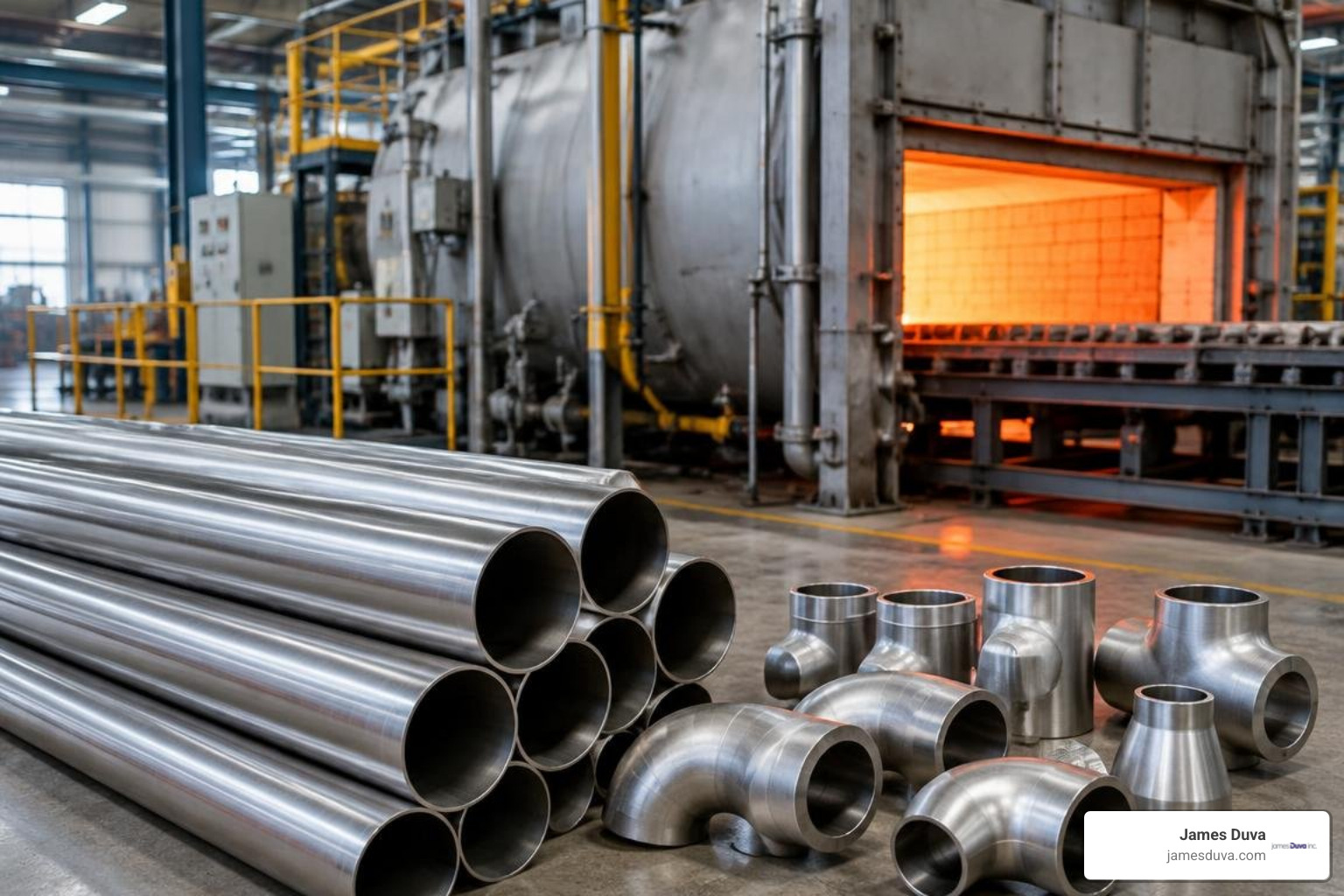
Inconel is used where heat, stress, and corrosion can cause ordinary metals to fail. Its nickel-based alloys help turbine parts hold their shape, furnace components resist oxidation, and process equipment withstand hot, corrosive fluids. The right grade depends on the job: Inconel 718 is valued for strength at temperatures up to about 650°C (1,202°F), while 600 and 625 are often chosen for their resistance to heat and corrosion.
I’m Billy Walker, vice president of James Duva Inc., where I help power and process customers source high-nickel piping components. That experience informs this guide to inconel high temperature applications, starting with where these alloys do their most useful work.
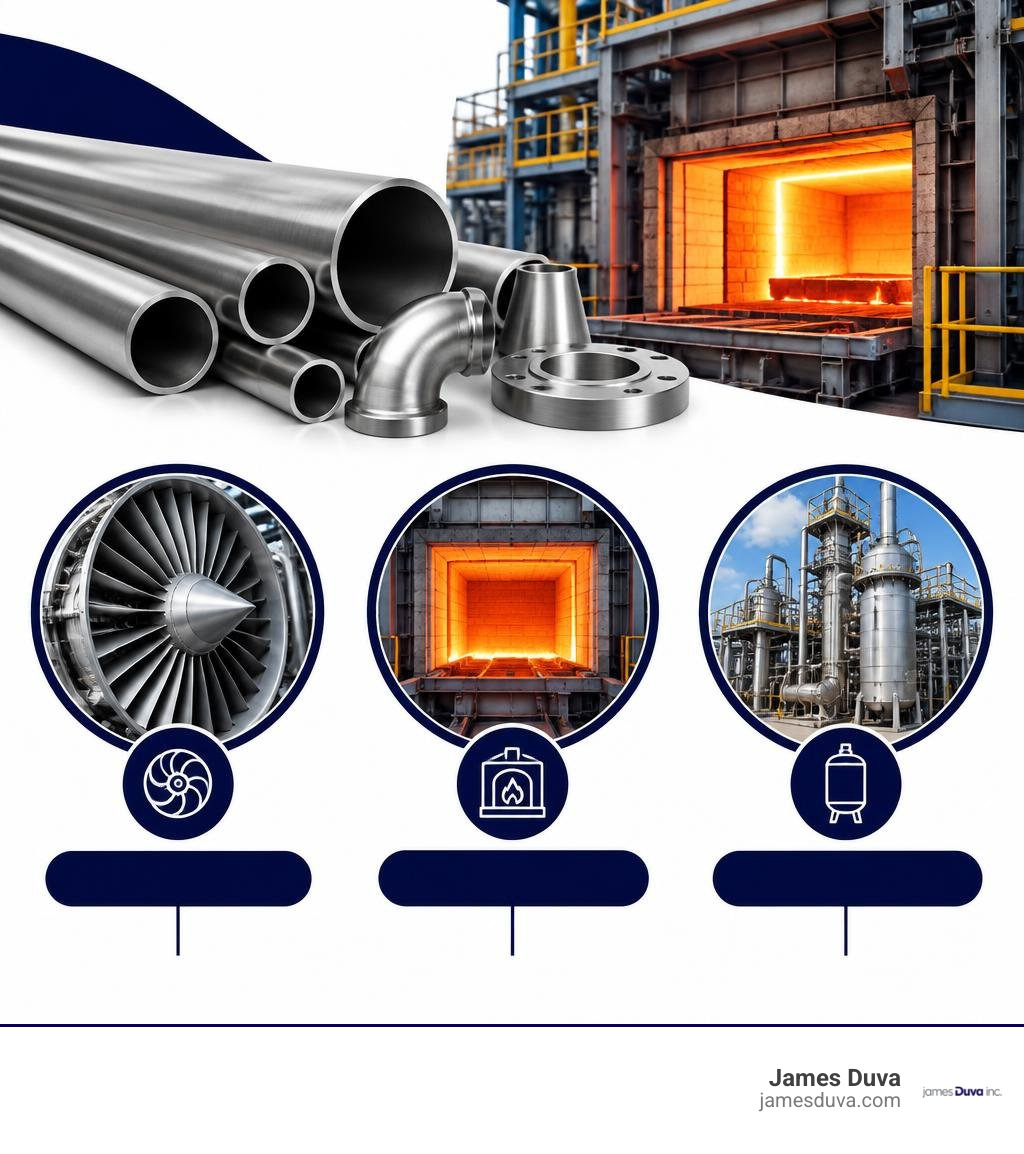
Inconel high temperature applications terms made easy:
Why Are Alloys So Valuable in Industry?
Elemental base metals like pure iron are often too soft for heavy structural duty and are prone to rust when exposed to moisture and air. To solve these limitations, materials scientists blend base metals with carbon, chromium, nickel, and molybdenum to form engineered alloys. Standard structural steel, for example, delivers superior strength and durability compared to raw iron, allowing modern bridges and commercial buildings to carry massive static and dynamic loads.
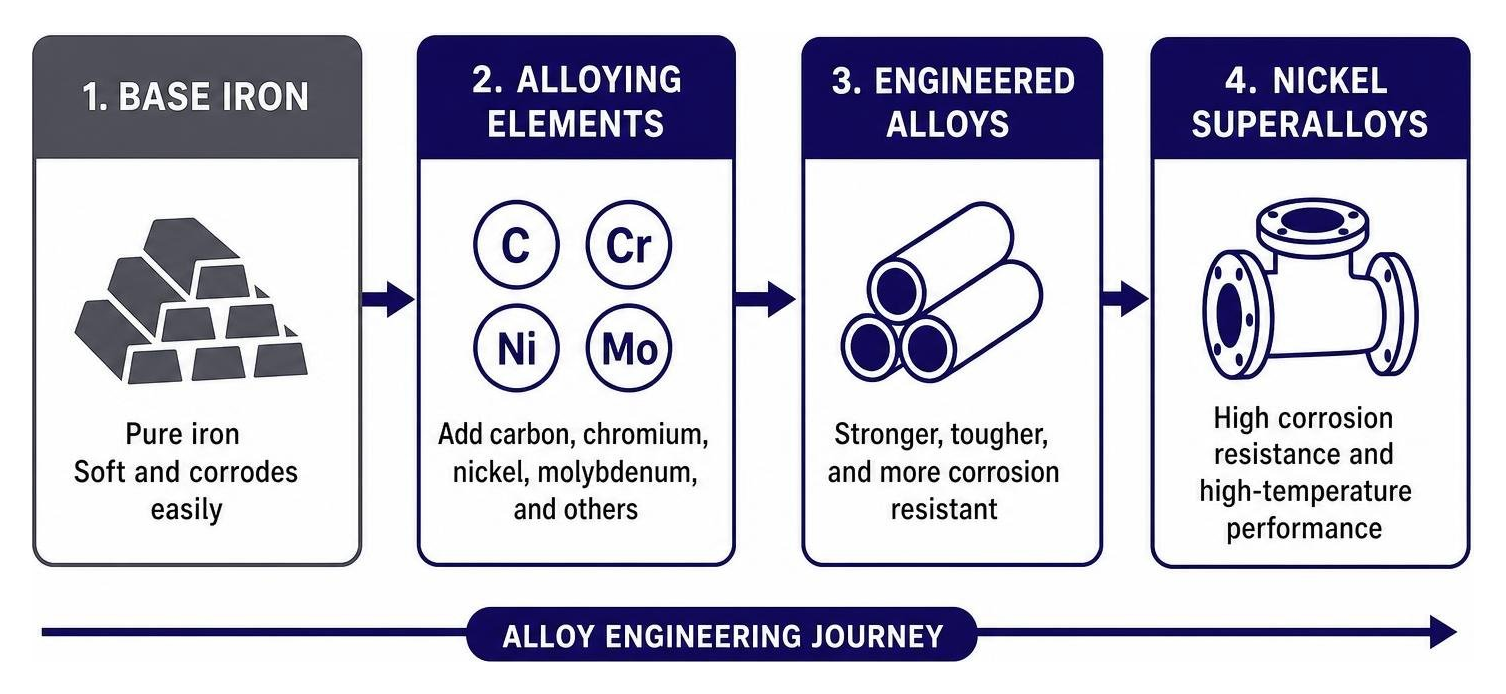
Alloy formulation enables modern infrastructure across major sectors:
- Construction: High-strength carbon and structural alloy steels form load-bearing beams, reinforcement rebar, and primary piping infrastructure in commercial building projects.
- Oil & Gas: Heavy-duty process systems rely on specialized alloy components, high-integrity Ball Valves, flanges, and forged fittings to contain pressurized, corrosive hydrocarbons.
- Automotive & Aerospace: Precision-engineered alloys construct high-rigidity chassis frames, structural fuselage bulkheads, and combustion engine assemblies.
- Medical & Consumer Goods: Biocompatible titanium and stainless alloys yield surgical bone implants, while durable austenitic grades form sterile medical tools and commercial kitchenware.
Standard alloys eventually hit physical boundaries under extreme operational demands. When temperatures exceed several hundred degrees Celsius alongside aggressive chemical exposure, ordinary steels soften, scale, and deform. Industrial operations turn to metals engineered for intense heat and rust resistance to maintain mechanical integrity where conventional grades fail.
The Metallurgy of Superalloys: What Keeps Inconel Stable at Extreme Heat?
Inconel superalloys withstand severe environments because of their face-centered cubic (FCC) austenitic nickel-chromium solid matrix. Unlike ferritic steels that undergo crystal phase transformations when heated, the austenitic nickel lattice remains structurally stable from cryogenic temperatures up to its melting boundary.
High chromium levels react with atmospheric oxygen at elevated temperatures to form an adherent, self-passivating chromium oxide (Cr2O3) scale. This continuous barrier restricts oxygen diffusion into the base metal, preventing catastrophic oxidation and carburization.
The thermal properties of Inconel support high-heat operations. As detailed in the manufacturer’s Physical Constants and Thermal Properties documentation, Inconel 600 features a melting range of 2,470°F to 2,575°F (1,354°C to 1,413°C), a density of 0.306 lb/in³ (8.47 Mg/m³), and a Young’s modulus of 31.1 × 10³ ksi (214 GPa) at room temperature. Its mean coefficient of thermal expansion is 7.4 × 10⁻⁶ in/in-°F (13.3 μm/m-°C) at 200°F (93°C), moderating thermal shock stresses during rapid temperature swings.
Understanding why high-temperature nickel alloys resist pressure comes down to atomic packing: the nickel lattice offers low atomic self-diffusion rates, which severely restricts dislocation climb and atomic grain-boundary sliding under high loads.
Precipitation Hardening vs. Solid Solution Strengthening
Nickel superalloys derive their mechanical load-bearing capability from two strengthening mechanisms: solid-solution strengthening and precipitation hardening.
Solid-solution strengthened alloys, such as Inconel 600 and Inconel 625, disperse heavy alloying elements throughout the primary nickel matrix. Refractory elements like molybdenum and niobium distort the crystal lattice, generating localized internal stress fields. These stress fields block dislocation movement across slip planes, preserving mechanical strength across wide operating temperature spans.
Precipitation-hardened superalloys, like Inconel 718 and Inconel X-750, utilize controlled aging heat treatments to grow nanoscale intermetallic phases within the matrix. Elements such as titanium, aluminum, and niobium precipitate into coherent particles that act as physical barriers against dislocation motion.
While precipitation-hardened grades deliver exceptionally high yield strength at moderate-to-high temperatures, solid-solution grades provide superior structural ductility and thermal stability in environments exceeding the aging window.
Phase Dynamics: Gamma Prime, Gamma Double Prime, and the Delta Phase
The mechanical performance of precipitation-hardened Inconel relies on microstructural phase dynamics:
- Gamma Prime (γ′ – Ni3[Al, Ti]): An ordered face-centered cubic intermetallic precipitate that provides steady creep resistance at elevated temperatures.
- Gamma Double Prime (γ″ – Ni3Nb): A body-centered tetragonal precipitate that provides the primary high-strength mechanism in Inconel 718. The lattice strain around γ″ discs creates strong barriers to dislocation glide.
- Delta Phase (δ – Ni3Nb): An equilibrium orthorhombic phase that forms when the metastable γ″ precipitate is exposed to temperatures above 650°C (1,202°F) for extended durations. While small amounts of delta phase at grain boundaries help control grain growth during hot working, excessive delta precipitation depletes niobium from the matrix, reducing tensile and rupture strength.
- Laves Phase ([Ni, Fe, Cr]2[Nb, Mo, Ti]): An undesirable, brittle hexagonal close-packed intermetallic compound that can segregate during welding or casting. Laves phase depletes essential strengthening elements and initiates premature microcracks.
Top Inconel Alloys for High-Heat Environments
Selecting an appropriate superalloy requires balancing temperature limits, mechanical stress requirements, and environmental exposure conditions. A broader Inconel material overview highlights that subtle adjustments to alloying elements significantly alter thermal and mechanical performance.
| Alloy Grade | Primary Composition (%) | Strengthening Type | Max Operating Temp | Key Characteristics |
|---|---|---|---|---|
| Inconel 600 | 72.0 Ni, 15.5 Cr, 8.0 Fe | Solid Solution | 2,000°F (1,095°C) | Oxidation resistance, halogen attack resistance, chloride cracking immunity |
| Inconel 625 | 58.0 Ni, 21.5 Cr, 9.0 Mo, 3.6 Nb | Solid Solution | 1,800°F (982°C) | High fatigue strength, pitting and crevice corrosion resistance, weldability |
| Inconel 718 | 52.5 Ni, 19.0 Cr, 3.0 Mo, 5.1 Nb, 0.9 Ti, 0.5 Al, Bal Fe | Precipitation (γ″ + γ′) | 1,200°F (650°C) | High yield and creep-rupture strength, post-weld crack resistance |
| Inconel X-750 | 70.0 Ni, 15.5 Cr, 2.5 Ti, 0.7 Al, 1.0 Nb, 7.0 Fe | Precipitation (γ′) | 1,300°F (704°C) | Relaxation resistance, high-temperature spring resilience |
When evaluating raw stock dimensions for industrial projects, reviewing round rod and bar alloy selection helps match material cross-sections with specific design criteria.
Inconel 600: Thermal Shock Resistance and High-Temperature Corrosion Protection
Inconel 600 serves as a standard engineering material for industrial thermal processing. In the annealed condition at room temperature, it offers a tensile strength of 80 to 100 ksi (550 to 690 MPa). It retains approximately 60 ksi (414 MPa) tensile strength at 1,000°F (538°C). Its shear strength reaches 60.8 ksi (419.2 MPa) annealed and 82.4 ksi (568.1 MPa) in the full-hard temper.
For high-temperature creep resistance, Inconel 600 demonstrates a creep rate of 0.01% per 1,000 hours at 1,000°F (538°C) under a constant stress of 6.10 ksi (42.1 MPa). It delivers a 10,000-hour stress-rupture life at 1,200°F (649°C) under 9.40 ksi (64.8 MPa). Toughness remains stable across temperatures; its Charpy keyhole impact strength measures 63.5 ft-lb (86.1 J) at room temperature and 60.8 ft-lb (82.4 J) at -320°F (-196°C).
Reviewing the essential properties of Inconel 600 shows that its minimum 72% nickel composition prevents chloride-ion stress-corrosion cracking while resisting reducing gases. Its total normal emissivity ranges from 0.85 to 0.98 in oxidized states from 900°F to 2,000°F (480°C to 1,090°C), making it suitable for furnace muffles, heat-treating retorts, and nuclear reactor thermal wells.
Inconel 625: Solid-Solution Powerhouse for Extreme Temperatures
Inconel 625 achieves high yield and tensile strength without age-hardening heat treatments. The interaction between molybdenum (9%) and niobium (3.6%) inside its nickel-chromium matrix strengthens the alloy lattice without inducing phase instability.
Engineers rely on the technical breakdown of Inconel 625 when designing equipment that must endure hot, corrosive service conditions. The alloy resists pitting, crevice corrosion, and intergranular attack up to 1,800°F (982°C).
When evaluating Inconel 600 versus 625, grade 625 delivers superior fatigue strength and hot acid resistance, making it an effective choice for sea-water piping, submerged flare-boom components, and high-temperature chemical scrubbers.
Inconel 718 and X-750: Precipitation-Hardened Heat Resistance
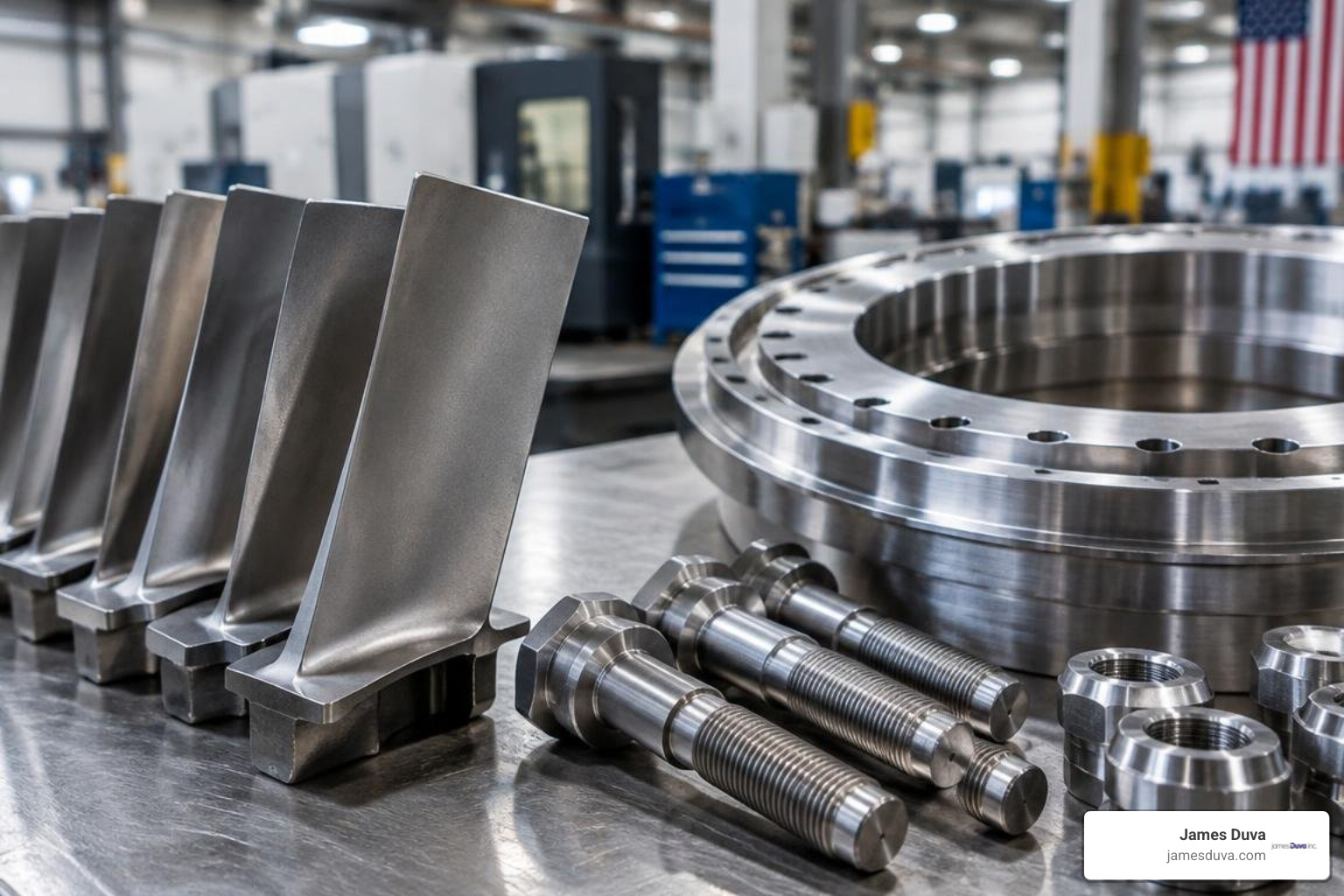
Inconel 718 has a solidus temperature of 1,260°C (2,300°F) and a liquidus of 1,336°C (2,437°F). It retains high tensile strength and fatigue resistance at temperatures up to 650°C (1,202°F), achieving an endurance limit (10⁸ cycles) of 85 to 114 ksi (586 to 786 MPa) at room temperature in the annealed state.
At 650°C to 700°C, Inconel 718 exhibits a creep stress exponent near n=36. This high exponent indicates that steady-state creep deformation rates depend heavily on applied stress levels, requiring precise structural calculations during component design.
Inconel X-750 uses titanium and aluminum to form strengthening γ′ precipitates. It resists relaxation under stress at temperatures reaching 1,300°F (704°C), making it a reliable alloy for high-temperature springs, gas turbine bolts, and extrusion tooling.
Primary Inconel High Temperature Applications Across Major Industries
Superalloys serve in aggressive environments where components face mechanical stress, thermal cycling, and chemical degradation simultaneously. When analyzing corrosion-resistant nickel alloys in aggressive service, matching the alloy chemistry to the thermal envelope is critical.
In some chemical processes, comparing Hastelloy and Inconel performance helps determine whether severe acid corrosion or mechanical thermal creep is the primary failure mode. For lower thermal duty, evaluating high-temperature 310 stainless steel against superalloys offers a practical baseline for structural cost optimization.
Aerospace and Rocketry: Critical Inconel High Temperature Applications
In commercial turbofans and military jet engines, Inconel superalloys withstand intense combustion temperatures:
- Combustor Liners and Baskets: Alloys 600 and 625 resist hot thermal gas flows and aggressive combustion byproducts.
- Turbine Discs and Rotor Rings: Inconel 718 provides high tensile and creep-rupture strength beneath rotating turbine stages.
- Rocket Thrust Chambers and Injectors: Additively manufactured Inconel 718 combustion chambers endure intense thermal gradients across thin cooling jackets during static burns and orbital launches.
- Afterburner Envelopes and Exhaust Nozzles: Solid-solution grades maintain structural shape under dynamic acoustic loads and hot exhaust gases.
Energy, Nuclear, and Petrochemical Processing
Energy infrastructure requires long-term component durability to avoid unplanned downtime:
- Nuclear Steam Generators: Inconel 600 and 690 tubing resists high-purity water stress corrosion at elevated temperatures and pressures.
- Reformer Furnaces and Pyrolysis Coils: Inconel piping withstands continuous carburizing and oxidizing environments during hydrocarbon cracking.
- Flare Stack Tips and Acid Recovery: Plants evaluating Hastelloy C-276 and Inconel 625 often select Inconel 625 for its balance of high-temperature strength and mixed-acid resistance.
- Waste Incineration Retorts: Heavy structural alloy assemblies resist attack from chlorine, sulfur, and volatilized heavy metals at temperatures up to 2,000°F.
High-Performance Automotive and Racing Exhausts
High-performance motorsport environments test materials against rapid thermal cycling and extreme vibration:
- Exhaust Headers and Manifolds: Formula One and high-end racing vehicles use thin-wall Inconel 625 exhaust tubing to reduce weight while surviving 1,000°C exhaust gas streams without cracking.
- Turbocharger Turbine Housings and Wastegates: Cast and machined Inconel components resist thermal fatigue and erosion from hot exhaust pulses.
- High-Amperage Electrical Contacts: Modern performance electric vehicles employ Inconel structural busbar contact springs to conduct high-amperage current without thermal relaxation or contact degradation.
Manufacturing and Processing Challenges Under Extreme Heat
Inconel’s high-temperature strength creates specific challenges during workshop fabrication:
- Machining Dynamics: Inconel alloys work-harden rapidly. As cutting tools contact the metal, the shear zone hardens immediately, accelerating tool wear. Machining requires rigid setups, positive rake tool geometry, and slow cutting speeds paired with continuous feeds to cut beneath the work-hardened surface layer.
- Cryogenic and Advanced Machining: Utilizing high-pressure cryogenic cooling (liquid nitrogen or supercritical carbon dioxide) directs coolant precisely into the tool-chip interface, reducing localized cutting temperatures and extending tool life. Ceramic and PCBN tooling enable higher surface speeds during roughing operations.
- Welding Challenges: Precipitation-hardened grades like Inconel 718 can develop microfissuring and strain-age cracking in the heat-affected zone. To limit these issues, parts are welded in the solution-annealed condition using gas tungsten arc welding (GTAW) or electron beam welding (EBW), followed by complete solution treating and aging cycles.
- Additive Manufacturing (AM): Laser powder bed fusion (LPBF) and directed energy deposition (DED) produce complex, thin-walled Inconel 718 and 625 geometries. AM processes generate fine cellular dendrites and anisotropic grain growth due to rapid solidification rates, requiring post-process hot isostatic pressing (HIP) and solution annealing to eliminate micro-porosity and optimize mechanical fatigue resistance.
Frequently Asked Questions About High-Temperature Inconel
What makes Inconel superior to stainless steel at elevated temperatures?
While 300-series austenitic stainless steels provide cost-effective heat resistance up to roughly 1,500°F (815°C), their load-bearing capacity declines sharply as temperatures rise. Inconel superalloys maintain high tensile and creep-rupture strength past these limits due to their stable face-centered cubic nickel matrix, solid-solution elements, and gamma prime or gamma double prime precipitates.
In addition, Inconel forms a self-passivating chromia layer that resists oxidation and cyclic spalling better than the oxide films formed on standard stainless grades.
How does Inconel 718 withstand creep and thermomechanical fatigue?
Inconel 718 resists creep and thermomechanical fatigue through its coherent γ″ (Ni3Nb) precipitates, which create strong lattice strain fields that pin crystal dislocations and prevent them from climbing under thermal stress.
To maximize this resistance, components undergo a dual-stage aging heat treatment (typically 8 hours at 1,325°F/718°C, furnace cooling to 1,150°F/621°C, and holding for a total aging duration of 18 hours). This controlled process precipitates fine, uniformly dispersed γ″ and γ′ phases throughout the microstructure.
What are the main limitations of using Inconel in extreme heat?
The primary limitation of Inconel 718 is its upper temperature threshold of roughly 650°C (1,202°F). Prolonged exposure above this limit causes the metastable γ″ precipitates to transform into the equilibrium delta (δ) phase, which depletes niobium and lowers the alloy’s strength.
From a manufacturing standpoint, raw material costs are substantially higher than standard stainless grades, and aggressive work-hardening requires specialized tooling, rigid setups, and longer machining cycles.
Conclusion
Industrial systems operating in extreme environments rely on nickel superalloys to maintain mechanical strength, dimensional stability, and oxidation resistance. Selecting the appropriate grade—whether solid-solution strengthened Inconel 600 and 625 or precipitation-hardened Inconel 718—ensures mission-critical reliability across aerospace turbines, chemical reactors, and high-temperature energy systems.
Since 1978, James Duva Inc. has operated from our central facility in Branchburg, NJ, supplying high-grade stainless steel and specialty nickel alloy piping, valves, and fittings to demanding industrial sectors. For technical assistance with material selection, dimensional specifications, or custom procurement, explore our specialty Inconel inventory and technical solutions to support your next high-temperature project.
About James Duva Inc.
Since 1978, James Duva Inc. has been your trusted source for stainless steel and high-nickel alloy industrial products. Whether you’re in the water treatment, process or power industry, we pride ourselves on always having what you need. Say goodbye to your sourcing problems with just one call to James Duva.