
Choosing the Right Superalloy When Inconel 600 and 625 Face Off
Oct 15, 2026
Inconel 600 vs 625: Which Should You Choose?
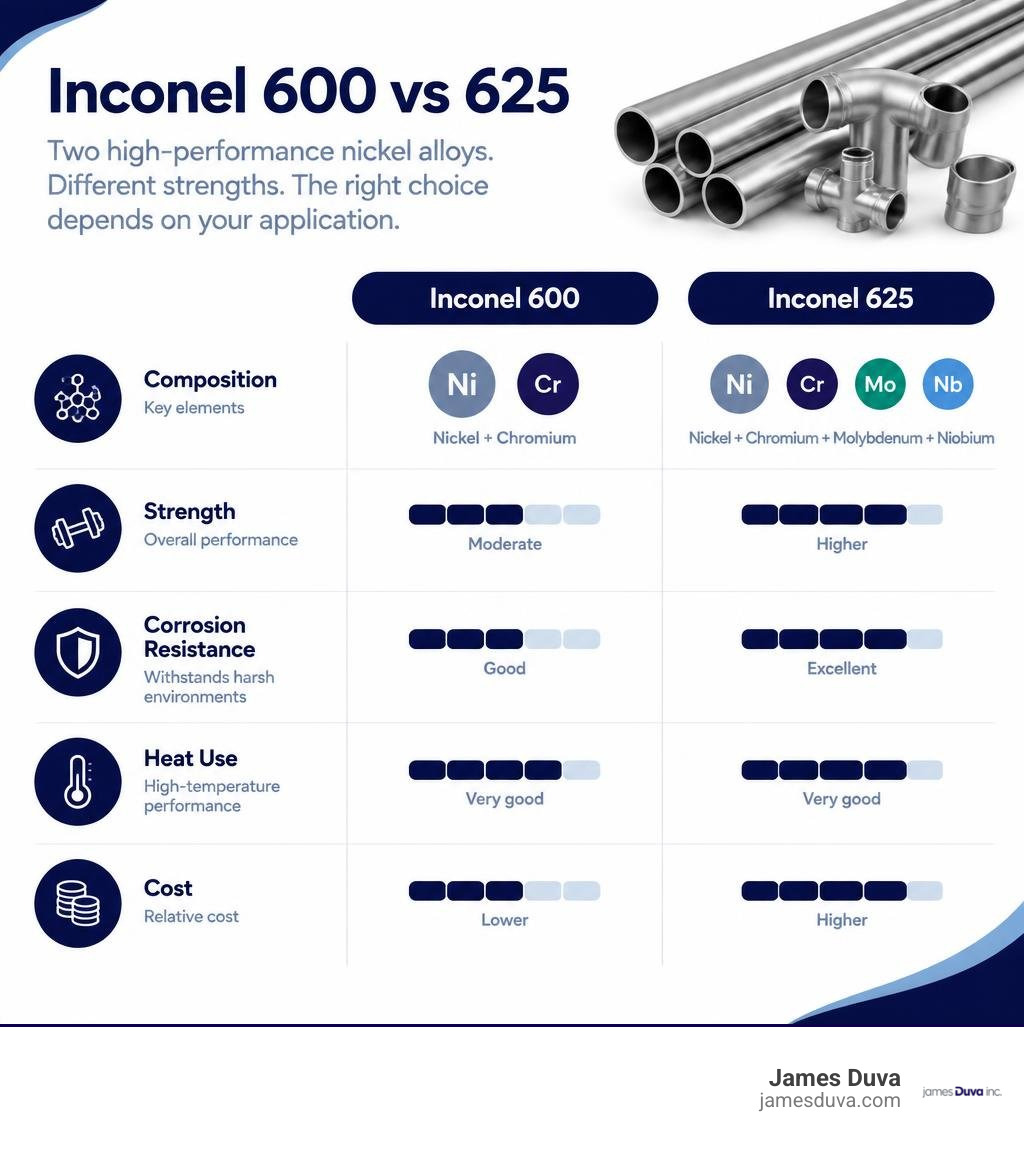
Choose Inconel 600 for hot, oxidizing equipment when its corrosion resistance meets the job’s needs. Choose Inconel 625 when you need greater strength or better protection against seawater, chloride pitting, and corrosive process fluids. The key difference is composition: 625 adds molybdenum and niobium and contains more chromium, while 600 is a simpler nickel-chromium alloy that may cost less.
I’m Billy Walker, vice president of James Duva Inc., where I help source specialty piping for power, process, and water treatment projects. That experience shapes this guide to inconel 600 vs 625, starting with why alloy choice matters.
Terms related to inconel 600 vs 625:
Why Are Alloys So Valuable in Industry?
Pure metals have their place, but in heavy industry, they rarely have the muscle to handle tough operating environments. Pure metals like elemental iron, for instance, are often too soft, malleable, or prone to rapid oxidation and rust when exposed to moisture and oxygen, whereas alloys like steel and specialized nickel formulations offer superior strength and durability. To build components that withstand high pressures, aggressive chemicals, and extreme thermal cycling, engineers turn to engineered alloys.
By blending base elements like nickel or iron with chromium, molybdenum, niobium, and carbon, metallurgists create crystalline matrices that resist deformation, wear, and corrosive attack. Understanding when to upgrade from stainless steel to nickel alloys is critical across various sectors:
- Construction: Heavy-duty structural beams, specialized piping, and architectural supports require alloys that prevent premature mechanical failure.
- Oil & Gas: Downhole equipment, subsea manifolds, high-pressure fittings, flanges, and severe-service Ball Valves rely on specialized alloys to resist sour gas and chloride stress cracking.
- Automotive & Aerospace: Exhaust frames, engine combustion chambers, turbine discs, and thrust reversers demand materials with high strength-to-weight ratios and oxidation resistance.
- Medical & Consumer Goods: Surgical tools, prosthetic implants, and specialized commercial kitchenware utilize corrosion-resistant formulations for cleanliness, biocompatibility, and durability.
When operating conditions exceed what standard stainless steels can handle, nickel-based superalloys like Inconel 600 and Inconel 625 step in.
Chemical Composition and Mechanical Properties: Inconel 600 vs 625
The primary differences between Inconel 600 and Inconel 625 stem from their distinct chemical compositions. Inconel 600 is fundamentally a high-nickel, moderate-chromium binary alloy, whereas Inconel 625 is a multi-element solid-solution-strengthened superalloy containing substantial amounts of molybdenum and niobium.
| Property / Element | Inconel 600 (UNS N06600) | Inconel 625 (UNS N06625) |
|---|---|---|
| Nickel (Ni) | 72.0% min | 58.0% min |
| Chromium (Cr) | 14.0% – 17.0% | 20.0% – 23.0% |
| Molybdenum (Mo) | — | 8.0% – 10.0% |
| Niobium + Tantalum (Nb+Ta) | — | 3.15% – 4.15% |
| Iron (Fe) | 6.0% – 10.0% | 5.0% max |
| Room Temp. Tensile Strength | 550 – 690 MPa (80 – 100 ksi) | 827 – 1034 MPa (120 – 150 ksi) |
| Room Temp. Yield Strength (0.2%) | 240 – 345 MPa (35 – 50 ksi) | 414 – 600 MPa (60 – 87 ksi) |
| Density | 8.47 g/cm³ (0.306 lb/in³) | 8.44 g/cm³ (0.305 lb/in³) |
| Thermal Conductivity (at 100°C) | 14.9 W/m·K | 9.8 W/m·K |
Chemical Makeup and Strengthening Mechanisms
Inconel 600 relies primarily on its high nickel content (minimum 72%) to provide resistance to chloride-ion stress corrosion cracking and alkaline media. Its chromium content delivers oxidation resistance at elevated temperatures. However, because it lacks refractory elements, its strength comes mostly from solid solution hardening of the nickel matrix and basic cold working. You can review full mechanical and chemical limits in our guide to Inconel 600 specifications.
In contrast, Inconel 625 derives its strength from the interaction between its nickel-chromium matrix and the addition of 8% to 10% molybdenum and 3.15% to 4.15% niobium. These heavy refractory atoms distort the face-centered cubic (FCC) lattice, creating solid-solution strengthening that prevents dislocation movement without requiring precipitation-hardening heat treatments. For an in-depth breakdown of these mechanisms, explore our guide to Inconel 625 properties.
Mechanical Strength and High-Temperature Performance

At ambient temperatures, Inconel 625 delivers nearly double the yield strength of Inconel 600. Its room-temperature tensile strength reaches 827 to 1034 MPa, compared to Inconel 600’s 550 to 690 MPa.
When evaluated under creep and stress-rupture conditions at 650°C (1200°F), Inconel 625 maintains a rupture life of 1,000 hours at a stress level of 150 MPa. Inconel 600 achieves a 1,000-hour rupture life at the same temperature under a lower stress of 100 MPa. Practical insights into these mechanical behaviors are frequently reviewed in engineering discussions on Inconel 600 and Inconel 625.
Corrosion Resistance and Environmental Durability
Both alloys offer exceptional resistance across severe environments, but their optimal performance windows differ based on specific chemical exposures. Engineers sourcing corrosion resistant nickel alloys must weigh oxidizing versus reducing conditions, as well as the presence of aggressive halides.
Pitting and Acid Corrosion: Inconel 600 vs 625
In marine and halide-rich environments, Inconel 625 outperforms Inconel 600. The combination of 20% to 23% chromium and 8% to 10% molybdenum gives Inconel 625 a Pitting Resistance Equivalent Number (PREN) above 45. In seawater testing, Inconel 625 exhibits a Critical Pitting Temperature (CPT) exceeding 100°C, remaining virtually immune to pitting and crevice corrosion under standard marine exposures.
Inconel 600, having no molybdenum and a lower chromium content (14% to 17%), records a CPT of approximately 20°C in similar halide environments. While Inconel 600 performs well in caustic soda and alkaline solutions, it is vulnerable to pitting in stagnant seawater and localized attack in acidic chloride media. For facilities handling severe acid combinations, engineers often evaluate Inconel 625 alongside other specialized chemistries, as seen in our comparison of Hastelloy C-276 and Inconel 625.
High-Temperature Oxidation and Thermal Cycling: Inconel 600 vs 625
For high-temperature dry oxidation, Inconel 600 remains an industry benchmark. With a continuous service rating up to 1093°C (2000°F) in oxidizing atmospheres, it forms a protective, tightly adherent oxide scale that resists spalling under moderate thermal cycles. Furthermore, its higher thermal conductivity (14.9 W/m·K at 100°C vs. 9.8 W/m·K for Inconel 625) facilitates rapid heat dissipation, reducing thermal gradients across heavy walls.
Inconel 625 is generally rated for continuous service up to 982°C (1800°F). While it possesses superior strength at intermediate temperatures (600°C to 850°C), prolonged exposure in the 600°C to 750°C range can precipitate intermetallic phases (such as delta phase), which slightly reduces room-temperature ductility over long operating campaigns. Comprehensive evaluations of high-temperature scale stability can be reviewed in Inconel alloy oxidation behavior research.
Fabrication, Weldability, and Cost Considerations
Fabricability plays a major role in project scheduling and overall lifecycle costs:
- Machining: Both alloys work-harden rapidly. Rigid tooling, heavy feed rates, sharp carbide inserts, and positive rake angles are essential. Inconel 625 generates higher tool wear due to its higher shear strength and abrasive molybdenum/niobium content.
- Welding: Inconel 625 offers exceptional weldability. It is widely used as a cladding overlay and filler metal (ERNiCrMo-3) because its weld deposits resist hot cracking and strain-age cracking without requiring post-weld heat treatment (PWHT). Inconel 600 is readily weldable using matching filler metals (such as ERNiCr-3), but joint designs must account for thermal expansion and potential micro-fissuring in thick cross-sections.
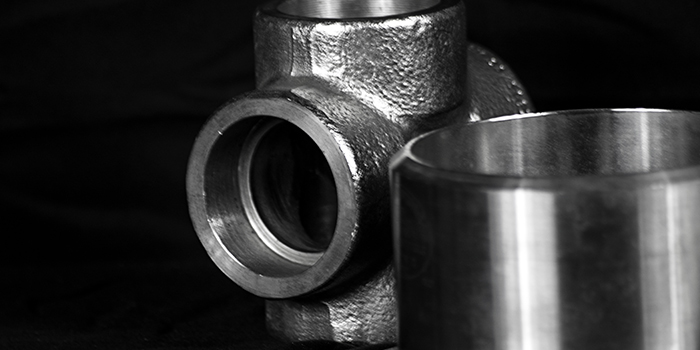
- Forming & Tubing: Both grades can be cold-worked into seamless and welded tubular products. When designing high-pressure instrumentation or heat exchangers, engineers source durable nickel alloy tubing paired with specialized nickel alloy fittings to maintain mechanical integrity throughout the piping network.
- Cost: Due to significant additions of molybdenum and niobium, raw material costs for Inconel 625 typically range from $30 to $40 per kg, whereas Inconel 600 averages $20 to $30 per kg. When high mechanical strength or severe pitting resistance is not strictly required, Inconel 600 offers an economical alternative for thermal service.
Industrial Applications and Selection Guide
Selecting between Inconel 600 and Inconel 625 depends on balancing temperature, chemical exposure, mechanical loads, and budget constraints:

- Aerospace: Inconel 625 is widely selected for ducting systems, engine exhaust liners, thrust reversers, and turbine shroud rings where fatigue strength and high yield stress are mandatory. Inconel 600 is used in jet engine lockwire and non-structural heat-shielding components.
- Chemical Processing: Inconel 600 serves in furnace retorts, heater coils, caustic evaporators, and chlorination equipment up to 540°C. Inconel 625 is selected for wet scrubber systems, reaction vessels containing organic/inorganic acids, and sour gas processing units.
- Nuclear Engineering: Inconel 600 is used in nuclear steam generator tubing and reactor control rod components due to its resistance to high-purity, primary water stress corrosion cracking.
- Marine & Offshore: Inconel 625 is the standard choice for subsea fasteners, propeller blades, mooring wire rope, downhole safety valves, and offshore piping where raw seawater exposure is constant.
When designing custom shafts, valve stems, or machined fittings, structural engineers routinely specify nickel alloy round rod and bar stock to ensure material integrity from the mill to final installation.
Frequently Asked Questions About Inconel Alloys
Which alloy is stronger at room temperature, Inconel 600 or Inconel 625?
Inconel 625 is substantially stronger at room temperature, with a yield strength of 414 to 600 MPa and tensile strength of 827 to 1034 MPa. Inconel 600 exhibits a yield strength of 240 to 345 MPa and tensile strength of 550 to 690 MPa. The superior strength of Inconel 625 comes from solid-solution lattice straining provided by molybdenum and niobium.
Can Inconel 600 replace Inconel 625 in marine environments?
No, Inconel 600 is not recommended as a substitute for Inconel 625 in marine or raw seawater service. With a critical pitting temperature of approximately 20°C and no molybdenum content, Inconel 600 is susceptible to crevice corrosion and pitting under stagnant seawater conditions, whereas Inconel 625 remains resistant at temperatures exceeding 100°C.
Why is Inconel 625 more expensive than Inconel 600?
Inconel 625 is more expensive because it contains significant amounts of high-cost alloying elements, specifically 8% to 10% molybdenum and 3.15% to 4.15% niobium, in addition to higher chromium levels. Inconel 600 features a simpler nickel-chromium-iron composition, lowering overall raw material costs.
Conclusion
Both Inconel 600 and Inconel 625 are proven superalloys that solve demanding engineering challenges. Inconel 600 provides a cost-effective, thermally conductive solution for furnace environments, heat-treating fixtures, and alkaline chemical systems operating up to 1093°C (2000°F). Inconel 625 delivers the yield strength, fatigue endurance, and pitting resistance needed for aerospace ducting, subsea offshore equipment, and severe acid processing.
At James Duva Inc., we maintain a comprehensive inventory of piping products, fittings, flanges, and round bar across these advanced material grades. For reliable project delivery and expert material selection assistance, explore our full catalog of premium Inconel industrial products or reach out to our team in Branchburg, NJ.
About James Duva Inc.
Since 1978, James Duva Inc. has been your trusted source for stainless steel and high-nickel alloy industrial products. Whether you’re in the water treatment, process or power industry, we pride ourselves on always having what you need. Say goodbye to your sourcing problems with just one call to James Duva.