
Demystifying ASTM Stainless Steel Standards for Specifiers
Oct 26, 2026
How ASTM Stainless Steel Standards Guide Material Selection
ASTM stainless steel standards set requirements for specific products, including their grade, chemistry, dimensions, and testing. To specify material, start with its intended use and product form, such as pipe, tubing, or plate. Then choose the matching ASTM specification and grade, and check the required condition, finish, and tests before ordering. A grade name alone does not tell a supplier everything they need to deliver the right material.
I’m Billy Walker, Vice President of James Duva Inc., where I help source stainless steel and high-nickel alloy products for industrial customers. My work with ASTM stainless steel standards has shown me how much a clear specification matters to purchasing and quality control.
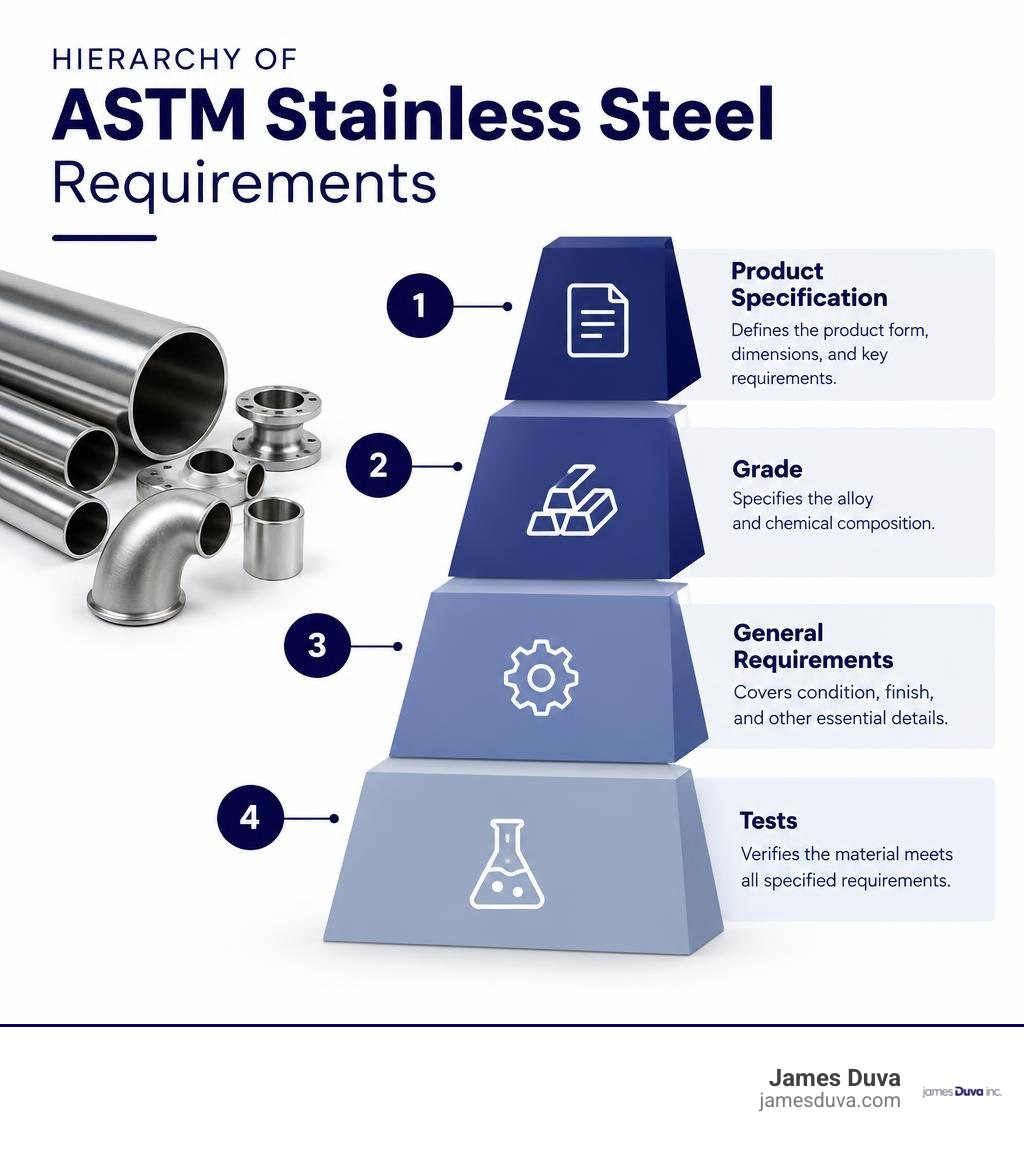
Astm stainless steel standards terms at a glance:
Why Are Alloys So Valuable in Industry?
Pure metals like raw iron have served humanity for centuries, but they come with severe structural limitations. Elemental iron oxidizes rapidly when exposed to moisture and oxygen, turning into flaky rust that degrades mechanical integrity. Pure iron is also relatively soft, lacking the tensile strength, creep resistance, and hardness required to endure industrial service environments. In contrast, engineered alloys like stainless steel offer superior strength and durability to withstand harsh operating conditions.
Alloying transforms basic elements into materials engineered for extreme demands. By introducing precise percentages of elements such as chromium, nickel, molybdenum, and carbon, metallurgists overcome pure metal weaknesses. In stainless steel, adding at least 10.5% chromium creates an invisible, self-healing chromium oxide passive film across the metal’s surface. This passive layer prevents oxidation and blocks corrosive chemicals from attacking the underlying steel.
Understanding the difference between stainless steel or carbon steel performance is critical when designing infrastructure. While carbon steel provides structural strength at lower raw-material costs, it lacks passivity and requires heavy coatings or frequent maintenance in corrosive settings. In contrast, selecting metals engineered for extreme heat and rust provides extended operating lifespans across diverse industrial sectors:
- Construction: Heavy structural beams, industrial piping, bridge supports, and concrete reinforcement rebar rely on alloy durability to resist environmental weathering.
- Oil & Gas: Critical subsea flowlines, heavy-wall pipe fittings, high-pressure flanges, and rugged Ball Valves require advanced alloys to resist sour gas, pitting, and crevice attack.
- Automotive & Aerospace: High-strength structural frames, exhaust manifolds, hydraulic lines, and engine combustion zones demand alloys that resist thermal fatigue and stress cracking.
- Medical & Consumer Goods: Biocompatible surgical tools, orthopedic bone implants, pharmaceutical sanitization tanks, and commercial kitchenware depend on smooth, non-reactive, and easily sanitized stainless surfaces.
Core Categories of ASTM Stainless Steel Standards
ASTM International categorizes stainless steels into five metallurgical families based on their crystalline microstructure and hardening mechanisms. Each family offers distinct trade-offs between mechanical strength, formability, weldability, and corrosion resistance.
| Stainless Steel Family | Crystal Structure | Key Alloying Elements | Typical Grades | Primary ASTM Specs | Key Industrial Applications |
|---|---|---|---|---|---|
| Austenitic | Face-Centered Cubic (FCC) | 16–25% Cr, 8–20% Ni, 0–6% Mo, low C | 304, 304L, 316, 316L, 310, 321 | A240, A276, A312, A269 | Chemical processing, food and beverage piping, cryogenic tanks, heat exchangers |
| Ferritic | Body-Centered Cubic (BCC) | 10.5–27% Cr, low Ni, low C | 409, 430, 439, 444 | A240, A268, A479 | Automotive exhaust, architectural trim, home appliances, mild chemical equipment |
| Martensitic | Body-Centered Tetragonal (BCT) | 11.5–18% Cr, 0.1–1.2% C, minimal Ni | 410, 420, 440C | A276, A479, A565 | Turbine blades, pump shafts, cutlery, valve components, high-wear tooling |
| Duplex | Mixed Austenite / Ferrite (~50/50) | 21–27% Cr, 4–8% Ni, 2.5–5% Mo, 0.1–0.3% N | 2205 (S32205), 2507 (S32750) | A240, A789, A790, A890 | Offshore oil platforms, desalination plants, marine piping, pulp digesters |
| Precipitation-Hardening | Martensitic or Austenitic Matrix | 15–17.5% Cr, 3–5% Ni, Cu, Al, Nb | 17-4 PH (S17400), 15-5 PH | A564, A693, A705 | Aerospace structural hardware, nuclear reactor components, high-strength pump shafts |
- Austenitic Stainless Steels: The most widely specified alloys, non-magnetic in the annealed condition and hardened exclusively by cold work. They offer exceptional toughness down to cryogenic temperatures and outstanding weldability.
- Ferritic Stainless Steels: Magnetic alloys containing higher chromium and lower carbon with little or no nickel. They provide strong resistance to stress corrosion cracking in chloride environments at a lower cost than austenitic grades.
- Martensitic Stainless Steels: Magnetic alloys capable of achieving high hardness, wear resistance, and mechanical strength through quench-and-temper heat treatment cycles, as detailed in our guide to Grade 410 martensitic properties.
- Duplex Stainless Steels: Austenitic-ferritic hybrids that deliver approximately twice the yield strength of conventional austenitic alloys alongside superior pitting resistance; review our analysis on duplex alloy performance advantages to see why specifiers rely on them in harsh marine settings.
- Precipitation-Hardening (PH) Steels: High-strength alloys that develop exceptional tensile and yield strength through low-temperature aging heat treatments that precipitate intermetallic compounds within the crystal matrix.
Comparing ASTM Stainless Steel Standards with AISI, UNS, ASME, and EN Systems
Navigating global steel procurement requires understanding how ASTM integrates with other standardizing frameworks:
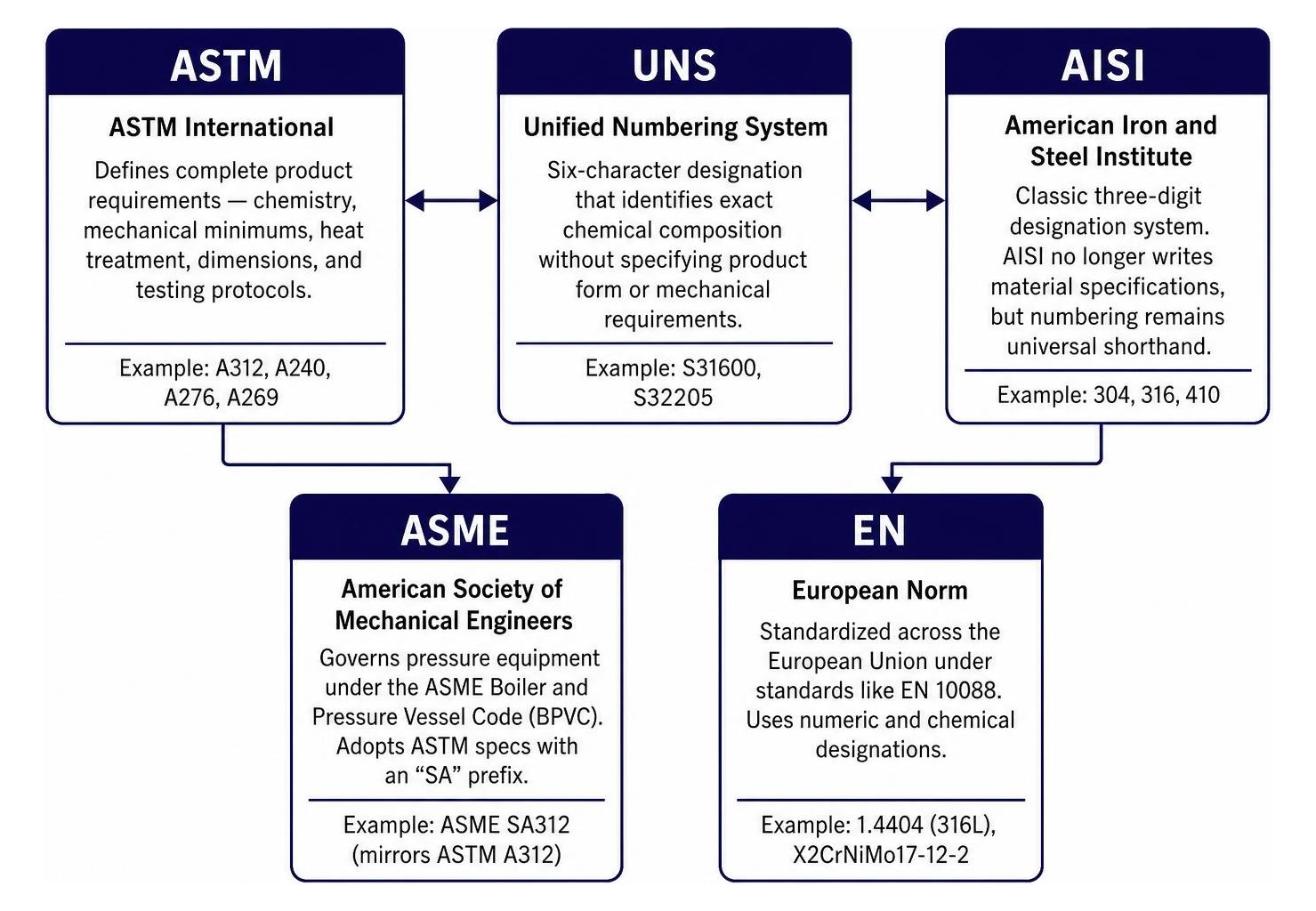
- ASTM International: Maintained primarily under the ASTM Committee A01 scope and governance, ASTM specifications define the complete product requirements—chemistry, mechanical minimums, heat treatment condition, dimensional tolerances, and destructive/non-destructive testing protocols.
- UNS (Unified Numbering System): A six-character designation (such as S31600 or S32205) jointly managed by ASTM (ASTM E527) and SAE. UNS designates exact chemical compositions without defining product forms, mechanical requirements, or inspection criteria.
- AISI (American Iron and Steel Institute): The classic three-digit designation system (such as 304, 316, 410). While AISI no longer writes material specifications, its numbering remains universal shorthand across commercial supply chains.
- ASME (American Society of Mechanical Engineers): Governs pressure equipment under the ASME Boiler and Pressure Vessel Code (BPVC). ASME Section II Part A adopts ASTM specifications, applying an “SA” prefix (for example, ASME SA312 mirrors ASTM A312, subject to specific code case revisions and allowable design stresses).
- EN (European Norm): Standardized across the European Union under standards like EN 10088. EN utilizes a numeric system (such as 1.4404 for 316L) and chemical designations (such as X2CrNiMo17-12-2).
Matching cross-referenced alloys correctly ensures structural safety. Specifiers should evaluate comprehensive alloy property selection criteria before substituting equivalent grades across different regulatory standards.
Key Specifications by Product Form: Pipe, Tubing, Plate, Bar, and Castings
ASTM organizes its steel standards strictly by product form rather than alloy family alone. Reviewing a comprehensive overview of ASTM stainless steel specifications demonstrates that an identical chemical composition must meet distinct testing, dimensional, and fabrication criteria depending on whether it is manufactured into plate, seamless pipe, drawn tube, or hot-rolled bar.
Critical General Requirements in ASTM Stainless Steel Standards: A480, A484, and A999
Individual product specifications reference overarching “umbrella” standards that define baseline manufacturing rules, surface quality, test specimen lotting, and allowable dimensional tolerances:
- ASTM A480/A480M: The core general requirements standard for flat-rolled stainless steel plate, sheet, and strip. It establishes standard mill finishes (such as No. 1 hot-rolled annealed, 2B cold-rolled, and No. 4 polished), camber tolerances, thickness variations, and edge slitting allowances.
- ASTM A484/A484M: Governs wrought stainless steel bars, billets, shapes, and reforging stock. It sets allowable diameter deviations, out-of-round limits, length tolerances, and straightening criteria for hot- and cold-finished long products.
- ASTM A999/A999M: Dictates general requirements for alloy and stainless steel pipe, setting hydrostatic testing protocols, nondestructive electrical test parameters, wall thickness variations, and weld repair limits.
- ASTM A1016/A1016M: Specifies baseline requirements for ferritic alloy, austenitic alloy, and stainless steel tubing, defining flare tests, reverse flattening tests, and wall gauge tolerances.
Pressure Piping, Tubing, and High-Temperature Standards (A312, A269, A213)
Process piping and instrumentation tubing operate under rigorous pressure and temperature environments:
- ASTM A312/A312M: The industrial benchmark for seamless, straight-seam welded, and heavily cold-worked austenitic stainless steel pipe. Widely specified for high-temperature and general corrosive service across petrochemical refineries.
- ASTM A358/A358M: Electric-fusion-welded (EFW) austenitic stainless steel pipe for high-temperature and severe processing service, categorized into five radiographic testing classes.
- ASTM A269/A269M: Covers seamless and welded austenitic stainless steel tubing for general corrosion-resisting and low- or high-temperature service. ASTM A269 requires flare, flange, hardness, and reverse flattening tests, though mechanical tensile testing does not apply to small-diameter tubing under 1/8 in. inside diameter or walls thinner than 0.015 in.
- ASTM A213/A213M: Defines seamless ferritic and austenitic alloy-steel boiler, superheater, and heat-exchanger tubes engineered for high-temperature creep strength.
- ASTM A789 / ASTM A790: Respectively govern seamless and welded duplex stainless steel tubing and pipe for applications requiring higher strength and superior chloride stress cracking resistance.
Specifiers designing process lines should consult our stainless steel tubing specification guide and our breakdown of Grade 304 tubing standards to ensure wall thickness calculations accommodate pressure ratings. In severe thermal equipment, selecting specialized high-temperature stainless alloys prevents scaling and embrittlement.
Flat Products and Bars (A240, A276, A479)
Structural fabrication and pressure vessel manufacturing rely on heavy plate and bar stock specifications:
- ASTM A240/A240M: The primary specification for chromium and chromium-nickel stainless steel plate, sheet, and strip used in pressure vessels, storage tanks, and general industrial equipment.
- ASTM A276/A276M: Specifies hot-finished or cold-finished bars (rounds, squares, hexagons, and hot-rolled shapes) for structural and general engineering use. It designates five specific heat-treated conditions:
- Condition A: Annealed for optimal ductility and maximum corrosion resistance.
- Condition H: Hardened and tempered at a moderate temperature for elevated strength.
- Condition T: Hardened and tempered at a high temperature for balanced toughness.
- Condition S: Strain-hardened or lightly cold-worked for higher yield strength.
- Condition B: Severely cold-worked for maximum tensile properties.
- ASTM A479/A479M: Governs stainless steel bars and shapes specifically intended for boilers and pressure vessels, mandating strict mechanical testing and grain size controls to comply with ASME BPVC Section III and VIII requirements.
Engineers specifying structural stock can explore our guide to 304 stainless steel bar standards or review Duplex 2205 piping specifications when upgrading mechanical components.
Testing, Composition, and Quality Verification in ASTM Specifications
ASTM specifications enforce strict testing procedures to ensure that supplied materials perform safely in high-consequence operating environments.
Mechanical and Hardness Testing (ASTM A370)
ASTM A370 defines standardized mechanical testing methods and definitions for steel products, ensuring uniform verification across manufacturing mills:
- Tensile and Yield Testing: Measures the material’s ultimate tensile strength (UTS), 0.2% offset yield strength, and elongation percentage.
- Hardness Testing: Evaluates surface resistance using Brinell (HBW) or Rockwell (HRB/HRC) scales to verify that cold work or heat treatment meets the standard.
- Charpy V-Notch Impact Testing: Evaluates notch toughness and ductile-to-brittle transition temperatures for materials operating in sub-zero or cryogenic environments.
Chemical Verification (ASTM A751)
ASTM A751 standardizes test methods, practices, and terminology for the chemical analysis of steel products:
- Heat Analysis (Ladle Analysis): Conducted by the producing mill during the initial melting of the heat. It represents the baseline chemistry of the entire production batch and must fall completely within the specified grade limits.
- Product Analysis (Check Analysis): Performed on a sample taken from finished stock. ASTM standards permit minor, tightly controlled tolerances (known as product analysis variations) beyond heat analysis limits to account for normal elemental segregation during ingot solidification.
Corrosion Resistance and Packaging Standards
- ASTM A262: Details standard practices for detecting susceptibility to intergranular attack in austenitic stainless steels (Practices A through F, including oxalic acid etch and copper sulfate-sulfuric acid tests) to verify that material was properly solution annealed and desensitized.
- ASTM A380 & ASTM A967: Define standardized procedures for cleaning, descaling, and chemical passivation using citric or nitric acid solutions to establish a robust passive oxide film.
- ASTM A700: Outlines standard practices for packaging, marking, and loading steel products for domestic and international shipment, protecting clean alloy surfaces from carbon steel contamination and transit damage.
For critical chemical handling, understanding 316 stainless steel corrosion performance and the precise chemistry differences in 316 and 316L ensures that field welds will not fail from carbide precipitation.
Frequently Asked Questions About ASTM Stainless Steel Standards
What is the difference between heat analysis and product analysis under ASTM standards?
Heat analysis (ladle analysis) represents the chemical composition determined from a liquid sample taken during the initial melting of the steel heat. Product analysis (check analysis) is performed on the finished wrought metal. Because elements segregate slightly as molten steel solidifies, ASTM specifications allow small, defined variations for product analysis beyond the nominal heat analysis limits. Both analyses are documented on Certified Material Test Reports (MTRs) governed by ASTM A751.
How do ASTM material specifications align with ASME Boiler and Pressure Vessel Code (BPVC)?
The ASME Boiler and Pressure Vessel Code adopts ASTM material specifications within ASME Section II Part A, designating them with an “SA” prefix (e.g., SA240, SA312). While many SA specifications are identical to their ASTM counterparts, ASME frequently introduces supplementary testing requirements, tighter chemical controls, or specific heat-treatment mandates. Pressure vessel construction requires verifying that the specific revision year complies with ASME Section II criteria and applicable code cases.
What do the condition letters (A, H, T, S, B) mean in ASTM bar specifications like A276?
Under ASTM A276/A276M, condition letters specify the thermal and mechanical processing of the finished bar:
- Condition A: Annealed (softened for maximum corrosion resistance and machinability).
- Condition H: Hardened and tempered at a moderate temperature for high strength.
- Condition T: Hardened and tempered at an elevated temperature for improved impact toughness.
- Condition S: Strain-hardened (light cold work to boost yield strength).
- Condition B: Severe cold work to achieve maximum mechanical tensile strength.
Conclusion: Best Practices for Specifying ASTM Stainless Steels
Procuring stainless steel components requires precise purchase order specifications. Omissions lead to delivery delays, non-conforming materials, or unexpected plant downtime.
When preparing industrial purchase orders, always include these critical details:
- Complete ASTM Specification Number: Include the revision letter/year and metric designation if applicable (e.g., ASTM A312/A312M-25).
- Exact Alloy Grade and UNS Designation: Identify both commercial names and UNS numbers (e.g., Grade 316L, UNS S31603).
- Product Form and Dimensions: Specify outer diameter, nominal pipe size (NPS), wall thickness schedule, bar cross-section, or plate gauge.
- Material Condition and Finish: Detail heat treatment status (e.g., Condition A – Annealed) and surface finish requirements (e.g., No. 2B or descaled).
- Mandatory Supplementary Requirements: Explicitly list non-destructive examination (NDE), Charpy V-notch impact testing, intergranular corrosion testing (ASTM A262), or dual ASTM/ASME certification.
- Documentation Requirements: Mandate EN 10204 Type 3.1 Certified Material Test Reports detailing heat chemistry and mechanical test results.
Since 1978, James Duva Inc. has served as a trusted partner from our central facility in Branchburg, NJ. We supply heavy-wall seamless pipe, structural tubing, plate, bar, fittings, flanges, and specialty valving to demanding sectors including chemical processing, power generation, and offshore oil and gas.
When your upcoming project demands verified compliance with rigid ASTM standards, contact our experienced engineering and sales team for dependable inventory, rapid turnaround, and full material traceability. Explore our complete catalog of high-grade stainless steel products to source fully certified industrial alloys.
About James Duva Inc.
Since 1978, James Duva Inc. has been your trusted source for stainless steel and high-nickel alloy industrial products. Whether you’re in the water treatment, process or power industry, we pride ourselves on always having what you need. Say goodbye to your sourcing problems with just one call to James Duva.